Community Engineers Recreate Iron Nest Artillery Mechanics in Other Sandboxes
Discover how the dedicated simulation community is reverse-engineering the manual ballistic calculations and heavy turret intelligence systems of Iron Nest in voxel building games.
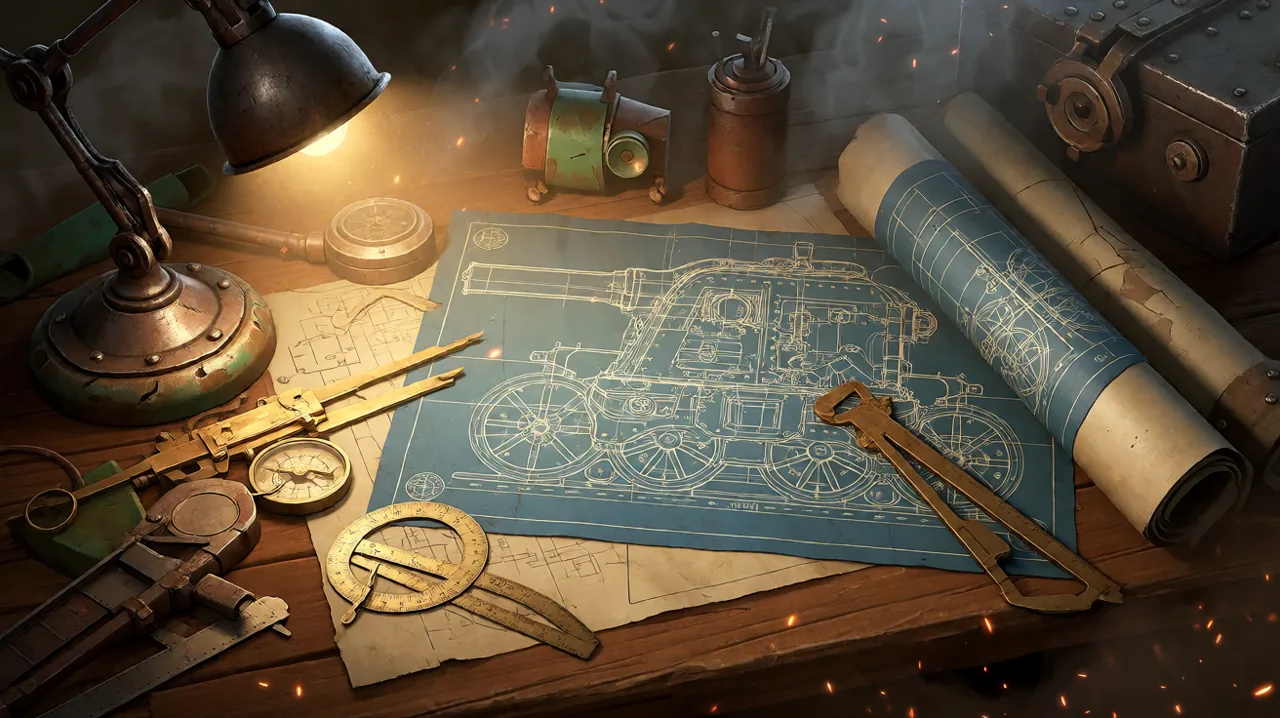
The launch of IRON NEST: Heavy Turret Simulator has sent undeniable shockwaves through the hardcore simulation and tactical gaming communities. While thousands of operators are currently busy manually loading massive shells and adjusting analog azimuth dials within the grim, dieselpunk confines of the game’s colossal artillery installations, the title’s influence is already spilling over into vastly different corners of the gaming world. In a fascinating display of cross-community creativity, dedicated virtual engineers are now attempting to recreate the meticulous ballistic systems and unique tactical isolation of IRON NEST within other sandbox building environments.
This crossover highlights a highly specific phenomenon in modern gaming. The title developed by the two-person team of Nick Nieuwoudt and Dominik Latos does not merely ask you to point a crosshair and shoot at designated targets; it demands that you thoroughly understand the underlying mathematics and physics of indirect artillery fire. It requires you to parse raw intelligence, account for environmental variables, and calculate complex firing solutions entirely by hand. This mechanical depth has resonated so strongly with simulator enthusiasts that they are now treating the game’s core gameplay loop as a literal engineering blueprint to be exported, analyzed, and replicated in other engines.
A Tribute Forged in Another Engine
Recently, a highly compelling project surfaced on the popular r/FromTheDepths subreddit, spearheaded by a dedicated user known as CryendU. For those unfamiliar with the landscape of engineering games, From The Depths is a notoriously complex voxel-based vehicle builder where players construct warships, aircraft, and mechs block by block, often programming their AI behaviors and weapon systems from scratch. It is a sandbox that shares a deep, spiritual kinship with IRON NEST, as both titles inherently attract players who prefer a slide rule and a protractor to a simple aim-assist mechanic.
CryendU’s post, appropriately titled “Waiting on orders from High Command,” showcases a work-in-progress logic build directly inspired by the towering, stationary artillery pieces of the alternate-history Spanish conflict. However, what makes this tribute extraordinary is not just the physical recreation of a large-caliber gun barrel. Instead, it is the deliberate attempt to reverse-engineer and simulate the distinctive, isolated gameplay loop that defines the true IRON NEST operator experience.
Rather than simply building a massive cannon that tracks enemies automatically, the project aims to replicate the severe information dependency of a bunker-bound gunner. In IRON NEST, you are stripped of magical mini-maps and omniscient enemy blips. You are effectively blind, sealed inside a vibrating steel behemoth, relying entirely on raw numerical coordinates relayed by vulnerable forward spotters.
Simulating the Information Chain
The most ambitious aspect of CryendU’s community build is the emulation of the tactical intelligence network. The creator explicitly noted their intention to “use drones to simulate enemies, map, and reference points.” Specifically, the customized system is being designed to provide the actual relative position to the spotter drones’ coordinates, rather than feeding the gunner perfect, absolute situational awareness.
This ambition perfectly mimics the exact tension and methodology required when Reading the Tactical Map in the official game. In IRON NEST, players must constantly monitor radio chatter or decipher teletype printouts from forward observers stationed miles away in the ash-choked wasteland. You are frequently given a static reference point—perhaps a ruined cathedral, a rail junction, or a prominent coastal ridge—and informed that an enemy armored column is moving 400 meters North-Northwest of that specific landmark.
By attempting to use programmable drones in a sandbox game to act as these forward spotters, the community build forces the player to calculate the exact offset manually. If the observation drone is hovering at Coordinate A, and the enemy is spotted at a specific bearing and distance from that drone, the turret operator must use rapid trigonometry to translate that raw data into a viable firing solution for the main battery permanently affixed at Coordinate B. This is the exact intellectual puzzle that makes the heavy turret simulator so incredibly compelling. It elevates the act of firing a weapon from a mere reflex action to a deliberate, high-stakes mathematical execution.
The Tactile Appeal of Manual Ballistics
Why would players go through such immense trouble to recreate a demanding system from one game inside the engine of another? The answer lies in the profound satisfaction of manual mechanical operation, a feeling that modern gaming often completely abstracts away in favor of accessibility. Most contemporary titles eliminate the friction of combat; you press a trigger button, and the software silently calculates the trajectory, the wind resistance, and the bullet drop, delivering the payload exactly where your mouse clicked.
IRON NEST fundamentally and aggressively rejects this modern abstraction. Whether you are relying on the mechanical in-game Ballistic Calculator or referencing the hastily scribbled notes in your own First Session Operator Notebook, you are forced to physically engage with the stubborn physics of the world.
Consider the rigorous, step-by-step process of a single engagement. You receive the coordinates. You immediately consult the topographical chart to determine the severe altitude difference between your fortified coastal bunker and the targeted inland valley. You must factor in the current meteorological data; wind speed and direction will drastically push a heavy shell off its intended course over a five-kilometer flight path. Next, you physically set the azimuth by engaging the hydraulic traverse mechanisms, rotating the multi-ton turret with a deafening metallic groan—a process that eats up precious, terrifying seconds. You carefully set the elevation dial, constantly double-checking the math in your head. This is not a fast, twitch-based process. It is a methodical, deliberate, and industrial ritual.
When an engineer in a different gaming community attempts to recreate this ritual, they are trying to capture that specific adrenaline rush. There is an unmatched sensation when you spend two solid minutes calculating a firing solution, selecting the correct Ammunition type—deciding between an Armor-Piercing (AP) round to crack heavy armor, a High Explosive (HE) shell to scatter infantry, or an Illumination flare to light up a dark sector—and finally pulling the heavy firing lever. The screen shakes, cordite smoke obscures your vision, and you wait in agonizing silence for the forward observer to confirm the strike. It is the raw, unfiltered reward of applied mathematics.
Expanding the Boundaries of Tactical Simulation
When discussing Games Like Iron Nest, players and critics typically point to other hardcore flight simulators, submarine combat games, or punishing tactical shooters. However, this recent Reddit crossover project suggests a completely different angle: the true peers of IRON NEST are games that treat heavy mechanics as complex logic puzzles.
The fact that an independent title is actively inspiring complex logic builds in established sandbox games speaks volumes about its structural integrity. It proves that the core concept—a claustrophobic, dieselpunk artillery simulator—is not merely a stylistic gimmick, but a highly robust mechanical framework that stands up to intense scrutiny.
Players are not just playing the game; they are analyzing the different shell trajectories, studying the blast radii of various ordnance types, and trying to quantify the exact parameters that the engine uses to calculate atmospheric drag. They want to know the internal logic of the heavy turret so intimately that they can theoretically reconstruct it from basic logic gates and weapon blocks. This level of dedication requires a deep understanding of the Controls and Interface that Nick and Dominik have meticulously designed.
Looking Ahead: A Culture of Reverse Engineering
As the player base settles into the long-term rhythm of the game, this type of cross-pollination is incredibly healthy for the simulation community. It draws attention from analytical players who might not typically purchase stationary turret simulators, but who are deeply invested in engineering, logic programming, and realistic ballistics. The demanding System Requirements of the game suddenly make perfect sense to these players when they realize the sheer volume of real-time physics calculations happening every time a heavy shell leaves the barrel.
For those who are currently entrenched in the grim, smoke-filled battlefields of the alternate-history conflict, seeing these community tributes is a stark reminder of the unique skills they are developing. Operating the massive turret is not just about blind obedience to High Command; it is about mastering an uncompromising industrial machine.
We fully expect to see even more elaborate community projects surface as players continue to dissect the game’s intricate mechanics. Perhaps an ambitious engineer will soon attempt to recreate the exact sequential loading mechanism, complete with the terrifying hydraulic crush hazards, or build a physical, custom control panel to interface directly with the game.
In the meantime, whether you are coordinating devastating artillery strikes from within the rusted, claustrophobic confines of the official game, or drafting experimental blueprints in a voxel sandbox environment, the core objective remains exactly the same: receive the raw coordinates, calculate the precise trajectory, and deliver devastation with absolute mathematical precision. The High Command is always waiting on your firing solution.