Games Like IRON NEST: Five Evidence-Based Recommendations
Five games that share a specific part of IRON NEST's appeal, compared through official store descriptions rather than vague genre labels.
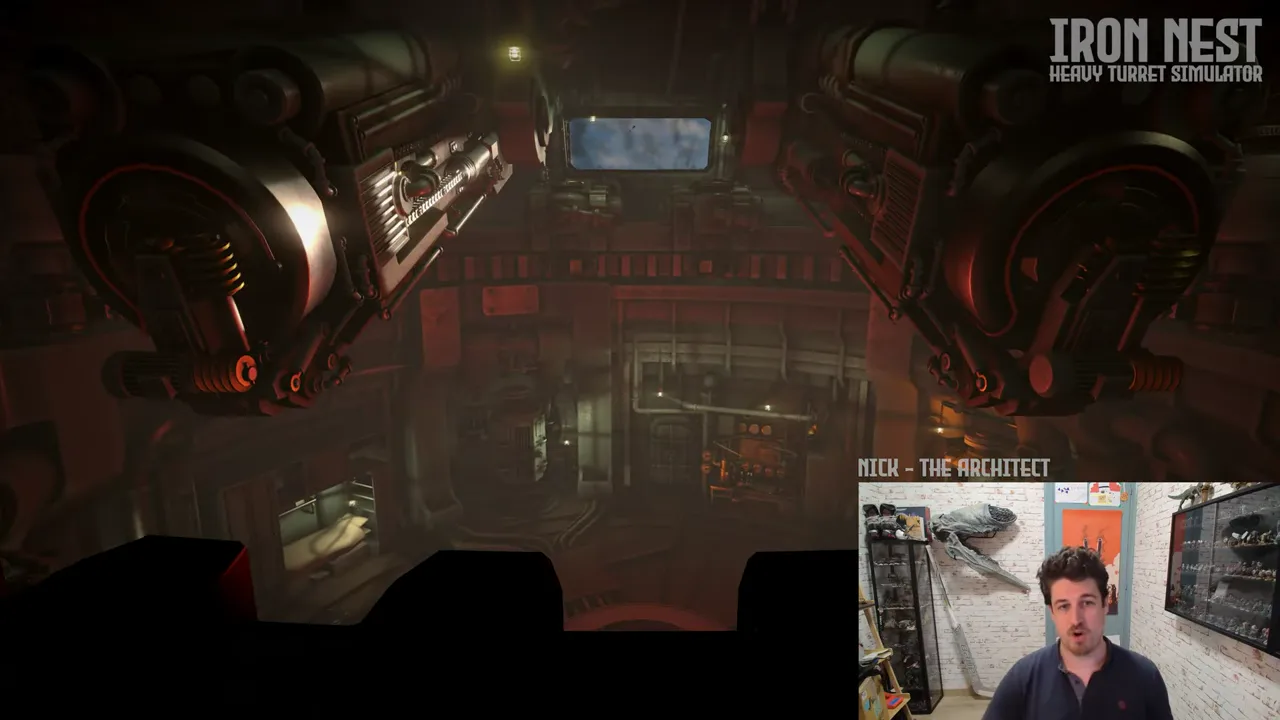
The best “game like IRON NEST” depends on which part of IRON NEST you actually want more of. Its official description combines several unusual pleasures: operating a 5,000-ton machine by hand, converting imperfect intelligence into firing solutions, choosing ammunition, watching a war through reports, and inhabiting a dieselpunk alternate history. No other game reproduces that exact mixture.
This guide therefore avoids pretending that five broadly tagged simulators are interchangeable. Each recommendation matches a specific part of the experience. The comparisons use current official Steam descriptions checked on August 9, 2026. They describe design and availability, not review scores or an unverifiable claim that one title is objectively “best.”
Quick recommendations
| If you want more of this | Start with | Important difference |
|---|---|---|
| Dieselpunk machinery and campaign-scale pressure | HighFleet | Fleet action-strategy, not a first-person artillery procedure |
| Detailed ballistics, optics and fire control | Gunner, HEAT, PC! | Mobile Cold War armor with streamlined controls |
| Learning a mysterious panel by experimentation | Nauticrawl | Turn-based escape adventure rather than military gunnery |
| Command through incomplete reports and a map | Radio Commander | Strategic command, not direct machine operation |
| Another huge-cannon cockpit fantasy | PVKK | Planned for 2027 and not yet available |
1. HighFleet — for dieselpunk command under pressure
HighFleet is the most natural atmospheric recommendation. Its official page describes an action-strategy game mixing arcade combat, exploration, management and diplomacy. The player commands enormous flying ships across the Kingdom of Gerat, balancing fuel, people, resources and politics while fighting a campaign. Its published visual identity is explicitly dieselpunk.
That creates several meaningful points of contact. Both games make military hardware feel heavy and inhabited. Both obscure the battlefield behind instruments and information. Both place mechanical work inside a distinctive political world instead of presenting disconnected skirmishes. A player who enjoys the mood of IRON NEST’s analogue compartment, newspaper framing and pressured command relationship may appreciate HighFleet’s radios, maps, resource calculations and colossal machines.
The difference is structural. HighFleet gives the player a fleet and a strategic theater. Its battles are active aerial duels in which positioning and enemy weak points matter, and its larger campaign includes exploration, diplomacy, ship construction and supply management. IRON NEST keeps the player inside one artillery machine and makes the firing chain itself—reports, map work, charge, elevation, traverse and shell purpose—the central performance. Choose HighFleet for broader command and improvisational campaigning, not for a replica of the ballistic calculator.
For a deeper two-game breakdown, read IRON NEST vs. HighFleet.
2. Gunner, HEAT, PC! — for ballistics and fire-control systems
Gunner, HEAT, PC!, usually shortened to GHPC, is the strongest recommendation for players whose favorite part of IRON NEST is technically grounded gunnery. Its official Steam page describes modern mounted combat with a balance of authenticity and accessible control. The current Early Access build includes more than 50 playable combat units and models optics, fire-control systems, projectile flight, armor penetration and post-penetration effects.
The overlap is not merely that both games have guns. In each, information and equipment determine the shot. GHPC asks the gunner to work with sights, rangefinders, lead compensation, ammunition behavior and the characteristics of a particular vehicle. Its after-action review exposes flight paths, fragmentation and damage, turning a miss or ineffective hit into evidence. IRON NEST similarly rewards players who diagnose the chain rather than blame randomness; our miss troubleshooting guide treats map input, charge, elevation and gun state as separate checkpoints.
GHPC is much more mobile and immediate. It simulates armored units in a fictional 1985 NATO–Warsaw Pact conflict in central Germany, lets the player drive and shoot, and supports platoon-level battlefield action. Its controls are intentionally consistent across vehicles instead of asking the player to walk around a room and pull every physical mechanism. As of August 9, 2026 it remains an Early Access product, so its official page warns that features and performance can continue to change. Pick it when terminal ballistics, armor and modern tank combat matter more than dieselpunk machinery.
3. Nauticrawl — for the joy of understanding the panel
Nauticrawl is the least obvious military recommendation and perhaps the purest match for IRON NEST’s tactile curiosity. Its official premise is simple: the player has stolen an unfamiliar machine and must discover how to operate it before pursuers or the planet kill them. Progress comes from checking radar, turning knobs, redirecting power, hacking devices and learning how consoles interact.
That learning style resembles the first hours inside IRON NEST. A lever is not satisfying because it has a detailed animation; it is satisfying because the player understands what state it changes, which gauge confirms the change and how that action fits into a larger procedure. Nauticrawl intensifies this idea by withholding a normal operating manual. Knowledge learned through mistakes persists even when a run begins again.
The genres diverge everywhere else. Nauticrawl is a 2019 single-player, turn-based exploration and puzzle adventure about escape. It does not attempt a researched artillery model, a battlefield campaign or shell-selection tactics. Its machine is a mystery to solve, while IRON NEST’s turret becomes an instrument to master repeatedly under changing orders. Choose Nauticrawl if your happiest IRON NEST moment was not the explosion but the realization that you finally understood what three connected switches were doing.
4. Radio Commander — for fighting through incomplete information
Radio Commander matches IRON NEST’s intelligence problem rather than its machinery. Its official page says the player commands American forces in the Vietnam War using radio reports and a strategic map. There is no omniscient overhead view. Units describe events by voice; the commander tracks their locations with tokens and notes, then makes decisions about infantry, evacuation, artillery and air support.
IRON NEST also refuses a frictionless god’s-eye battlefield. The operator receives coordinates, bearings, frontline calls and reconnaissance, then decides how those fragments fit together. The tactical map guide exists because information has to be interpreted before it becomes a shot. In both games, a report can be late, incomplete or emotionally significant. Responsibility stays with the person who acts on it.
Radio Commander operates at a different altitude of command. The player does not personally load a round or lay a gun. Its official description emphasizes nine campaign missions, unit statistics, morale, supplies, stamina, dialogue and narrative choices. The interface is deliberately sparse so imagination fills the gap between radio words and battlefield events. Choose it for fog of war, listening and morally pressured decisions. Choose IRON NEST when you want those decisions to terminate in a painstaking physical firing procedure.
5. PVKK — the unreleased project to follow
PVKK: Planetenverteidigungskanonenkommandant deserves a separate category because it is not a current purchase recommendation. Its official Steam page lists a planned 2027 release as of this guide’s verification date. Announced features place a cannon operator in a planetary-defense bunker under an autocratic regime, with scanning, threat analysis, trajectory calculation, generator management, upgrades, secrets and multiple endings.
The surface resemblance to IRON NEST is strong: a huge defensive weapon, retro controls, procedural work and troubling orders. The focus appears different. PVKK describes a bunker that can be maintained and customized, investigation beyond the official story, political choices and skyborne threats. IRON NEST is a released terrestrial artillery game about late-1920s alternate-history Spain, frontline intelligence, ammunition effects and a moving 5,000-ton turret.
IRON NEST’s own store page acknowledges PVKK as a project that helped shape this emerging genre. In a May 2026 Q&A, the developers welcomed similar games and argued that finite single-player experiences can help one another: finishing one unusual machine game often creates demand for another. Our IRON NEST vs. PVKK comparison separates confirmed IRON NEST features from PVKK’s pre-release promises.
What remains distinctive about IRON NEST
Each recommendation isolates one ingredient, but IRON NEST’s identity comes from their conjunction. It uses a first-person physical space like a machine puzzle, demands ballistic work like a gunnery simulation, filters war through reports, and wraps repeatable objectives in a handcrafted alternate-history story. Its current official listing also distinguishes the scale: 30 ammunition types and abilities in combined wording, more than 100 medals, 15 regions, two challenge modes and leaderboards.
The frame above captures that conjunction. It is not simply a cockpit or decorative menu. The distant observation window, red industrial light and layered mechanisms make the compartment feel like a workplace whose logic must be learned. The player moves between stations because no single interface contains the whole answer.
If you are unsure which ingredient matters most, use the free IRON NEST demo guide first. Notice what you think about after stopping: the calculations, the machinery, the reports, the atmosphere or the moral context. That answer is a better recommendation engine than a shared Steam tag. HighFleet, GHPC, Nauticrawl and Radio Commander are all worthwhile comparisons precisely because none of them is a disguised copy of the same game.
Frequently asked questions
What game is most like IRON NEST?
There is no exact substitute. HighFleet is the closest atmospheric recommendation; Gunner, HEAT, PC! is the strongest match for researched ballistics and fire control; Nauticrawl best matches the pleasure of learning an unfamiliar control panel; and Radio Commander best matches decision-making through incomplete reports.
Is HighFleet the same kind of artillery simulator as IRON NEST?
No. HighFleet is an action-strategy game about commanding, supplying and fighting with a fleet of flying ships. It shares dieselpunk atmosphere, weighty machinery and information management, but not IRON NEST's stationary first-person artillery workflow.
Are all of these games available now?
IRON NEST, HighFleet, Nauticrawl and Radio Commander are released. Gunner, HEAT, PC! is purchasable in Early Access as of August 9, 2026. PVKK is included as a bonus game to follow because its official Steam page lists a planned 2027 release rather than current availability.