IRON NEST vs. HighFleet: Machinery, War and Dieselpunk Compared
An evidence-based comparison of IRON NEST and HighFleet across controls, combat, strategy, information, progression, narrative and dieselpunk atmosphere.
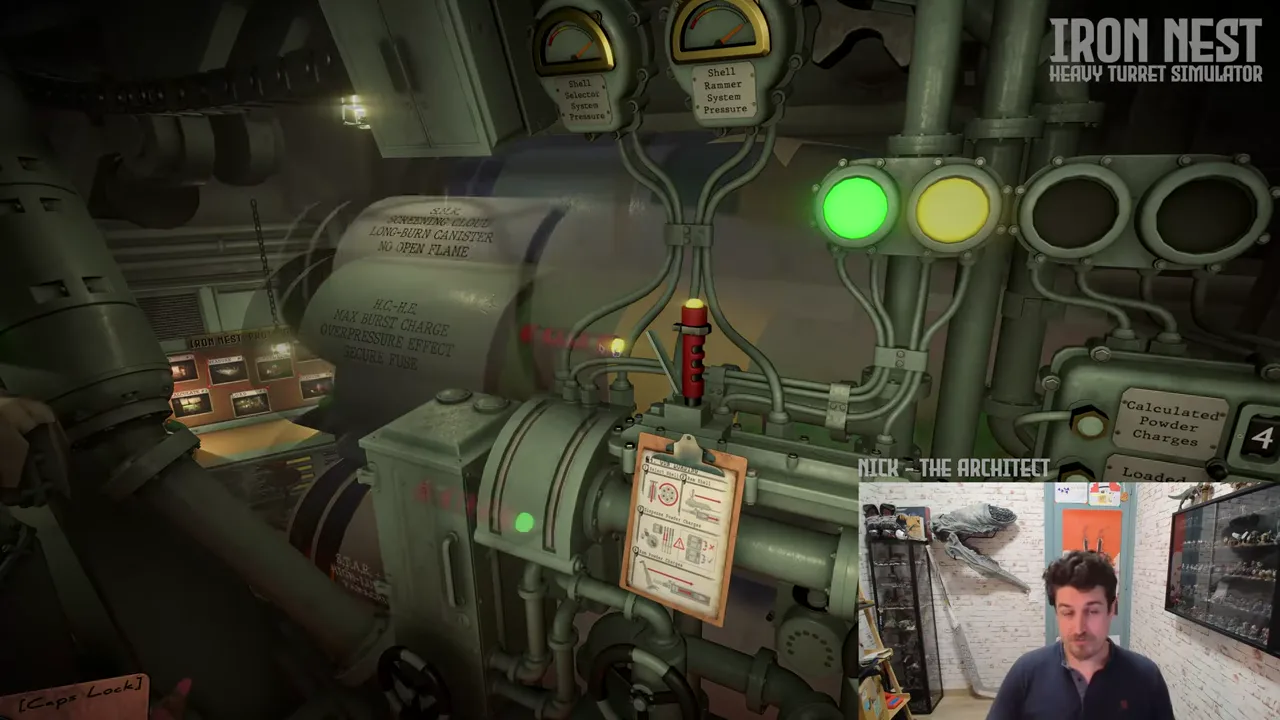
IRON NEST and HighFleet belong in the same conversation because both make colossal military machinery feel strange, costly and politically charged. They use dieselpunk aesthetics, deny the player a clean modern command interface, and build a single-player war around information that must be interpreted. Yet they are not close mechanical substitutes.
IRON NEST is a first-person heavy-turret simulator. The operator receives reports, plots targets, calculates a solution, configures a charge, loads ammunition, lays the guns and fires. HighFleet is an action-strategy game about commanding a task force of flying ships through exploration, management, diplomacy and direct aerial combat. One magnifies a single firing procedure; the other expands outward to an entire fleet campaign.
Both comparisons below use current official pages checked on August 9, 2026. HighFleet released July 27, 2021. IRON NEST released August 6, 2026. This is a design comparison, not a review-score contest.
At a glance
| Category | IRON NEST | HighFleet |
|---|---|---|
| Core role | Operator inside a 5,000-ton artillery turret | Commander of a flying-ship task force |
| Combat | Indirect fire through reports, map work and physical gun controls | Direct aerial duels based on movement and weak-point attacks |
| Campaign layer | Handcrafted story, procedural objectives, regions, medals and unlocks | Exploration, fuel and resource management, diplomacy and fleet building |
| Information | Coordinates, bearings, ranges, frontline calls and aerial evidence | Strategic detection, navigation, campaign intelligence and contact management |
| Machine scope | One deeply modeled workplace with multiple stations | Multiple ships with distinct roles and an in-game editor |
| Setting | Late-1920s alternate-history Spain | Mysterious future Earth and the rebellious Kingdom of Gerat |
| Current status | Released August 6, 2026 | Released July 27, 2021 |
Shared appeal: machinery with political weight
Neither game treats a war machine as a neutral power fantasy. IRON NEST places the operator under High Command while frontline reports and visible consequences complicate official orders. HighFleet sends the Sayadi Task Force to regain control of a rebellious kingdom while a larger prophecy and forgotten past surround the campaign. In both, hardware belongs to a regime, history and contested territory.
The machines also have material presence. The IRON NEST frame above shows a loader surrounded by labeled powder settings, lamps and a handwritten operating card. HighFleet’s official description emphasizes thousand-ton flying ships, fuel, repairs, weaponry and construction. Equipment is not a stat icon floating above the battlefield; it is the medium through which the battlefield can be understood and changed.
This shared weight explains why players often connect the games despite their different controls. A sleek science-fiction interface promises frictionless command. Dieselpunk machinery promises friction, limits and maintenance. Both projects make those constraints aesthetically attractive.
The decisive difference: one station versus a fleet
IRON NEST narrows the player’s body to one compartment. Walking between the teleprinter, tactical map, calculator, loading equipment and gun controls is the central choreography. Even a single shot is a sequence of transformations: language becomes geometry, geometry becomes range and bearing, range becomes charge and elevation, and settings become a physical firing state.
HighFleet distributes attention across ships and campaign systems. The official page asks the commander to explore Gerat, manage ships, people, fuel and other resources, negotiate with factions, and build a fleet. Direct battles then require active movement to exploit weak points. The player alternates between strategic planning and action combat rather than completing a room-scale artillery checklist.
If the satisfaction you want is physically verifying each prerequisite before one enormous gun fires, IRON NEST is the closer fit. If you want to decide which vessels to send, how to supply them and when to accept battle, HighFleet provides the wider command problem.
Combat: calculation versus piloting
IRON NEST’s weapon often cannot see the target directly. Intelligence arrives through other people and instruments. The operator reconstructs a location, measures from the turret, selects ammunition for the intended effect, and establishes a charge–elevation pair. A miss becomes an investigation across the whole chain.
HighFleet’s official combat description is direct and kinetic. Giant ships duel above the desert, and victory depends on movement that exposes enemy weak points. Its action component asks for piloting skill and positional judgment in the moment. Weaponry and ship design matter, but the player’s immediate relationship to the enemy is not mediated through a distant observer and ballistic plotting table.
That makes the games complementary. IRON NEST stretches anticipation before the shot. HighFleet compresses danger into the maneuver itself. Players who dislike reflex pressure may prefer the former; players who want to personally dodge and exploit openings may prefer the latter.
Strategy and resources
HighFleet clearly owns the broader resource-management layer. Fuel and other supplies determine how the task force moves. Diplomacy affects relations with factions. Ship choice and upgrades shape what the fleet can survive, and the official page advertises an editor for building a fleet suited to the player’s style.
IRON NEST’s strategic resources are closer to the weapon. The released feature list advertises 30 ammunition types and abilities in combined wording, more than 100 medals and 15 regions. Shell purpose, available charge, rotation time and exposure to counter-battery fire influence each operation. The game also moves through a handcrafted story and procedurally generated objectives, but it does not market itself as a fleet logistics simulator.
HighFleet therefore asks, “Can this force reach and survive the next strategic situation?” IRON NEST asks, “Can this operator turn the current information and equipment into the correct effect?” Both reward planning, but they place the planning horizon at different distances.
Information and uncertainty
The games share an aversion to omniscience. In IRON NEST, a target may exist first as coordinates, bearings, ranges or a voice report. The operator must plot those constraints, and later reconnaissance may reveal consequences that the original order omitted. Information arrives through institutions with different priorities.
HighFleet’s campaign also makes detection and navigation consequential. A task force that reveals itself or spends resources carelessly creates strategic danger. Exploration and diplomacy matter because the commander does not begin with complete control of the world. The official description does not justify mapping every HighFleet sensor rule onto IRON NEST, but the higher-level resemblance is real: knowledge is operational equipment.
The feel is different. IRON NEST turns uncertainty into a geometry problem on one tactical map. HighFleet turns it into campaign-scale movement, contact and risk. Fans of one may appreciate the other’s refusal to show everything, even when the actual reasoning tools differ.
Progression and replayability
IRON NEST advertises a handcrafted story alongside procedural objectives, two challenge modes and leaderboards. Repetition is grounded in mastery of a stable workplace: a new target or restriction asks the operator to reuse the same stations with better discipline. Unlockable ammunition and abilities expand what the machine can do.
HighFleet advertises replay value through distinctive ships, upgrade paths and its editor. A campaign can change because the fleet composition, resource position and political decisions change. Its variety comes from the interaction of strategic systems and direct combat rather than from leaderboard-focused artillery challenges.
The contrast is useful for buyers. If repeating a precise manual workflow sounds meditative, IRON NEST’s structure has a strong foundation. If replay means experimenting with force composition and campaign routes, HighFleet offers more of that particular freedom.
Narrative tone and world
IRON NEST’s current official setting is late-1920s alternate-history Spain. The monarchy remains in power while a republican uprising spreads. High Command, frontline reports, newspapers and the consequences of shell choice frame the operator’s place in the conflict.
HighFleet takes place on a mysterious future Earth. The House of Sayadi sends a task force to restore control of Gerat, while diplomacy, factions, prophecy and a forgotten past expand the story beyond the military objective. Its world is more overtly speculative and geographically expansive.
Both use mystery and political legitimacy, but at different scales. IRON NEST asks what one operator does when directives and evidence conflict. HighFleet asks how a commander navigates conquest, survival, competing factions and destiny across a region. Similar visual texture does not make the stories interchangeable.
Which should you play?
Choose IRON NEST if you want a released simulator centered on indirect fire, tactile controls, methodical calculation, ammunition effects and the moral distance between an order and its impact. The first firing solution guide shows how much deliberate work can live inside one shot.
Choose HighFleet if you want direct aerial combat embedded in a larger campaign of exploration, fuel management, diplomacy, fleet construction and strategic survival. Its official description promises a commander fantasy in which the composition and movement of many ships matter more than operating every switch in one room.
Play both if the real attraction is machinery that resists effortless control. HighFleet turns the machine into a fleet and asks where it should go. IRON NEST turns the machine into a workplace and asks whether you truly understand it. Their shared dieselpunk language makes the contrast clearer: one looks outward across a war, while the other makes the player earn a single shot from the inside.
Frequently asked questions
Is IRON NEST like HighFleet?
They share dieselpunk atmosphere, massive military machines, imperfect information and single-player campaigns, but their core play is different. IRON NEST is a first-person heavy-artillery procedure; HighFleet is an action-strategy campaign about fighting, supplying and managing flying ships.
Which game has more strategic management?
HighFleet's official description gives it the broader strategy layer: exploration, resource management, diplomacy, fleet building and ship editing. IRON NEST concentrates on operating one turret, solving firing problems and responding to objectives.
Are both games released?
Yes. Steam lists HighFleet as released on July 27, 2021 and IRON NEST as released on August 6, 2026. Both are currently listed as single-player games.