IRON NEST vs. PVKK: Two Very Different Heavy-Cannon Simulators
An evidence-based comparison of IRON NEST and PVKK across release status, setting, controls, firing workflow, narrative structure and progression.
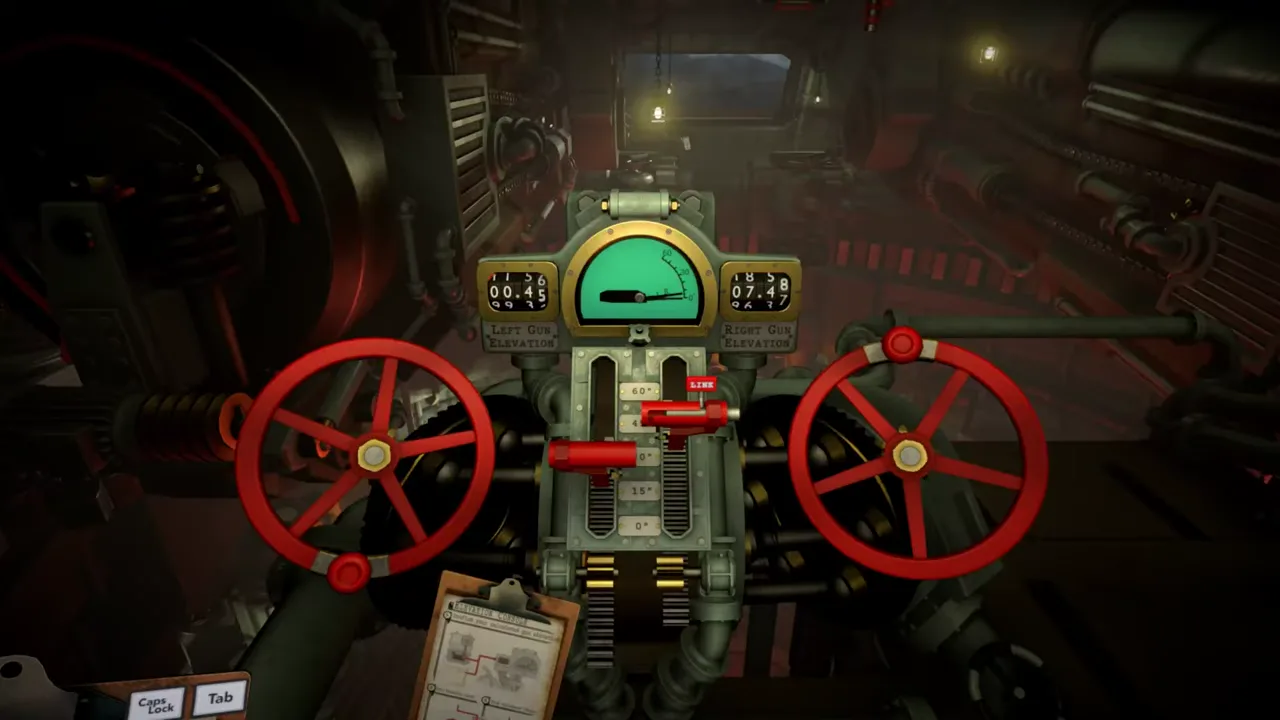
IRON NEST: Heavy Turret Simulator and PVKK: Planetenverteidigungskanonenkommandant immediately invite comparison. Both place a single operator inside a large defensive weapon. Both make buttons, wheels, levers and calculations part of the fantasy. Both use an oppressive command structure to ask what obedience means when the person at the controls must carry out the order.
Those similarities describe a promising niche, not interchangeable games. IRON NEST is a dieselpunk artillery simulator set in alternate-history Spain. PVKK’s official store description places a cannon pilot in a planetary-defense bunker under an autocratic regime during an interplanetary invasion. One emphasizes battlefield intelligence, gun laying and shell effects; the other promises sky scanning, energy management, bunker improvement, secrets and multiple endings.
Release status is the most important practical difference. As of August 9, 2026, IRON NEST is a released PC game: Steam records its launch on August 6. PVKK is not yet available on Steam and its official page lists a planned 2027 release. This comparison can describe PVKK’s announced design, but it cannot review an unreleased final build or claim that every listed feature will ship unchanged.
At-a-glance comparison
| Category | IRON NEST | PVKK |
|---|---|---|
| Current status | Released August 6, 2026 | Not yet available; planned for 2027 |
| Developer | Nick Nieuwoudt and Dominik Latos | Bippinbits |
| Setting | Late-1920s alternate-history Spain near civil war | Planetary-defense bunker during alien invasion |
| Main weapon | 5,000-ton heavy artillery turret | Massive planetary-defense cannon |
| Information problem | Reports, coordinates, bearings, ranges and aerial photos | Scan the sky, analyze threats and calculate trajectories |
| Confirmed/announced structure | Handcrafted story, procedural objectives, two challenge modes, leaderboards | Narrative choices, bunker upgrades, secrets, puzzles and multiple endings |
| Command theme | High Command issues directives; operator bears consequences | Autocratic regime gives orders and obscures outside truth |
The table uses only the projects’ official Steam descriptions. “Announced” is especially important in PVKK’s column because its final feature set cannot yet be verified through a released build.
Shared appeal: operating the machine by hand
The strongest overlap is tactile interaction. IRON NEST says every lever, dial and shot is under the player’s control. Its official imagery shows the operator moving between a tactical table, ballistic calculator, loading equipment, elevation wheels and firing controls. The frame above gives the machinery visual weight: two red wheels flank analogue instruments in a cramped metal interior.
PVKK similarly promises a retro-tech cockpit full of buttons, levers, dials and switches. Its operator manages generators, scans for vessels, analyzes threats, calculates trajectories and performs a firing procedure. In both games, the control room is not a decorative frame around an ordinary aiming reticle. Learning the room is the play.
That design changes the source of satisfaction. The spectacle of the shot matters, but it arrives after preparation. Success confirms that the player understood a system and coordinated multiple actions. Fans of physical interfaces, analogue instruments and procedural work are the most obvious shared audience.
Different firing problems
IRON NEST’s documented firing loop begins on a terrestrial battlefield. Directives and frontline reports provide intelligence. The operator plots coordinates or reconstructs a target from bearings and ranges, measures from the turret, selects ammunition and propellant, obtains elevation, lays the guns and fires. Aerial photographs and later reports reveal consequences.
PVKK’s store page frames the information problem vertically and cosmically. The operator scans the skies for enemy vessels, analyzes threats, manages limited resources and calculates fire trajectories for a planetary-defense cannon. The description establishes precision procedures but does not publish enough final mechanical detail to compare formulas, difficulty or station count directly.
The distinction matters to player taste. IRON NEST offers a map-room artillery fantasy in which geography, spotters and shell purpose are central. PVKK promises an interception fantasy in which detection, threat analysis and generator management surround the shot. Both involve calculation, but the information being calculated belongs to different battle spaces.
A war machine versus a bunker home
IRON NEST centers on an enormous mobile turret. Its official feature list calls out manual control of a 5,000-ton machine, heavy mechanisms and movement-related operation. The interior includes humanizing details such as a coffee machine and a customizable cat, but the campaign loop remains focused on battlefield work, medals, ammunition, abilities and regions.
PVKK describes the bunker as both duty station and retreat. Between missions, players are expected to maintain and improve it, customize the space with earned resources and investigate secrets. The word “cozy” is used alongside “oppressive,” suggesting domestic routine is part of its contrast: tea rations and personal comfort exist inside a regime-controlled defense installation.
This makes progression feel conceptually different even before PVKK releases. IRON NEST advertises 30 unlockable ammo types and abilities, more than 100 medals and 15 regions. PVKK advertises bunker and cannon upgrades plus customization. One expands the operator’s artillery toolkit and record of service; the other promises to change the inhabited space and defensive system.
Command, propaganda and moral distance
Both official descriptions question obedience. In IRON NEST, High Command sends top-priority directives while frontline calls and aerial evidence can expose the human meaning of those instructions. The store text insists that the operator, not the distant authority, carries the consequences. Newspaper reports and slogans add a layer of propaganda after action.
PVKK places the operator under an explicitly autocratic regime. Its page promises moral dilemmas, political intrigue and outsiders who challenge the official story. It says decisions can shape the narrative and lead to multiple endings. Secret areas and escape-room-style puzzles are intended to reveal clues about what is really happening beyond the bunker.
The shared question is whether a technically correct action is also an ethically acceptable one. The announced narrative mechanisms differ. PVKK explicitly markets branching outcomes and investigation. IRON NEST markets battlefield consequences, a handcrafted story and the friction among orders, reports and the player’s chosen shells. Until PVKK ships, it would be premature to judge which approach is deeper or more reactive.
Structure and replayability
IRON NEST’s released store page lists procedural objectives, endless replayability, two challenge modes and leaderboards alongside its story. Those systems support repeated practice with the same machinery under varying conditions. Players can improve measurement speed and operating discipline even after knowing the basic control layout.
PVKK’s page emphasizes progression, upgrades, story decisions, multiple endings and hidden discoveries. That suggests replay value built partly around alternative choices and uncovering information, although the amount and structure remain unverified until release. It currently lists single-player, as does IRON NEST.
Neither official page supports describing the games as traditional multiplayer vehicle simulators. IRON NEST has leaderboards; a pre-release Q&A discussed simple cooperative or competitive possibilities only as ideas. Current purchase decisions should be based on the listed single-player features, not speculative multiplayer.
Influence without a false rivalry
IRON NEST’s official Steam page directly acknowledges PVKK, saying that PVKK helped shape the genre in which IRON NEST stands. During the May 2026 community Q&A, the developers also said they welcomed similar games and hoped the format would become a genre. They argued that finite single-player projects can help one another because players who finish one often want more.
That context makes a simple accusation of copying especially unhelpful. Genre formation happens when projects explore a shared interaction idea in different ways. A first-person cockpit, a huge cannon and an authoritarian superior are broad ingredients. Setting, information design, narrative structure, art direction and the exact work demanded of the player determine the resulting game.
The timeline alone also cannot prove a creative lineage beyond what the developers have openly stated. The responsible conclusion is narrower: IRON NEST recognizes PVKK’s genre influence, and the official descriptions show substantial divergence within that shared space.
Which one should you follow or play?
Choose IRON NEST now if you want a released, terrestrial heavy-artillery game built around map measurement, reconnaissance, powder charges, shell selection, gun laying and repeatable objectives. Its machine is an operating puzzle tied to a specific alternate-history battlefield, and its current Steam listing makes the available feature set inspectable.
Follow PVKK if planetary defense, generator management, bunker customization, political choices, multiple endings and hidden-room investigation sound especially appealing. Wishlist it with the understanding that the Steam page currently gives only a planned 2027 window and that announced designs can evolve before launch.
There is no need to choose a permanent side. The projects appear complementary: one lets players operate a massive gun now, while the other proposes a different version of the fantasy for the future. Their most interesting shared achievement may be proving that careful procedures, inconvenient machinery and morally uneasy orders can support more than one game—and perhaps an entire genre.
Frequently asked questions
Are IRON NEST and PVKK made by the same developers?
No. IRON NEST is developed and published by Nick Nieuwoudt and Dominik Latos. PVKK is developed by Bippinbits and published by Bippinbits and Kepler Interactive.
Which game is available now?
As of August 9, 2026, IRON NEST is released on Steam with an August 6, 2026 launch date. PVKK's official Steam page says it is not yet available and lists a planned 2027 release.
Did IRON NEST copy PVKK?
Shared tactile-cannon ideas do not establish copying. IRON NEST's own Steam page openly acknowledges PVKK as a project that helped shape the genre, while the two official descriptions establish different settings, structures and priorities.