IRON NEST Ammunition Task-Card Labels
First-party visual taxonomy: PGAS, TGAS, SMK, AP, STAR and HCHE
A frame-by-frame reading of the official IRON NEST task clipboard, what each visible ammunition label proves, and what the cards do not reveal.
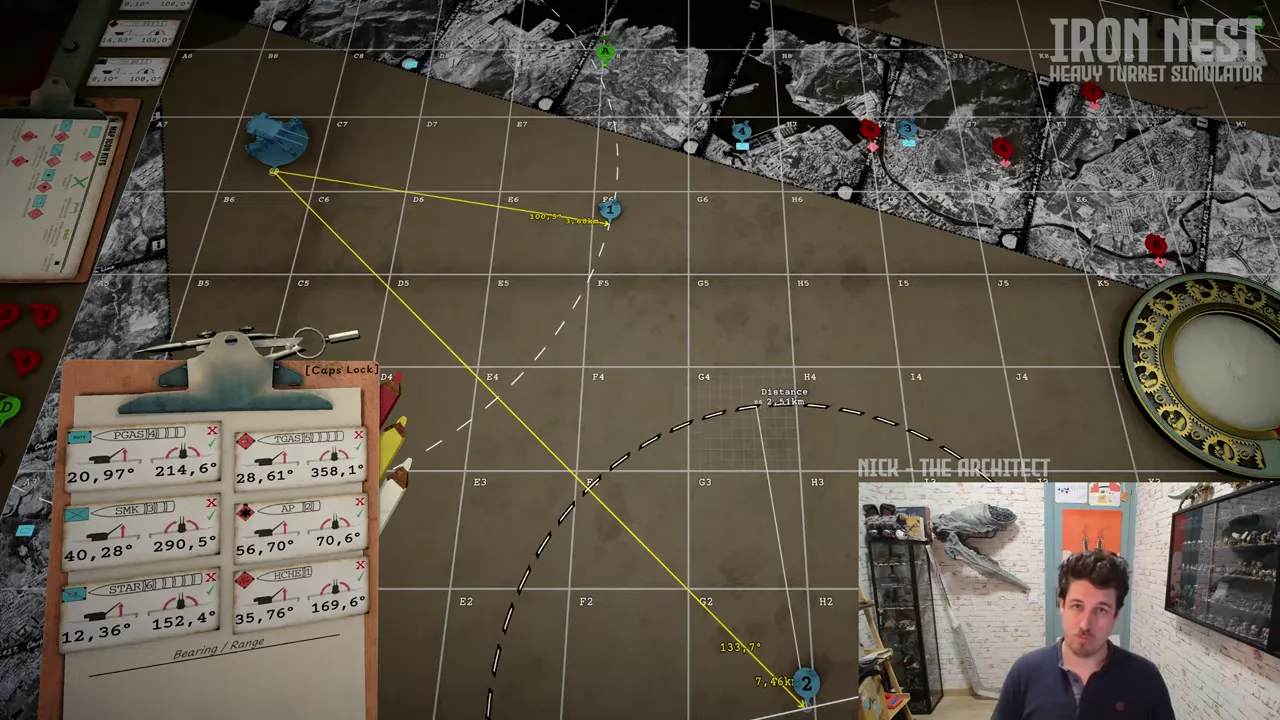
The labels are readable evidence; their unwritten mechanics are not.
An official IRON NEST video provides the clearest first-party snapshot of the ammunition interface currently available outside the game. At approximately 00:17, the task clipboard shows six readable cards: PGAS, TGAS, SMK, AP, STAR and HCHE. Each card includes a shell outline, a segmented charge indicator and two values represented with gun and wheel symbols.
This frame is valuable because the current store description names only three examples in prose: armor-piercing rounds for breaching bunkers, smoke for screening a friendly withdrawal, and phosgene gas inside a censored sentence. The clipboard expands the visible vocabulary without requiring us to guess an entire arsenal from historical artillery.
It remains pre-release footage uploaded April 24, 2026. A card visible there proves that the label existed in the demonstrated build, not that every card is unlocked in every version 1.0 mode or that its mechanics remained unchanged through launch.
Reading the cards accurately
The left column contains PGAS, SMK and STAR. The right column contains TGAS, AP and HCHE. The page image preserves the full map and clipboard so the labels can be read in context rather than as isolated crops.
The charge indicators differ. The angular values also differ. Beneath the cards, the operation sheet records a shared bearing and range. That combination suggests multiple ammunition solutions prepared for a common target or task context, each with its own ballistic settings.
“Suggests” matters. The video does not include a narrated legend for every icon. We can safely say the cards associate ammunition labels with charges and operating values because that relationship is visible. We should not assign every number to a specific physical control without checking the current interface.
AP
AP is the strongest card-to-text match. The label is conventional shorthand for armor piercing, and the current official product description explicitly says armor-piercing rounds can breach bunkers.
The card confirms that AP receives its own solution. It does not disclose penetration thickness, angle rules, projectile mass or target classes beyond the official bunker example. The dedicated AP reference preserves those limits.
SMK
SMK aligns with the current official smoke example. The product text says smoke can screen friendly withdrawals. The card shows that this utility purpose still requires a calculated shot.
Nothing in the frame establishes wind, cloud duration, radius or a universal visibility formula. The smoke reference explains how to reason about the confirmed screening scenario without inventing those systems.
PGAS
PGAS appears on the clipboard while the official description separately names phosgene gas. It is reasonable to read PGAS as the phosgene-related card, but the frame itself does not expand the abbreviation.
The text surrounding phosgene deliberately censors the action. Therefore, the card cannot be used to reconstruct effect area, duration or objective behavior. It proves a distinct solution label. The chemical ammunition page also distinguishes PGAS from the physical TEAR SHELL seen in the launch trailer.
TGAS
TGAS is visible on the upper-right card. The launch trailer contains a shell labeled TEAR SHELL, making a tear-gas interpretation plausible. However, neither source explicitly states that TGAS is the abbreviation for that cylinder, and neither publishes its mechanical effect.
This is exactly where visual evidence can be overextended. Two first-party labels may refer to the same ammunition family, but a reliable wiki should wait for current-build confirmation before merging them. TGAS remains a confirmed visible label with an unconfirmed expansion.
STAR
STAR is readable on the lower-left card. Conventional artillery language makes “star shell” or illumination ammunition a sensible interpretation, but current official product text does not describe night lighting, parachutes, burn time or observation bonuses.
The card does establish a distinct charge and solution. The STAR evidence guide documents how to verify its released behavior without importing a real-world illumination model.
HCHE
HCHE appears on the lower-right card. A high-explosive-family interpretation is plausible, and the site’s legacy high-explosive slug now preserves that label rather than claiming a generic, fully known blast shell.
No official source cited here publishes the acronym expansion, blast radius, fragmentation model or preferred target table. See HCHE / High-Explosive Shell for the current evidence boundary.
What the check marks may mean
Each visible card includes red and green marks along its right edge. They may represent task completion, validation or another operator state. The frame alone does not provide a legend.
Do not describe them as guaranteed “hit confirmed” or “loaded” indicators. Their safe documentation is visual: the cards carry status marks, and some values appear checked. A current-build interaction sequence is needed to determine when and why those marks change.
This principle applies to every icon on the clipboard. A recognizable symbol can guide testing, but resemblance is not a substitute for observing state transitions.
Why the shared range does not create a universal solution
The operation sheet below the cards shows a bearing and range while the six cards show different charge patterns and angles. This is strong visual evidence against copying one charge–elevation pair across ammunition types.
Even if multiple shells are aimed at the same plotted point, their card values can differ. When changing ammunition, the operator should reselect the shell type, verify charge, obtain the matching elevation and confirm the gun state. The shell-change checklist turns that observation into a repeatable procedure.
The numbers in this pre-release frame should not be copied as a permanent lookup table. They belong to one demonstrated distance, bearing, build and task state.
Relationship to “30x Ammo Types and Abilities”
The released feature list advertises “Unlockable 30x Ammo Types and Abilities.” Because ammunition and abilities share one combined number, it does not mean 30 shell cards. The six visible labels also do not prove that only six ammunition entries exist.
Together, the sources support a partial taxonomy: three current prose examples, six pre-release task-card labels and a TEAR SHELL prop or in-game cylinder visible in the launch trailer. A complete unlock list requires current-build evidence.
The ammunition evidence status page records how these sources rank and why the site’s former concrete-piercing, incendiary and shrapnel entries were removed rather than padded with assumptions.
Using the labels during an operation
Treat the label as the first checksum. Copy it with the target identifier, range, bearing, charge and elevation. If the order changes from SMK to AP, do not leave only the numeric settings visible; the ammunition name prevents a plausible old value from being mistaken for the new solution.
After firing, preserve the card state until the outcome is understood. An aerial image or report is useful only when the operator can reconstruct which shell and settings produced it.
For multi-stage missions, archive completed cards and create a fresh block for the next objective. If the turret moves, recalculate bearing and range from its new position even when the ammunition label remains the same.
The dependable conclusion
PGAS, TGAS, SMK, AP, STAR and HCHE are readable labels in an official IRON NEST video. The cards visibly associate those labels with different charges and gun settings. Current official text independently confirms AP, smoke and phosgene examples.
The frame does not reveal a complete 1.0 arsenal or the hidden mechanics behind each abbreviation. Its value is more disciplined: it replaces speculative shell names with a source-backed vocabulary and gives operators a visual reason to recalculate whenever the selected ammunition changes.