Armor-Piercing Shell
Confirmed bunker-breaching ammunition
What IRON NEST officially confirms about armor-piercing ammunition, how its AP task card fits a firing solution, and which penetration claims remain unverified.
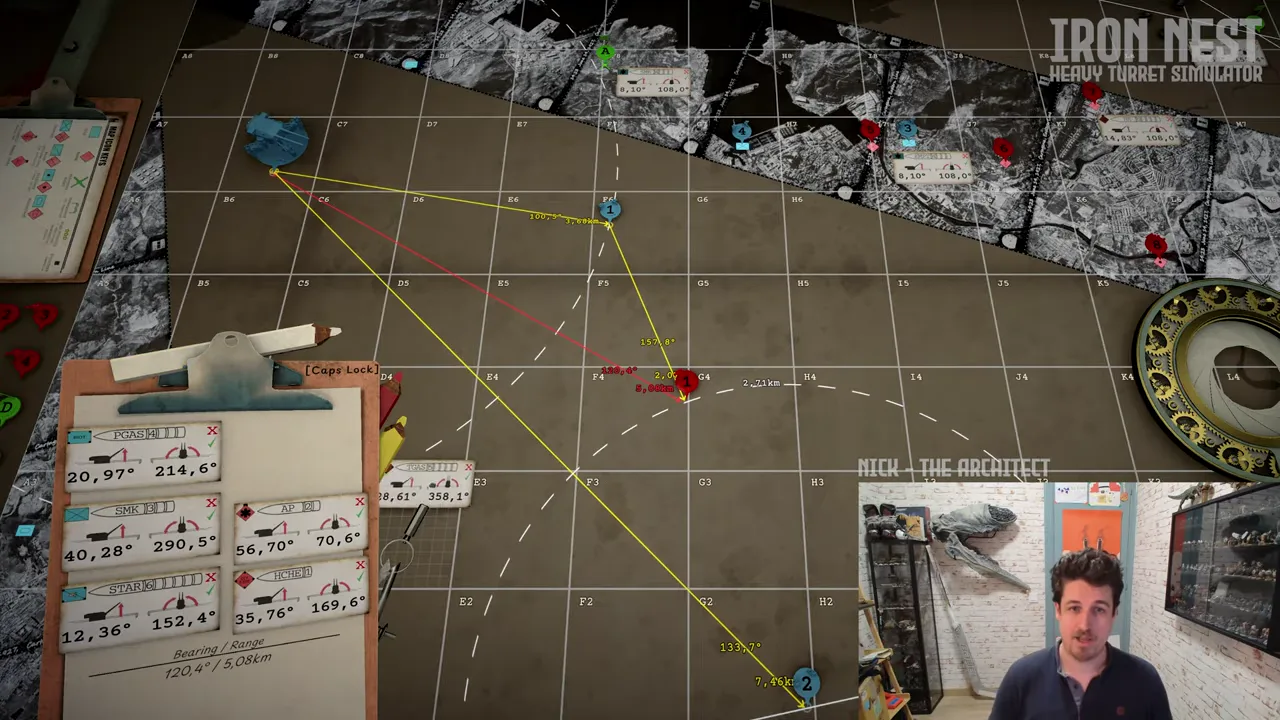
Confirmed purpose: breach bunkers. Exact penetration numbers are not published.
Armor-piercing ammunition is one of the few IRON NEST shell families confirmed by both current official text and readable official gameplay imagery. The version 1.0 Steam page and developer website say that armor-piercing rounds can breach bunkers. In the official video frame above, the task clipboard includes a card labeled AP beside separate cards for SMK, STAR, PGAS and HCHE.
Those sources establish the ammunition’s existence and one intended target example. They do not publish armor thickness, projectile mass, penetration angle, damage radius or a list of every target class. A reliable codex should preserve that boundary. “Breach bunkers” is confirmed; “automatically destroys every tank” is not.
What the AP card proves
The AP card is more informative than a simple inventory icon. It appears inside a complete firing problem. The clipboard shows an ammunition abbreviation, a charge indicator, an elevation value and a bearing value. Beneath the cards, the operation sheet records a bearing and range from the Iron Nest.
This layout demonstrates that shell identity belongs inside the solution. The operator does not solve a universal trajectory and then choose any projectile at the last second. Each ammunition card has its own recorded settings. The correct operational habit is therefore to treat a switch to AP as a reason to verify charge and elevation again.
The card does not reveal the formula behind the values. We cannot infer a universal AP ballistic coefficient, convert one shown mission into a table for every range, or assume the number printed in an April video remains unchanged in every version 1.0 operation. It is evidence of workflow, not a public technical manual.
Confirmed role: bunker breaching
Both official product descriptions use AP in the same example: breach bunkers. That is a stronger claim than a genre assumption. It tells the operator that shell purpose matters and that hardened construction can require a different effect from smoke or gas.
“Bunker” still covers many possible mission objects. The official pages do not specify whether every bunker uses one health model, whether angle matters, or whether a direct hit is mandatory. Follow the current objective text, protocol and observed outcome. If the mission identifies a hardened emplacement and supplies AP as the required or available tool, the official example supports that choice.
The old version of this page expanded the role to tanks, armored vehicles and concrete without direct evidence for those exact in-game interactions. Those may be plausible artillery uses, but plausibility is not confirmation. This revision limits the claim to what the current sources actually show.
AP selection checklist
Before loading, verify five things:
- The target identity. Make sure the report describes the object you intend to affect, not an observer or reference point.
- The required effect. Look for explicit language about breaching or a hardened target rather than selecting AP only because it sounds powerful.
- The target position. Complete the plot before copying a range into the calculator.
- The ammunition card. Use the AP card or current-build equivalent, not settings remembered from another shell.
- The physical load. Confirm that the mechanism contains the intended ammunition and matching charge before firing.
This process separates shell choice from target location while reconnecting both inside the final solution.
Recalculate when changing ammunition
IRON NEST’s official text says to match elevation with the exact propellant charge. The developer also discussed shell weight as a possible calculator input before release, while noting that calculator design was still evolving. Together, those sources justify a conservative rule: never assume two ammunition types share an interchangeable charge–elevation pair.
If a previous smoke or HCHE solution is still on the desk, archive it before preparing AP. Re-enter or re-read the range, select the AP data, confirm charge and copy the resulting elevation to the correct gun. The powder charges and elevation guide explains why changing one half of the pair invalidates the other.
This is particularly important in multi-stage missions. An AP requirement may arrive after the turret is already oriented and one gun is loaded for a different task. Record actual machine state instead of assuming a new objective reset the mechanisms.
Accuracy without invented penetration physics
A bunker-breaching round still needs to reach the correct location. Build the target from the reported coordinates, bearings or ranges, then measure from the current Iron Nest position. Use the tactical map guide when observer geometry is involved.
Do not add unsupported “square hit” or armor-angle rules to the solution unless the current build demonstrates them. Real armor penetration depends on complex variables, but a game can abstract those variables. A wiki should document the game’s rules after verification rather than import a real-world model and present it as implemented.
When a confirmed AP shot appears ineffective, diagnose the observable chain first: wrong target plot, stale range, mismatched charge, incorrect elevation, wrong traverse or incomplete loading state. Only after those are excluded should the operator investigate target-specific requirements.
Reading the result
IRON NEST uses aerial photos and reports to reveal consequences. Preserve the fired settings so the evidence can be interpreted. A visible impact at the wrong point is a trajectory problem. An impact at the intended structure without the expected mission result may indicate shell selection, objective interpretation or another condition.
Avoid describing every dark mark as a penetration. The official imagery does not provide a standardized penetration indicator in the sources cited here. Use the mission’s confirmation, updated report or objective state.
If the shot misses spatially, see why firing solutions miss. If it lands correctly but seems ineffective, return to the order and confirm that AP is the required effect rather than merely an available shell.
AP in the wider arsenal
The released feature list advertises “30x Ammo Types and Abilities,” a combined phrase rather than 30 confirmed shells. AP is valuable to documentation because it is explicitly named. Smoke is explicitly connected to screening a friendly withdrawal, and phosgene gas is also named. Official video cards add the abbreviations PGAS, SMK, STAR and HCHE.
That does not define the whole unlock tree. It provides a verified foundation for comparing purpose. AP represents breaching; smoke represents screening; the other cards require their own evidence-aware explanations. See the ammunition guide for the selection framework.
The dependable conclusion
Armor-piercing rounds are confirmed IRON NEST ammunition, the current official text names bunker breaching as their purpose, and official footage places AP on a dedicated solution card. Everything beyond that should come from the current build, not artillery folklore.
Use AP when the objective and available documentation call for a hardened-target effect. Recalculate its charge and elevation, verify the physical load, preserve the firing state and judge the result through official in-game feedback. That procedure is less dramatic than claiming a secret penetration table, but it is the difference between an evidence-based arsenal page and invented statistics.