IRON NEST Ammunition Evidence Status
Confirmed, visually documented and unverified arsenal claims
A source hierarchy for IRON NEST ammunition: what version 1.0 product text confirms, what official video labels show, and which legacy claims were removed.
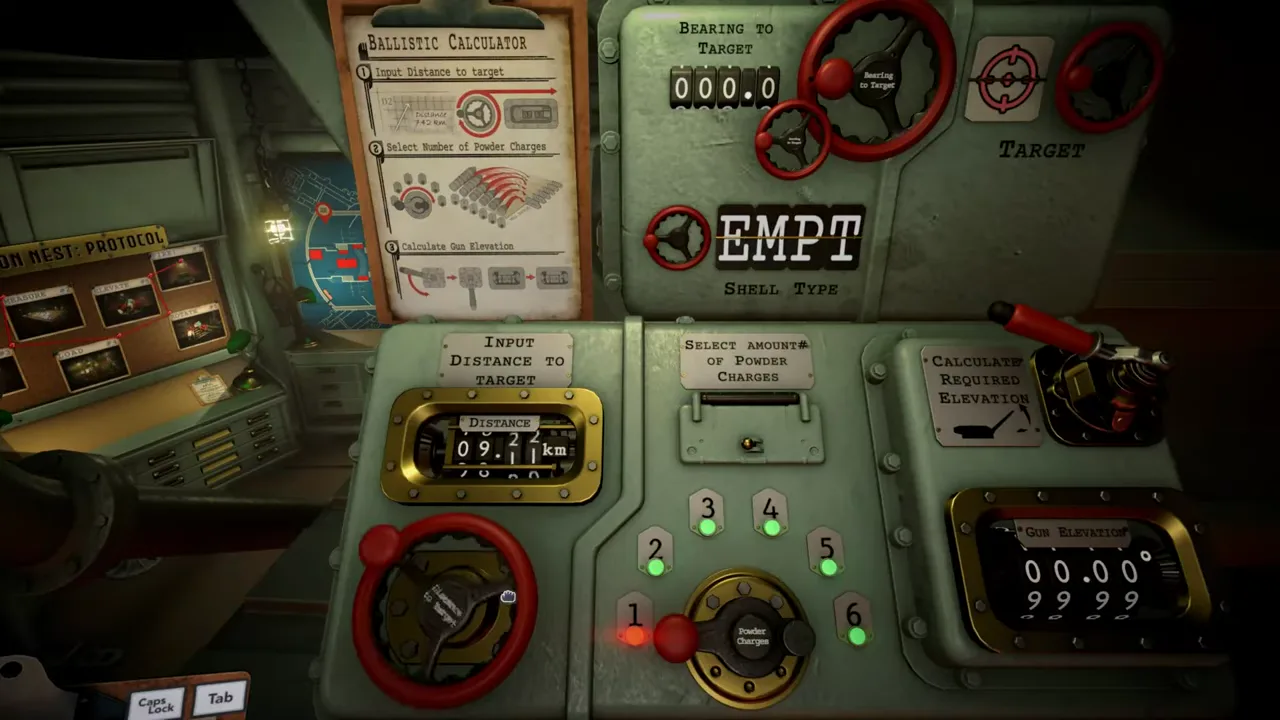
An empty shell-type field is better than a confident invented value.
IRON NEST advertises a broad ammunition system, but its public sources expose that system at different levels of detail. The current Steam page and official website explicitly name armor-piercing rounds, smoke and phosgene gas. A first-party April 2026 video shows task cards labeled PGAS, TGAS, SMK, AP, STAR and HCHE. The launch trailer shows a physical TEAR SHELL and a calculator with an explicit shell-type state.
Those facts are enough for a useful arsenal. They are not enough for a complete damage spreadsheet. This page defines the evidence standard used across the wiki and records why three older entries—concrete-piercing, incendiary and shrapnel—were removed as dedicated game-item pages.
Evidence tier 1: current official product text
The strongest public evidence for a broad feature is the released game’s current official description. As checked on August 9, 2026, both the Steam page and developer website say operators can breach bunkers with armor-piercing rounds, screen friendly withdrawals with smoke, and perform a censored action with phosgene gas.
These examples confirm names and one purpose for AP and smoke. Phosgene is named, but its exact action remains intentionally obscured. The same pages advertise “30x Ammo Types and Abilities,” combining two categories in a single number.
Tier 1 does not provide exact range tables, unlock order, shell counts, blast radii or penetration values. It is authoritative about what it actually says, not about details it omits.
Evidence tier 2: current official interface or released-build observation
Direct observation in the current version 1.0 build can establish mechanics that marketing text does not list. A useful record includes version, mission, mode, ammunition label, target, input state and outcome. Repeatability matters.
For example, seeing STAR create light once would confirm a visual event in that operation. Establishing a universal duration or accuracy effect would require repeated observation under controlled conditions. A scripted campaign moment may differ from a challenge-mode rule.
This tier is not fully populated by the public sources available to this project. Where build-level behavior has not been independently verified, the pages say so instead of promoting an inference.
Evidence tier 3: first-party pre-release video
Developer-owned videos are excellent evidence for visible labels, layouts and stated design intent. Their date matters. The April task-card footage predates the August release, so current build behavior can supersede it.
The labels PGAS, TGAS, SMK, AP, STAR and HCHE are directly readable. The cards visibly contain different charge patterns and angular values. That supports ammunition-specific firing solutions.
It does not prove that all six remain accessible in every released mode, reveal the acronym expansions or document effects. The task-card labels page records exactly what can be seen.
Evidence tier 4: developer statements about evolving design
The May 2026 community Q&A contains useful explanations of mathematics, calculator design, mission structure and shell weight as a possible input. Those statements were recorded before release and often describe plans or design exploration.
They can explain why a system was built a certain way, but they should not be treated as a promise that every discussed mechanic shipped unchanged. Current product text and released-build observation outrank them for version 1.0 behavior.
When a page relies on a Q&A statement, it should carry a date caveat and link to the relevant timestamp.
Evidence tier 5: historical plausibility
Historical artillery can help researchers form questions. Interwar forces used many projectile, fuse and chemical categories. Terms such as concrete-piercing, incendiary and shrapnel are plausible in a late-1920s-inspired setting.
Plausibility is not evidence that IRON NEST implements those items. The game is alternate history, its 5,000-ton turret is fictional, and its ammunition taxonomy may combine, simplify or rename real categories. A historical source cannot confirm a game inventory entry.
The old wiki treated plausible period ammunition as “expected” content and then described detailed in-game behavior. That approach produced confident pages without first-party support. Those pages have now been replaced by evidence-focused references.
Why the concrete-piercing page was removed
The former page claimed a delayed-action shell that penetrated fortifications before detonating. No reviewed current official source or readable video label names a concrete-piercing shell. AP is explicitly confirmed for bunker breaching, making a separate concrete shell even less safe to assume.
The game may contain one under another name or unlock. If the released build shows it, a new page can be created with the exact label, version, description and unique source image. Until then, the dedicated claim would duplicate AP’s confirmed role with invented detail.
Why the incendiary page was removed
The former page described persistent fire, flammable targets and flushing entrenched positions. None of those mechanics appears in the reviewed first-party sources. No visible task card is labeled incendiary in the documented frame.
Fire may appear visually in trailers or missions, but an explosion or burning scene does not identify the shell that caused it. Attribution requires a visible selection state or explicit official description.
Replacing the page prevents generic artillery expectations from being mistaken for IRON NEST rules.
Why the shrapnel page was removed
The former shrapnel entry asserted an airburst anti-personnel role, overhead fragments and specific cover interactions. Those are conventional descriptions, not verified game mechanics. The official card set does not show a readable SHRAP label in the cited frame.
HCHE may or may not cover some anti-personnel use, but its target and fragmentation behavior is also unpublished. One unsupported page cannot be corrected by transferring its claims to another uncertain label.
The responsible status is “not confirmed in reviewed sources,” not “expected because the era had it.”
The explicit shell-type field
The page image shows the calculator with SHELL TYPE set to EMPTY. That field is a small but important piece of interface evidence. Ammunition identity is an explicit machine state, not merely an inventory narrative.
An empty or wrong shell-type state can invalidate the rest of a solution. It also demonstrates why the wiki should leave unknown details empty: filling a field with an attractive guess is operationally worse than acknowledging that verification is missing.
The shell-change checklist uses this state as its first calculator checkpoint.
Standard for publishing a new ammunition page
A future page should have at least one first-party source that explicitly names or visibly labels the ammunition. Exact mechanical claims should come from current-build observation or current documentation. The record should include:
- exact in-game label and capitalization;
- build and verification date;
- mode or mission context;
- stated or demonstrated purpose;
- calculator and charge behavior;
- observable outcome and objective feedback;
- known limits and untested assumptions;
- a unique attributed frame from an approved official video.
If only the name is confirmed, the page can document the name and verification plan without inventing effects.
Maintaining the evidence ledger
Official store descriptions, the developer website and YouTube videos are recorded in the project’s source ledger. Each image has a separate entry with video URL, title, channel, timestamp, capture date and editorial purpose.
When a patch changes a mechanic, the page should receive an updated date and the claim should be retested. Old screenshots remain useful historical evidence but should not silently stand in for the current version.
This approach makes uncertainty visible instead of hiding it behind polished prose.
The dependable conclusion
Current official text confirms AP, smoke and phosgene examples. First-party video confirms the visible labels PGAS, TGAS, SMK, AP, STAR and HCHE and shows a TEAR SHELL. The combined feature wording promises 30 ammunition types and abilities, not 30 verified shells.
Concrete-piercing, incendiary and shrapnel were plausible legacy entries but lacked reviewed first-party evidence, so their dedicated pages were removed. That does not prove the items are absent from the game; it correctly records that their presence and mechanics are unverified. The arsenal will expand when evidence expands, not when a historical list supplies convenient names.