HCHE / High-Explosive Shell
Confirmed HCHE label; exact effect profile requires verification
What the official HCHE firing card confirms in IRON NEST, how it differs from generic HE assumptions, and how to verify its current target and blast behavior.
HCHE is visible on an official solution card; a complete blast table is not public.
An official IRON NEST task clipboard shows an ammunition card labeled HCHE. The card appears beside AP, SMK, STAR and PGAS and carries its own charge and angular values. That is direct evidence for the label and for an ammunition-specific firing solution.
The current official product descriptions do not spell out HCHE, publish its target list or provide a blast table. The conventional reading is a high-explosive family label, but the exact expansion and simulation should be verified in the released build. The previous page called generic high explosive a forgiving workhorse for infantry and grouped targets. Those claims were plausible but not sourced to current IRON NEST documentation.
What the HCHE card proves
The official frame at 00:20 in the behind-the-scenes video is the primary evidence. HCHE is printed inside a shell outline. A charge indicator appears beside it, and gun/elevation symbols accompany numeric values. A check mark shows the card as part of an active task state.
This layout establishes three useful facts. HCHE is distinct from AP and SMK, it is associated with its own charge, and the operator must lay the gun according to the corresponding solution. The card does not prove explosion size, fragmentation, near-miss damage or target vulnerabilities.
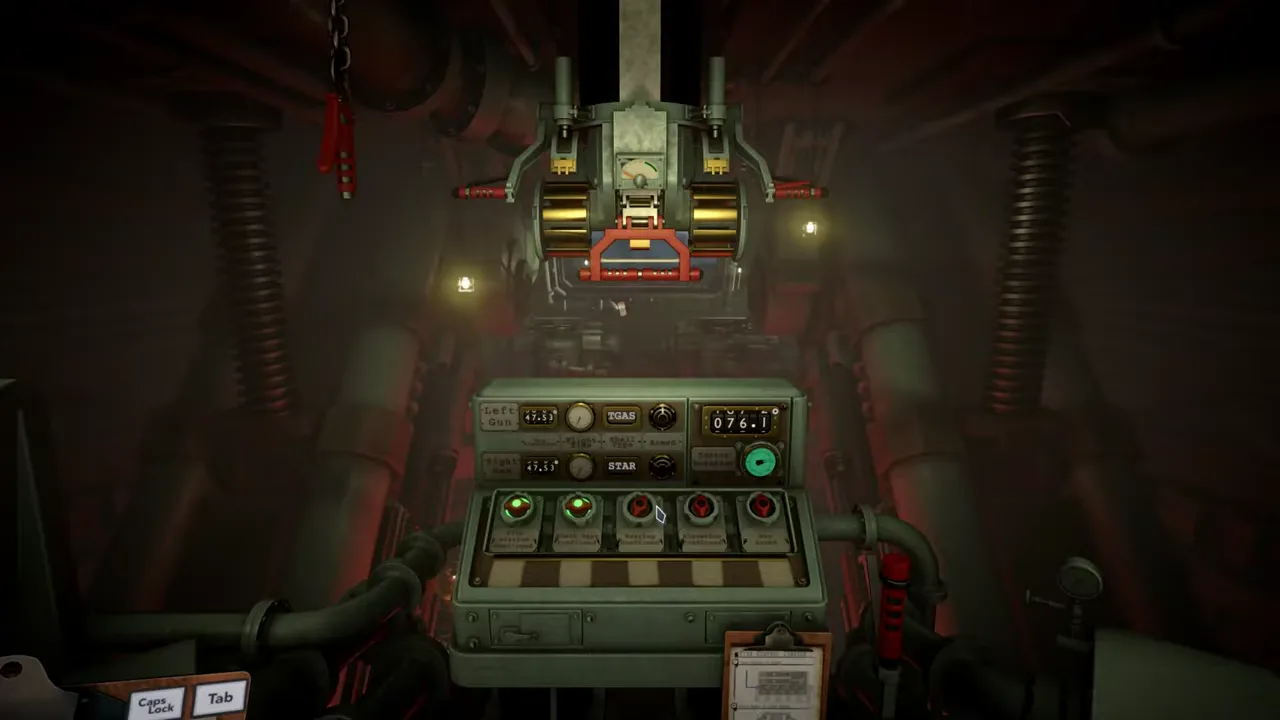
The page image shows the wider firing console rather than reusing the clipboard frame. It illustrates the machinery that must match the written HCHE solution: charge controls, indicators and gun-state mechanisms under alert lighting.
Why not simply call it universal HE?
“High explosive” is a broad real-world category. Different fillings, casings and fuzes can produce different effects, while games may simplify or rename those distinctions. HCHE is a specific on-screen label. Replacing it with an assumed universal HE model discards information.
The safest editorial formulation is “HCHE / high-explosive shell,” with the family marked as likely and the label marked as confirmed. If the version 1.0 inventory expands the abbreviation or provides a description, that build-level evidence can refine the title later.
Until then, do not promise that HCHE is always best against infantry, has a forgiving radius or cannot affect hardened targets. Those are testable gameplay claims, not consequences of the letters alone.
Build the solution around the shell card
Start with the objective, not with a preferred round. Determine the target’s reported location and the required effect. If the current operation supplies or recommends HCHE, complete the map plot, measure range and bearing from the Iron Nest, then use the HCHE data shown by the current calculator or task card.
Copy charge and elevation as a pair. The official product text emphasizes matching the exact propellant charge to elevation. A valid AP or SMK solution cannot be assumed valid for HCHE at the same range.
Before firing, confirm target, ammunition label, charge, elevation, bearing, correct gun and complete loading state. The first firing solution guide provides a reusable checksum.
Testing target effects responsibly
To document HCHE behavior, use repeatable observations rather than one dramatic impact. Record the mission, version, target type, distance, direct-hit status, shell card and objective result. Compare like with like when the game permits.
A near miss that advances an objective might suggest an area effect, but it does not reveal a universal radius. A direct hit that fails may reflect wrong target classification, mission scripting or incomplete conditions. Multiple variables must be controlled before writing a rule.
Do not convert visual debris into exact damage. IRON NEST communicates outcomes through aerial photos, reports, objective state and later newspaper coverage. Use those channels as the game-defined evidence.
HCHE versus AP
AP has a current official target example: bunker breaching. HCHE does not receive an equivalent description in the product text reviewed here. That asymmetry matters.
When a mission explicitly calls for breaching a bunker, AP has direct source support. HCHE should not displace it merely because explosive sounds more destructive. When the operation supplies HCHE and describes another effect, follow the current task and document the result.
The distinction also prevents a false damage ranking. Ammunition purpose can matter more than nominal power. The AP page explains its verified boundary.
HCHE versus smoke and STAR
Smoke has a confirmed screening example, while STAR likely serves an illumination-related role but lacks a current text description. HCHE is more plausibly effect-on-target ammunition, yet the exact effect profile remains unverified.
In a multi-stage operation, a utility shell may establish conditions before HCHE is used. Preserve separate solution blocks. After SMK or STAR, recalculate HCHE rather than leaving the prior charge or elevation in place.
The turret’s physical state makes this important. A clipboard can show the new card while a loader still contains the old shell. Verify both information and machinery.
Diagnosing an HCHE miss
Separate spatial error from effect error. If the impact is left or right, check target plot, bearing and traverse. If it is short or long, check range, HCHE selection, charge and elevation. If it lands at the intended point but the objective does not change, revisit shell purpose and task conditions.
Change one uncertain value at a time. Do not swap shell, redraw the target and change the charge simultaneously, because the next result cannot isolate the correction. The miss troubleshooting guide provides a full diagnostic order.
After turret movement, all range and bearing values must be recalculated from the new position even if HCHE remains selected.
What the sources do not establish
The official sources cited here do not publish:
- the full expansion of HCHE in the released interface;
- explosive filling, projectile weight or fuse behavior;
- blast and fragmentation radii;
- direct-hit versus near-miss modifiers;
- a universal list of optimal targets;
- inventory quantity or unlock timing;
- whether HCHE has variants.
These are appropriate subjects for later versioned testing. They are not blanks to fill with general artillery knowledge.
HCHE in the advertised arsenal
The official feature list says “30x Ammo Types and Abilities,” combining two kinds of unlock in one number. HCHE is one of the few additional ammunition labels visible in first-party footage beyond the text examples of AP, smoke and phosgene.
That evidence helps reconstruct a verified partial table: AP, SMK, PGAS, STAR and HCHE. It does not validate the site’s remaining legacy pages for concrete-piercing, incendiary or shrapnel ammunition. Each of those names needs its own current evidence or an explicitly unconfirmed rewrite.
See the ammunition guide for the source hierarchy and effect-first selection method.
The dependable conclusion
HCHE is a confirmed label on an official IRON NEST firing-solution card. It has its own charge and angular settings, so operators should treat it as ammunition-specific rather than generic. A high-explosive interpretation is reasonable, but detailed blast, fragmentation and target claims are not established by current official product text.
Use the current operation to define purpose, copy the HCHE solution accurately, verify the physical load and preserve post-shot evidence. Future build-tested documentation can add exact mechanics; until then, the label and workflow are solid facts, while the damage model remains an open verification task.