STAR-Labeled Shell (Illumination Evidence Guide)
Confirmed STAR card; exact released behavior requires verification
The official evidence for IRON NEST's STAR ammunition card, why illumination is a reasonable interpretation, and which night, visibility and burst claims remain unconfirmed.
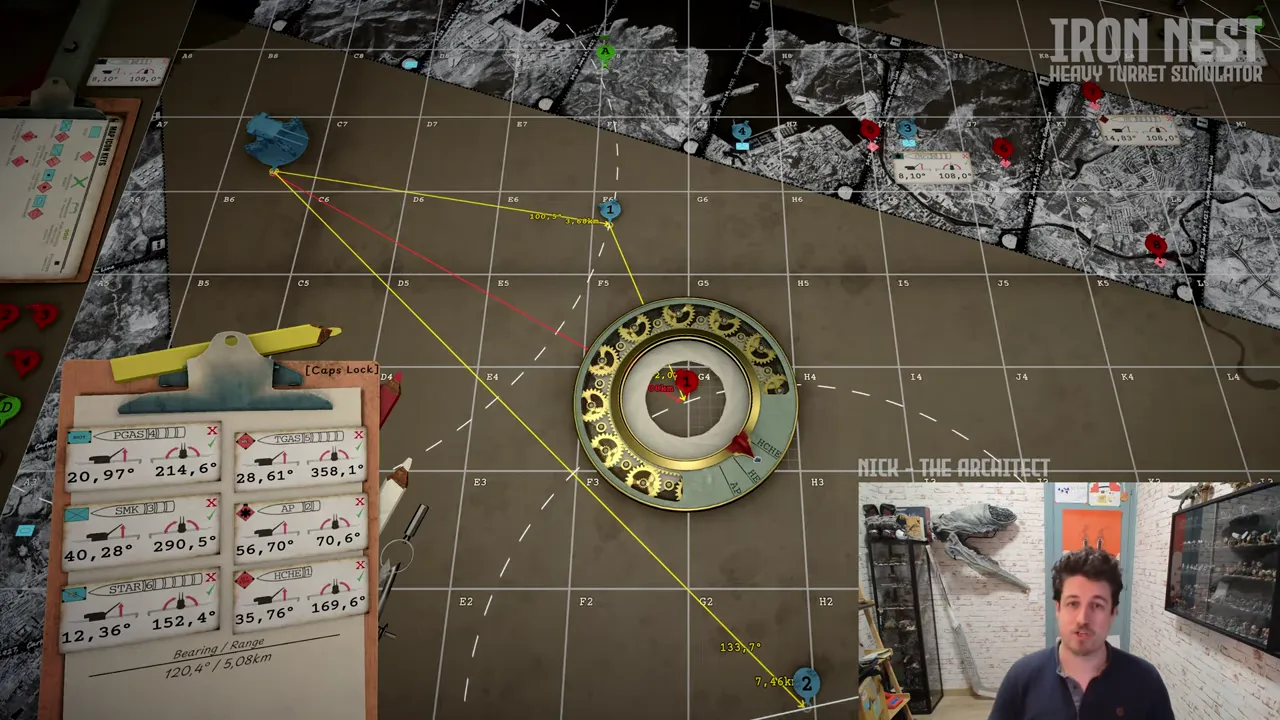
STAR is visible in official footage; a full illumination mechanic is not described in current product text.
Official IRON NEST footage shows a firing-solution card labeled STAR. The card sits on the operator’s clipboard beside PGAS, SMK, AP and HCHE, with its own charge indicator and angular values. That visual evidence confirms a STAR-labeled ammunition entry in the demonstrated build.
The natural interpretation is a star or illumination shell. However, the current Steam page and official website do not describe its effect, night missions, parachute behavior, light radius or duration. The old page treated all of those conventional artillery characteristics as implemented facts. This revision separates the visible game label from reasonable but unverified interpretation.
What the official frame establishes
The image above is a direct source, not concept art generated for this wiki. The STAR card is readable on a task clipboard above a bearing-and-range line. Its visual structure matches the other ammunition cards: shell label, a set of charge segments, and two operating values represented with gun and wheel icons.
This proves STAR participates in a firing solution. It also supports a broader conclusion: ammunition choice can change the settings associated with a target. The card is not merely a lore label.
The frame does not show the shell in flight or after functioning. It cannot prove altitude, deployment, brightness or whether STAR remains available in every released mode. The official video was uploaded April 24, 2026, before the August 6 release, so current-build confirmation should supersede it when available.
Why “illumination” remains an interpretation
In artillery terminology, “star shell” commonly refers to illumination ammunition. That historical association makes the interpretation sensible. Yet games can rename, stylize or repurpose ammunition. The word STAR alone does not reveal the exact simulation.
An evidence-aware page can say “STAR-labeled shell” as confirmed and “illumination” as the likely family. It should not say that the round hangs under a parachute, deals no damage, lights a specific radius or enables aerial reconnaissance unless the released build or current official documentation demonstrates those mechanics.
This distinction is not pedantry. Players make different decisions based on whether light affects spotting, objective state, accuracy or only presentation. Unsupported details create bad walkthroughs.
How to use the STAR solution card
When a current operation supplies or requests STAR, follow the normal firing chain. Locate the required point from coordinates or observer reports, measure range and bearing from the current turret position, select STAR data, copy its charge and elevation, load the correct ammunition, lay the guns and fire.
Do not substitute values from SMK or HCHE. The official clipboard shows different charge patterns and angles on each card. Even if the target location is identical, the projectile solution may not be.
Use the ballistic calculator guide for the physical station and the powder charges guide for the dependency between charge and elevation. Record what the current build displays rather than copying the example numbers from a pre-release video.
Verifying the released effect
A good STAR verification record should answer:
- What exact label appears in the current inventory or task?
- What objective wording requests it?
- Is the operation dark, obscured or otherwise visibility-limited?
- What visible effect occurs after the projectile functions?
- Does the effect change reconnaissance, target information or objective state?
- How long does it persist under those conditions?
- Does repeating the test produce the same result?
Record the game version and mission context. A scripted campaign event may not represent the general challenge-mode behavior. A visual flare does not by itself prove a mechanical accuracy bonus.
Placement questions
The old page advised placing the light “above and slightly beyond” a target. That may reflect real illumination practice, but it is not established as an IRON NEST rule by the cited sources. The correct placement should come from the mission, solution card and observed outcome.
If STAR is fired at a location rather than a conventional damage target, determine whether the order provides a designated coordinate or asks the operator to construct one. The target of an illumination task may be an area, but the gun still needs a specific firing solution.
When a shot produces no useful effect, distinguish a trajectory miss from a misunderstanding of function. First confirm the projectile reached the requested area. Then inspect objective updates and reports.
STAR in a multi-stage operation
Utility ammunition often makes sense as an enabling task: establish information or conditions before a later damage shot. That is an operational hypothesis, not proof that every STAR objective behaves this way.
If a STAR stage precedes another target, keep the solution blocks separate. Archive STAR charge and elevation after firing, then recalculate for the follow-up shell. Check which gun remains loaded and how much traverse the next bearing requires.
The primary and secondary objective guide explains how an enabling task can be important without becoming the campaign’s primary target.
Relationship to reconnaissance
IRON NEST officially uses aerial photos to reveal outcomes. It is tempting to claim STAR automatically improves those photos at night, but no cited official text says so. Reconnaissance may be scripted, delayed or independent of local illumination.
If the released build links STAR to observation, document the exact trigger: whether the operator fires before requesting a photo, whether the image changes, and whether the objective explicitly names illumination. Until then, treat the two systems as potentially related rather than confirmed to interact.
This caution also protects against circular reasoning. A brighter screenshot after firing does not prove the reconnaissance system calculated a light radius; it may be a mission-specific visual.
What not to import from real artillery
Do not assume parachutes, fuzes, burn times, drift, candlepower or historical shell construction. Those topics can provide background in a separate sourced history article, but they are not automatically IRON NEST mechanics.
Likewise, do not claim STAR has zero damage. A utility classification may be likely, but the game’s effect model must be observed. The codex field above describes a likely family while the effects list preserves the verification gap.
The site’s goal is to help operators reproduce what the game does. Real-world plausibility is useful for forming questions, not for answering them without evidence.
STAR and the “30x” wording
The version 1.0 feature list advertises “30x Ammo Types and Abilities.” Because ammunition and abilities share the number, it does not prove 30 shells. The STAR card is valuable because it is a visible named entry beyond the three examples in current product text.
Together, official sources directly show or name AP, smoke/SMK, phosgene/PGAS, STAR and HCHE. They still do not reveal the complete unlock table. See the ammunition guide for a source-aware overview.
The dependable conclusion
A STAR-labeled ammunition solution is confirmed in official pre-release footage. The card has its own charge and angular settings and belongs to the same manual workflow as other shells. “Star shell” and illumination are reasonable interpretations, but exact light, burst, duration, observation and damage behavior is not published in the current official descriptions cited here.
Use the current build’s task wording and calculator data, preserve the fired state, observe the result and document version-specific behavior. Until that verification exists, the strongest useful statement is also the most honest: STAR is real, its trajectory is distinct, and its full purpose must be demonstrated rather than inherited from artillery convention.