Primary and Secondary Objectives in IRON NEST Missions
How primary goals, secondary reports and multi-stage mission design change an IRON NEST firing plan, with clear boundaries between version 1.0 facts and pre-release statements.
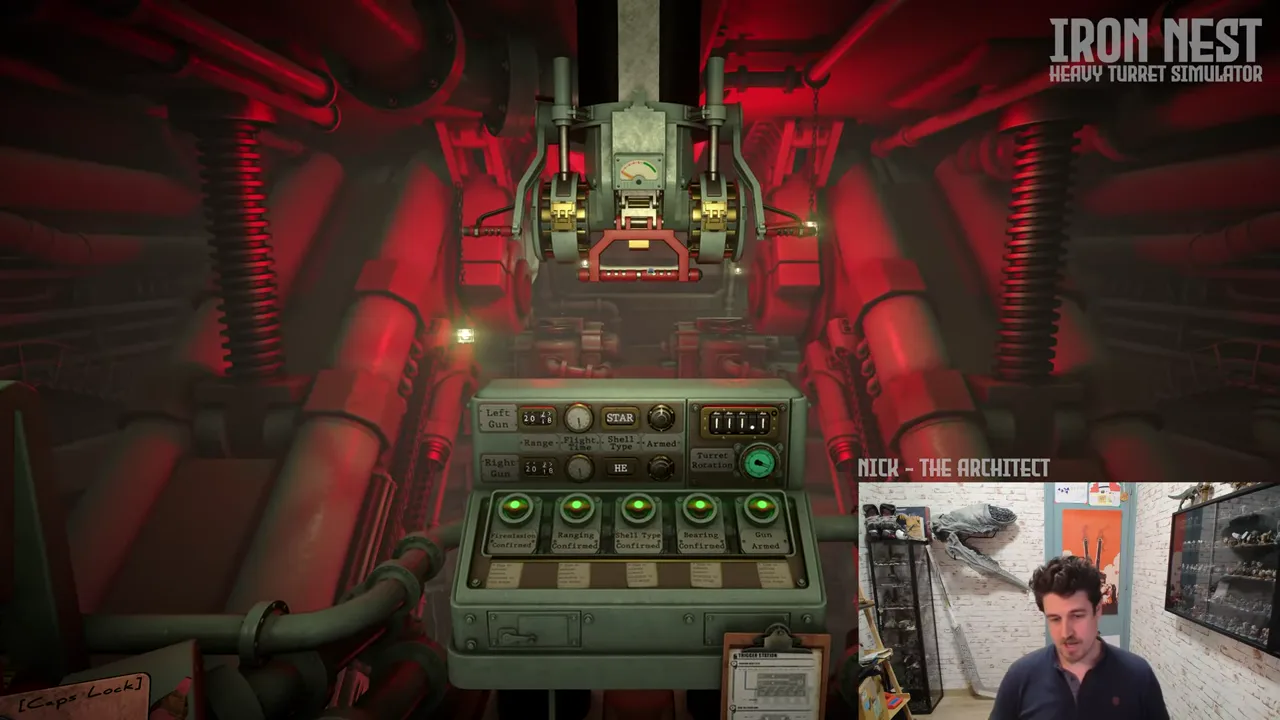
An IRON NEST objective is more than a marker to clear. Every new task can alter target priority, map geometry, shell choice, turret orientation, ammunition reserves and the meaning of the previous shot. When an operation contains a primary goal, secondary information and several stages, the real challenge is preserving a coherent firing plan while the battlefield changes.
The evidence needs careful labeling. The released Steam page confirms a handcrafted story, procedurally generated objectives, two challenge modes and leaderboards. In a May 2026 Q&A, recorded before version 1.0, the developer said most new missions were being designed as multi-stage operations and discussed primary and secondary objectives in campaign and challenge contexts. That statement documents design intent; it does not prove that every released mission uses an identical number of stages.
This guide therefore explains the operational logic without publishing a fabricated mission template or spoiler-heavy objective list.
Primary does not always mean “shoot first”
A primary objective defines the operation’s main success condition or narrative purpose. It deserves priority, but priority is not the same as immediate firing order. A secondary task might reveal the primary target, suppress a threat that blocks the main shot, or impose a deadline shorter than the primary objective’s.
Before acting, classify each incoming item:
- success condition: what must ultimately be achieved;
- enabling task: what makes the success condition possible or safer;
- threat: what will worsen if ignored;
- information: what changes confidence without itself requiring a shot;
- opportunity: a useful but expendable target or action.
This vocabulary is an analytical tool, not an official in-game taxonomy. Its value is preventing every radio call from becoming an equal-priority firing order.
Secondary objectives create tradeoffs
A well-designed secondary objective is not merely bonus points placed beside the main route. It forces the operator to compare costs. Traversing toward it may delay the primary shot. A specialized shell may be effective now but unavailable later. Acting on uncertain information may expose the turret or produce consequences disproportionate to the reward.
The calculation should include at least five variables: urgency, confidence, rotation time, ammunition cost and consequence. High urgency with low confidence calls for verification if time allows. High confidence with extreme traverse cost may still be a poor detour. A low-value opportunity becomes more attractive if it lies near the current bearing and uses already prepared ammunition.
Because IRON NEST is physical, switching tasks has mechanical overhead. The operator cannot instantaneously teleport an aiming reticle between icons. Old values remain on the map and calculator, the turret has a real orientation, and the loading system may already contain a round intended for something else. That friction makes objective order a genuine tactical decision.
Multi-stage missions test state management
In the pre-release Q&A, the developer described an evolving battlefield rather than a string of isolated targets. Multi-stage design allows one outcome to change the next problem. New intelligence can arrive after a shot, a threat can force movement, or the consequences of an earlier choice can alter later context.
The operator must then preserve useful state and discard stale state. Keep a separate solution block for each target: source reports, plotted location, range, bearing, ammunition, charge, elevation, confidence and status. When the mission advances, explicitly mark the old solution complete or invalid. Never leave a previous charge–elevation pair looking like the current answer.
Physical state matters too. Record the turret’s bearing, which gun is loaded, what ammunition is committed and whether an operating cycle is unfinished. A new stage begins from the actual machine state, not from a clean spreadsheet.
Build an objective board
A compact board or note can turn chaos into a queue:
| Objective | Type | Deadline | Confidence | Bearing cost | Required effect | Status |
|---|---|---|---|---|---|---|
| Main target | Primary | stated/unknown | high/medium/low | degrees or time | shell purpose | plotting/ready/fired |
| Supporting task | Enabling | stated/unknown | high/medium/low | degrees or time | observe/suppress/destroy | waiting |
| Incoming threat | Threat | timer | high/medium/low | movement cost | survive/reposition | active |
Do not fill unknown fields with guesses that look precise. Write “unknown” and identify which report or observation could resolve it. The objective board is successful when it separates uncertainty from oversight.
Link each objective to its map construction with a shared label or color. This matters when several bearing lines and range arcs overlap. The tactical map guide explains how observer-origin geometry works; the objective board explains why one valid intersection deserves attention before another.
Recalculate after movement
Counter-battery pressure makes multi-stage work especially dangerous. The developers described movement in the Q&A as a tradeoff: moving to a selected location could buy time without stopping the incoming-fire timer, while an emergency reposition could pause the timer but leave the turret’s new location initially unknown. Current build behavior should always outrank the old statement, but the operational lesson remains sound.
Any relocation changes the origin of the firing solution. A target location can remain valid while range and bearing from the Iron Nest change. Old elevation and traverse values must not survive as active instructions. Re-establish turret position, remeasure, recalculate and relabel the solution.
Our counter-battery and repositioning guide distinguishes the two movement concepts and their evidence status. In objective planning, movement is a stage boundary even if the mission interface does not call it one.
Protect the primary goal from secondary drift
Secondary drift occurs when attractive side work consumes the resources or time needed for the actual operation. The easiest safeguard is a reserve policy: decide what must remain available for the primary goal before accepting another shot.
Reserve the appropriate shell effect, sufficient powder configuration, traverse time and a verification window. If the main target is not yet fully located, reserve attention as well. A secondary report should not cause the operator to erase the only reliable construction for the primary target.
After every completed side task, repeat the primary objective aloud or in writing. Confirm that its target data remains current and that no new report has changed the success condition. This small reset prevents a mechanically successful secondary shot from becoming a mission-level failure.
When a secondary objective supports the primary
Some tasks are valuable precisely because they reduce uncertainty or pressure. Reconnaissance can improve target confidence. Suppression can create time. An observation request can turn a broad area into a valid intersection. In those cases, “secondary” describes hierarchy, not importance.
Evaluate support by asking what changes after completion. Does the task reveal a location, extend a timer, reduce incoming risk, unlock a safer shell choice or prevent a later constraint? If the answer is concrete and the cost is acceptable, the supporting task belongs early in the sequence.
If the benefit is merely speculative, preserve the primary plan. IRON NEST’s moral framing also matters: an optional target can have human and narrative consequences even when it offers operational convenience. Correct procedure does not automatically justify the chosen effect.
Campaign objectives versus procedural objectives
The official feature list separately names a handcrafted story and procedurally generated objectives. The safest interpretation is a hybrid: authored context and consequences can coexist with variable operational work. It does not support claiming that the narrative itself is generated or that every objective is fixed.
In the campaign, objective order can carry narrative meaning. High Command’s stated priority, a frontline report and later newspaper coverage may frame the same event differently. A secondary request can test whether the player treats institutional rank as the only measure of importance.
Procedural objectives emphasize transferable mastery. Different coordinates, bearings, target types or restrictions reuse the operating chain without requiring a new control room. Variation is valuable when it changes decisions, not merely the printed number. See campaign versus procedural objectives for the broader structure.
Challenge objectives and leaderboards
Version 1.0’s official page confirms two challenge modes and leaderboards. Challenge objectives can use the same map, calculator and weapon controls while framing success through repeatable performance. Time, accuracy, endurance or resource discipline become comparable outcomes.
That does not turn the game into multiplayer. The current store metadata describes a single-player game with asynchronous leaderboard competition. A campaign objective can be valuable because of its story consequence; a challenge objective can be valuable because it exposes an inefficient procedure and gives the player a measurable reason to improve.
For leaderboard attempts, standardize the objective board and checksum. Optimization should remove wasted motion, not remove verification. A fast wrong solution is difficult to learn from and unlikely to produce a stable score.
A practical priority sequence
When several objectives arrive, use this sequence:
- identify the main success condition and any explicit failure timer;
- separate target facts from observer facts;
- classify secondary items as enabling, threatening, informational or optional;
- estimate traverse, ammunition and recalculation costs;
- reserve what the primary objective needs;
- execute the supporting task only if its benefit exceeds its switching cost;
- archive the completed solution before the next stage;
- after movement or new intelligence, recalculate from the current turret state.
The red alert machinery in the page image represents the heart of the problem. A changing objective is not a popup laid over an unchanged game state. It arrives while loaders, guns, indicators and the operator’s notes are already committed to something. Multi-stage mastery means keeping story priority, tactical geometry and physical machine state synchronized.
The released game confirms enough variety to make that discipline useful, but exact objectives should be learned from the current build. Treat old developer comments as context, avoid universal mission counts, and let every new stage begin with a deliberate question: what changed, what remains true, and what must be reset before the next lever moves?
Frequently asked questions
Does every IRON NEST mission have primary and secondary objectives?
No universal count is published. In a May 2026 pre-release Q&A, the developer said most new missions were being designed as multi-stage operations and discussed primary and secondary objectives. The released store page confirms a handcrafted story and procedural objectives, but does not guarantee the same structure in every mission.
Should a secondary objective always be completed first?
Not automatically. Compare urgency, rotation time, ammunition cost, intelligence confidence and the consequence of delaying the primary goal. A secondary task can support the main objective, conflict with it or simply provide context.
Are campaign and challenge objectives the same?
They can use the same turret systems, but their framing differs. Campaign objectives serve the handcrafted story and its consequences; the two confirmed challenge modes use repeatable performance and leaderboards.