IRON NEST Campaign vs. Procedural Objectives
How the handcrafted story, evolving multi-stage missions, procedural objectives, challenge modes and leaderboards fit together without being the same thing.
IRON NEST combines several kinds of mission content that are easy to confuse. Its official Steam page lists a handcrafted story, procedurally generated objectives, endless replayability, two challenge modes and leaderboards. Those are related parts of one game, but they answer different player needs.
The campaign gives operations authored context and consequences. Procedural objectives vary the work performed through the turret’s repeatable systems. Challenge modes isolate skills and create a scoring environment. Leaderboards make those scores comparable. Understanding the boundaries prevents two opposite mistakes: describing the game as a purely scripted adventure, or claiming its entire narrative is generated afresh forever.
This page explains the official structure without listing late-game spoilers. The published feature list describes version 1.0; detailed comments from the May 2026 Q&A are labeled as pre-release design statements where appropriate.
What “handcrafted story” means here
A handcrafted story is authored rather than assembled entirely by a generator. In IRON NEST, the official setting places the campaign in late-1920s alternate-history Spain, where the monarchy remains in power and a republican uprising is spreading. High Command issues directives, frontline reports complicate them and the operator faces the consequences of action.
Authorship allows a mission sequence to control when information is revealed and how a decision is framed. A newspaper can comment on a previous shot. An aerial photograph can make damage visible. A later order can gain meaning because the player remembers an earlier one. Those connections are difficult to reduce to random target generation alone.
“Handcrafted” does not imply that every coordinate or objective is fixed. The same campaign can use variable tasks inside an authored arc. The Steam page deliberately lists both story and procedural objectives, so the evidence supports a hybrid structure.
What procedural objectives add
Procedural generation selects or constructs content according to rules. In an artillery game, that can vary operational information while preserving the same underlying stations: receive a report, locate the target, calculate, load, lay and fire. A new combination of target, range or objective type can test the operator without requiring an entirely new control system.
The official page promises procedurally generated objectives and endless replayability but does not expose the generator’s full rule set. We should not invent claims about seed counts, exact target pools or whether every coordinate is random. “Endless” is marketing language for repeatable play, not mathematical proof that no two operations can ever resemble one another.
Procedural variation works especially well with manual operation. Even when the player knows what every lever does, unfamiliar input can make the process demanding. A different bearing changes rotation planning. A different range changes the charge–elevation pair. A different objective changes shell choice and the meaning of success.
Multi-stage design connects objectives
During the May Q&A, the developer said most new missions were being designed with multiple stages and an evolving battlefield. He referred to primary and secondary objectives in both campaign and challenge contexts. Because the answer was recorded before launch, it documents intent rather than a guaranteed count for every shipped mission.
Multi-stage structure can connect authored and variable content. A primary goal provides the operation’s spine. Secondary needs can arrive through frontline calls or changed conditions. The result of one shot can determine what information or pressure defines the next stage.
For the operator, stages create state-management problems. A range written for the first target can contaminate the second calculation. A gun left at an old bearing can delay a response. Ammunition consumed earlier may constrain later choices. Narrative evolution and mechanical continuity reinforce each other.
Challenge modes have a different purpose
Challenge modes are not simply campaign chapters without dialogue. Their function is to make performance repeatable and comparable. The current Steam page confirms two challenge modes and leaderboards. The Q&A said leaderboards were planned across the challenge content so friends could compete at least through scores.
A challenge can emphasize speed, accuracy, endurance or another measurable skill without carrying the same canonical weight as a story operation. That separation lets players practice the machine aggressively without requiring every run to fit the campaign timeline.
It also changes how failure feels. Campaign failure may be meaningful because of story consequences. Challenge failure is often information about performance: the calculation was slow, the procedure was inefficient or the score can improve. Both use the same controls, but they frame mastery differently.
Leaderboards are confirmed; multiplayer is not
IRON NEST’s official store feature list includes leaderboards and labels the game single-player. In the pre-release Q&A, developers discussed simple cooperative or competitive ideas as possibilities, not as a confirmed shipped mode.
That distinction is important when describing challenge content. Players can compare leaderboard results, but that does not mean two operators occupy the same turret in current version 1.0. Social competition through asynchronous scores is the supported claim.
Future updates could change the feature set, but a wiki should follow current store metadata and patch notes rather than promoting old brainstorming as a promise.
Why one turret can support all three structures
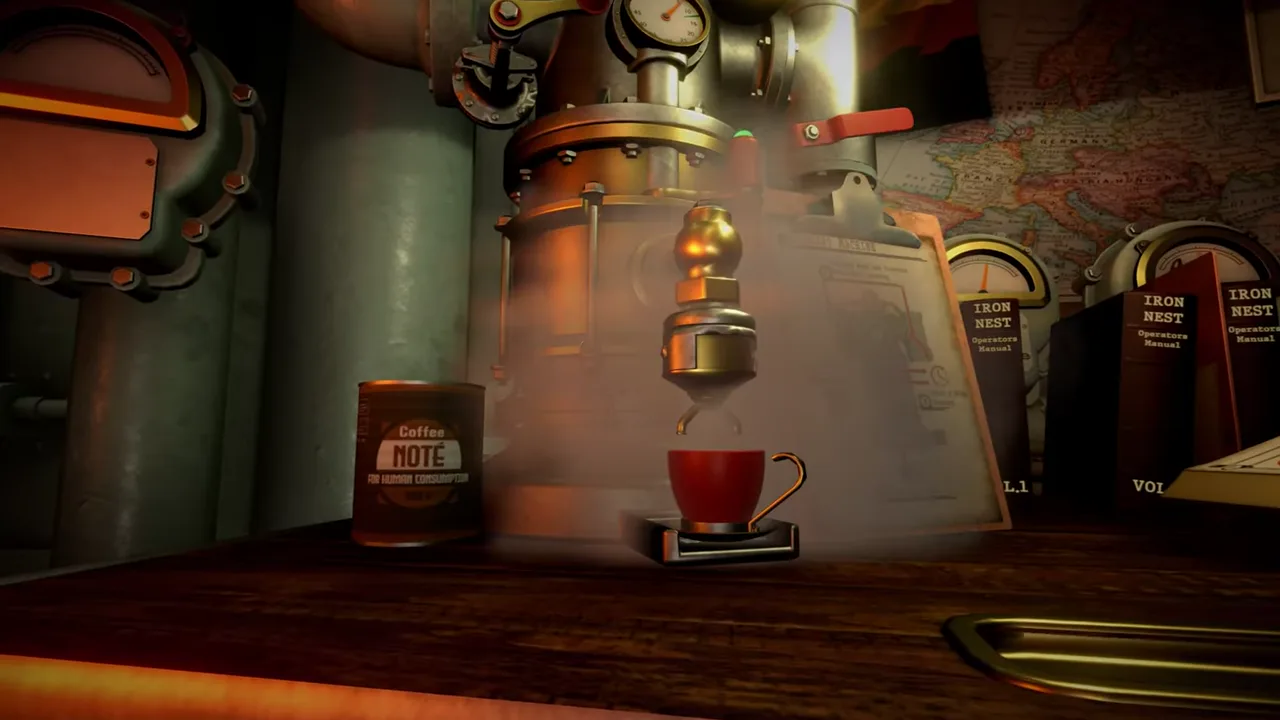
The operator station is stable while mission meaning changes around it. The frame above shows manuals, a wall map, coffee and machinery: a recurring workplace. The player learns this environment over time, much as a musician learns an instrument.
The campaign composes specific pieces for that instrument. Procedural objectives vary the notes and timing. Challenges ask how cleanly or quickly the player can perform. Because control knowledge carries across formats, time spent in one can improve performance in another.
This reuse is not automatically repetition. A good objective changes the decision problem, not merely the number printed on a report. Shell purpose, time pressure, uncertain intelligence, movement and competing priorities can make familiar mechanisms feel different.
What persists between operations
The official feature list advertises 30 unlockable ammunition types and abilities, more than 100 medals and 15 regions. Those progression elements provide a wider context for repeated objectives. The exact unlock schedule and whether every reward applies in every mode require build-level verification.
At a minimum, the list shows that the game records more than a single successful shot. Medals recognize performance or milestones, regions change operational context, and additional tools expand the set of choices. Progression can motivate another procedural run while the story gives that toolkit a world in which to matter.
The operator’s own knowledge is the most dependable persistence. Players learn how to organize notes, use rotation time, catch a mismatched charge and interpret the map. No generator needs to create a new button for those skills to remain relevant.
How to choose what to play
Start with the campaign if you want the setting, High Command, moral framing and authored sequence. Treat reports and consequences as part of the story rather than as obstacles between calculations. Avoid spoilers and let the information channels disagree before consulting an outcome guide.
Use procedural objectives when you want repeatable operational practice and unfamiliar firing problems. Focus on a disciplined workflow so variation tests understanding rather than memory of one coordinate.
Use challenge modes when you want a defined performance target and leaderboard comparison. Optimize only after establishing a reliable procedure; speed built on guessing is difficult to reproduce.
IRON NEST’s structure is strongest when these forms support one another. The story gives the weapon consequences. Procedural objectives keep its systems active after authored surprises are known. Challenges turn familiarity into measurable mastery. They are not competing definitions of the game, but three ways to make the operator return to the same massive machine with a different reason to pull the lever.
Frequently asked questions
Is the IRON NEST campaign procedurally generated?
The official Steam page separately lists a handcrafted story and procedurally generated objectives. That supports a combination of authored narrative content and variable operational tasks, not a claim that the story itself is generated.
How many challenge modes are in IRON NEST?
The current official Steam feature list states that there are two challenge modes and leaderboards.
Do procedural objectives make every run completely different?
Official material promises procedural objectives and replayability but does not publish every generation rule. Variation should not be interpreted as infinite unique story content.