Iron Nest Patch 8 Deploys 'Guarding the Strait' Skirmish Alongside Ambitious Multiplayer Roadmap
High Command has issued Patch 8 for Iron Nest, introducing the tactical 'Guarding the Strait' naval mission, crucial medal fixes, and a roadmap promising free multiplayer.
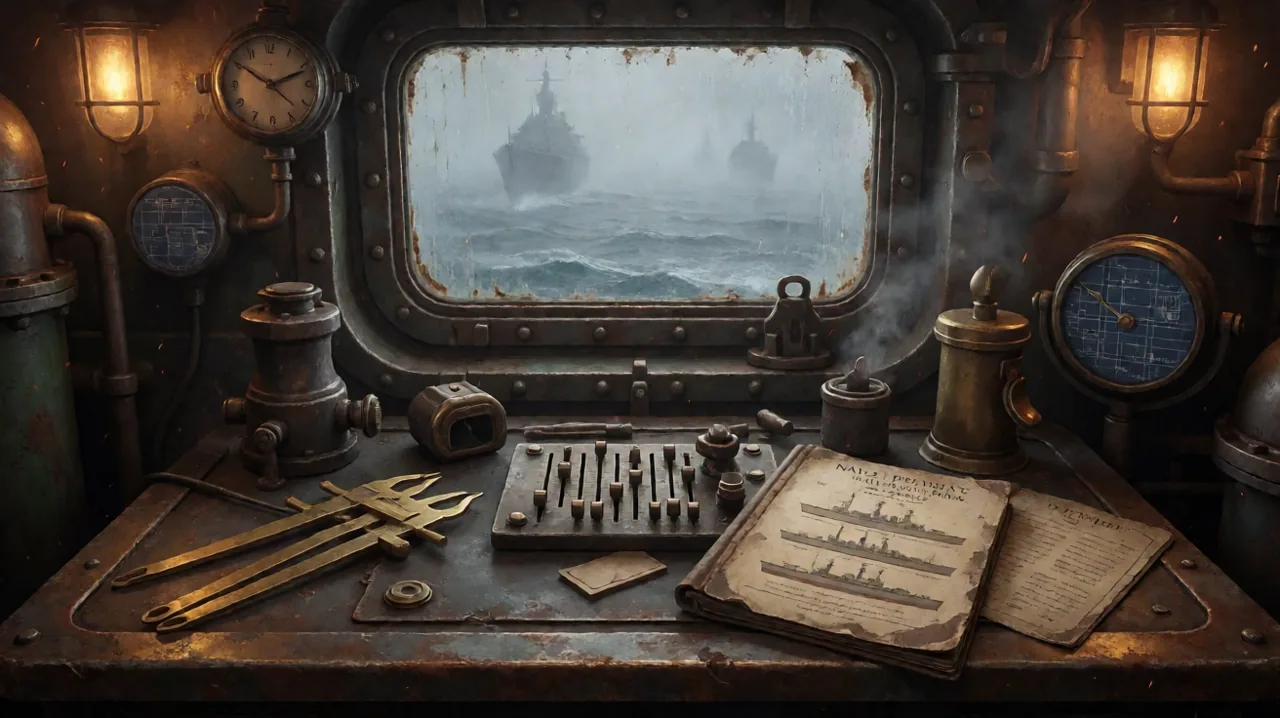
High Command has officially transmitted a major briefing for all deployed operators. Arriving simultaneously with Version 1.0 (1705), the latest updates for IRON NEST: Heavy Turret Simulator outline the immediate tactical situation alongside a sweeping look at the overarching strategic campaign. The two-person development team has initiated the highly anticipated “Free Skirmish Modes” phase of their post-launch roadmap, dropping Patch 8 to deliver the first of these new operations.
Alongside the fresh combat scenario, the patch executes severe corrections to the game’s medal scoring algorithms and resolves multiple deep-rooted ballistic bugs that have plagued dedicated achievement hunters. More importantly, the developers have pulled back the curtain on the future of the simulator, confirming plans for major expansions, a completely free multiplayer component, and eventual cross-platform deployments.
Tactical Analysis: Guarding the Strait
The first major content addition of the post-launch era drops operators into a grueling coastal defense scenario titled “Guarding the Strait”. Unlike stationary land fortresses or the predictable routes of armored trains found in earlier missions, engaging naval assets introduces an entirely distinct set of battlefield variables. The primary challenge in this skirmish is not merely destruction, but rigorous target identification. The mission briefing explicitly tasks the turret crew to identify the vessels moving through the water, determine friend from foe, and eliminate hostile ships before they can navigate the chokepoint.
In the chaotic environment of a dieselpunk combat zone, naval silhouettes are easily obscured by environmental fog, industrial smoke, and shifting weather patterns. Firing a massive heavy artillery shell into a friendly transport vessel carries catastrophic penalties for your overall mission rating. Operators must rely heavily on their observation optics and reference documents to match hull shapes, smokestack configurations, and flag markers before authorizing a firing solution. This creates a highly tense, high-stakes waiting game. You must hold your fire long enough to visually confirm the target’s identity, but waiting too long risks the hostile warship slipping out of your designated firing arc or closing the distance to unleash its own devastating broadside against your concrete bunker.
Once a target is confirmed as hostile, the arduous calculation phase begins. Ships are maneuvering targets moving across a two-dimensional fluid plane, requiring precise, constant estimations of speed and heading. You will need to calculate significant shell lead time, meaning your ballistic calculator and stopwatch become your most vital instruments. Furthermore, selecting the correct ordnance from your ammunition selection is a critical factor in naval engagements. Armor-Piercing (AP) shells might be necessary to penetrate the thick armored belts of military dreadnoughts, while High Explosive (HE) rounds are generally better suited for crippling the exposed wooden decks of unarmored auxiliary vessels. Accurately reading the tactical map to anticipate the enemy flotilla’s route will buy you the precious seconds needed to load the appropriate shell type and traverse the massive gun barrel into a firing position.
Patch 1.0 (1705): The Medal Overhaul
For the dedicated operators grinding out the perfect service record, Patch 8 addresses one of the most widely reported frustrations of the launch window. Previously, the threshold for earning Gold Medals on multiple missions was mathematically skewed. Due to overly strict accuracy requirements or entirely unrealistic time constraints, securing top honors in certain deployments was heavily reliant on luck, or in a few acknowledged cases, completely impossible to achieve regardless of operator skill.
This patch rectifies those stringent thresholds, bringing the medal requirements back down to achievable reality without sacrificing the unforgiving core difficulty that defines the game. Hardcore completionists tackling the rigorous challenge modes can finally earn the accolades their precision deserves. The developers have adjusted the internal scoring logic, ensuring that a flawless execution of a complex firing plan is appropriately recognized and rewarded on the post-mission summary.
Resolving Critical Battlefield Anomalies
Beyond the vital medal adjustments, Version 1.0 (1705) deploys essential fixes to the simulation’s underlying mathematical systems. A highly specific but lethal bug involving emergency positional moves has been successfully eliminated. Previously, if an operator fired a shell right before initiating an emergency move to a new firing position, the enemy’s counter-battery timer would erroneously trigger at the new location. This resulted in near-instantaneous retaliatory artillery strikes upon arriving at your fallback point, completely defeating the purpose of the shoot-and-scoot mechanic. With this calculation fixed, operators can once again use emergency displacement as a valid tactical retreat without facing immediate, unfair obliteration.
Additionally, the notorious anomalies present in Mission 13 have been resolved. The use of incendiary fires and particular shots from “PH” were erroneously registering as friendly fire or severely degrading the player’s overall accuracy statistics. This bug ruined countless perfect runs, as controlling the localized spread of incendiary damage is inherently unpredictable. Fixing this allows operators to utilize fire-based area denial tactics without being artificially penalized by the scoring system.
Other minor but highly welcome quality-of-life adjustments include addressing a UI glitch where clicking on the campaign map mid-mission would fail to quit the current session—a small friction point regarding the controls and interface that has now been smoothed out. The developers also patched a rare geographic spawn error in the “Rock of Gibraltar” mission that occasionally placed the player’s heavy turret slightly inland. This visual error interfered with the intended coastal firing arcs and broke immersion regarding the established Iron Nest lore. Finally, the severe issue where requisition credits would inexplicably reset to zero upon entering certain missions has been corrected, securing your hard-earned logistics budget for vital upgrades.
The Long-Term Roadmap: Expansions and Free Multiplayer
While the immediate focus of the community is locked on the current Skirmish phase, High Command has officially declassified the long-term operational roadmap. Following the conclusion of the Free Skirmish Modes, the development cycle will pivot to a series of escalating, major content drops. The confirmed sequence is as follows: Free Additional Content, followed by a Paid Expansion, and culminating in the highly requested Free Multiplayer.
The confirmation of a Paid Expansion implies significant new assets in active development. This could potentially introduce entirely new theaters of war, distinct turret chassis featuring unique mechanical loading quirks, or completely new enemy factions with their own armored doctrines. However, it is the prospect of Free Multiplayer that has generated the most intense community speculation.
How multiplayer will function within the confines of a localized, fixed-position simulator remains an exciting unknown. Will it feature cooperative dual-operator gameplay, where one player physically manages the heavy breech, heavy powder bags, and hydraulic shell hoists while the second operator commands the rangefinder, traverse gears, and ballistic charts? Or will it take the form of coordinated battery fire, with multiple players commanding adjacent distinct turrets to establish interlocking fields of fire against overwhelming AI assaults? While the exact structural details and release windows remain tightly classified, the confirmation that multiplayer is actively planned guarantees the operational lifespan of the game will extend far beyond its initial single-player campaign.
Expanding the Front: Consoles, VR, and Mobile
The transmission from the developers concludes with a surprising acknowledgment of aggressive platform expansion. Despite consisting of only Nick Nieuwoudt and Dominik Latos, the team is actively exploring ports to bring the heavy artillery experience to Consoles, Virtual Reality (VR) headsets, and Mobile devices.
A VR adaptation of the simulator feels like a natural, albeit technically demanding, evolution for the engine. The incredibly tactile nature of the gameplay—pulling massive rusted levers, spinning heavily damped elevation handwheels, and manually charting map coordinates with a pencil—would translate seamlessly to 1:1 motion controls. VR has the potential to drastically elevate the immersive, oppressive claustrophobia of operating inside the thick steel walls of the turret interior.
Conversely, console and mobile adaptations present massive UI and control mapping challenges. Successfully translating the complex, dense array of measurement dials, mechanical switches, and precise map tools to a standard gamepad joystick or a touch screen will require significant interface redesigns. The developers are maintaining strict operational security regarding target dates, stating they will not announce specific release windows until the technical groundwork is fully verified and functional. This cautious, methodical approach ensures that when the heavy turrets finally deploy on new hardware platforms, they will retain the uncompromising mechanical depth and grueling atmospheric tension that currently defines the core PC experience.