IRON NEST Challenge Modes and Leaderboards Explained
What version 1.0 officially confirms about IRON NEST's two challenge modes, leaderboards and procedural objectives, with practical preparation advice.
Challenge modes are where IRON NEST: Heavy Turret Simulator turns a complex operating procedure into repeatable performance. The current official Steam page confirms two challenge modes and leaderboards alongside the handcrafted story and procedurally generated objectives. That is the version 1.0 baseline.
Older copies of this guide claimed eight modes. The released store listing does not support that number, so it has been removed rather than preserved as a rumor. Exact mode names and scoring formulas should likewise come from the released interface or current developer notes, not from assumptions about what an artillery challenge “must” include.
What can be explained confidently is the role of challenge content. It asks the operator to repeat the same map, calculator, loading and gun-laying skills under a clear performance framework. Leaderboards then allow scores to be compared without turning the game into a conventional live multiplayer vehicle simulator.
Confirmed version 1.0 features
The current Steam listing establishes four relevant points:
- IRON NEST is a single-player game.
- It includes two challenge modes.
- It includes leaderboards.
- It uses procedurally generated objectives and advertises replayability.
These points can coexist. Procedural objectives provide changing operational inputs. Challenge modes define a repeatable ruleset or performance context. Leaderboards record comparable results. “Single-player” describes how the operator plays the session, while the leaderboard supplies an asynchronous social layer.
The official page does not publish every scoring weight. We therefore do not claim that speed, accuracy, ammunition economy or another variable always contributes a specific number of points. Read the mode’s current instructions before optimizing.
What the developer said before release
At 39:23 in the May 2026 community Q&A, the developer discussed challenges and said leaderboards were planned for all challenge modes. He also mentioned simple cooperative or competitive concepts as possibilities, while making clear they were not established full multiplayer systems.
The current store page resolves the most important uncertainty: leaderboards and two challenge modes shipped as advertised features, but multiplayer is not listed. The responsible interpretation is asynchronous competition through leaderboard scores. An old brainstorming answer is not evidence that two players can currently share the turret.
Pre-release sources remain useful when dated and compared with the finished store metadata. They explain design intent; they do not override the released product.
How challenges differ from the campaign
The handcrafted story uses objectives to deliver setting, consequences and an authored sequence. A campaign decision may matter because of who issued the order, which report arrived or what a later newspaper says. Challenge modes can reuse the same machinery while emphasizing repeatable execution and comparison.
That does not make challenges narratively meaningless or mechanically simple. It means their primary promise is different. A leaderboard needs conditions stable enough for one score to be compared with another, even when procedural generation varies target information inside those conditions.
Campaign progress teaches the controls in context. Challenges reveal whether the operator can apply that knowledge consistently when familiar story timing is no longer the main guide.
Procedural objectives and fair comparison
Procedural generation does not necessarily mean every element is random or that no two tasks repeat. It means objectives are selected or assembled through rules rather than existing only as one fixed authored sequence. The official Steam page does not publish the generator, so claims about seeds, target pools or exact distribution would be speculation.
For a leaderboard, controlled variation can test transferable skill. A player who memorizes one coordinate has learned a script. A player who can interpret a new report, measure a new range and produce a correct solution has learned the machine.
Fair comparison depends on whatever rules the released mode uses. Check whether a run identifies a seed, fixed rotation, time window or other condition before comparing results across sessions. This is practical advice, not a claim that all of those fields exist.
Build reliability before speed
The fastest improvement is often removing rework. A hurried operator who plots the wrong origin, transposes the range and fires twice may lose more time than one who performs a deliberate first solution. Establish a repeatable sequence before trying to shorten it:
- Identify the objective and preserve the original report.
- Plot the target from the correct observer or coordinate.
- Measure bearing and range from the turret.
- Select ammunition and powder charge for the intended solution.
- Calculate elevation and record it with the target identifier.
- Transfer bearing and elevation to the correct gun.
- Verify the physical loading state before firing.
Only after that chain produces consistent results should individual movements be optimized.
Use turret rotation time productively
The official Steam description notes that the massive turret takes time to rotate and that skilled operators use the interval for other tasks. In a scored run, this creates an opportunity for parallel planning without skipping verification.
Once a bearing is confirmed and rotation begins, the operator may prepare the next calculation, check ammunition or organize notes—provided the task does not disturb the active solution. The exact best sequence depends on the challenge rules and which stations remain accessible.
Avoid constantly adjusting the bearing while performing other work. A stable, verified setting is easier to audit than a control moved from memory several times.
Make the interfaces readable at a glance
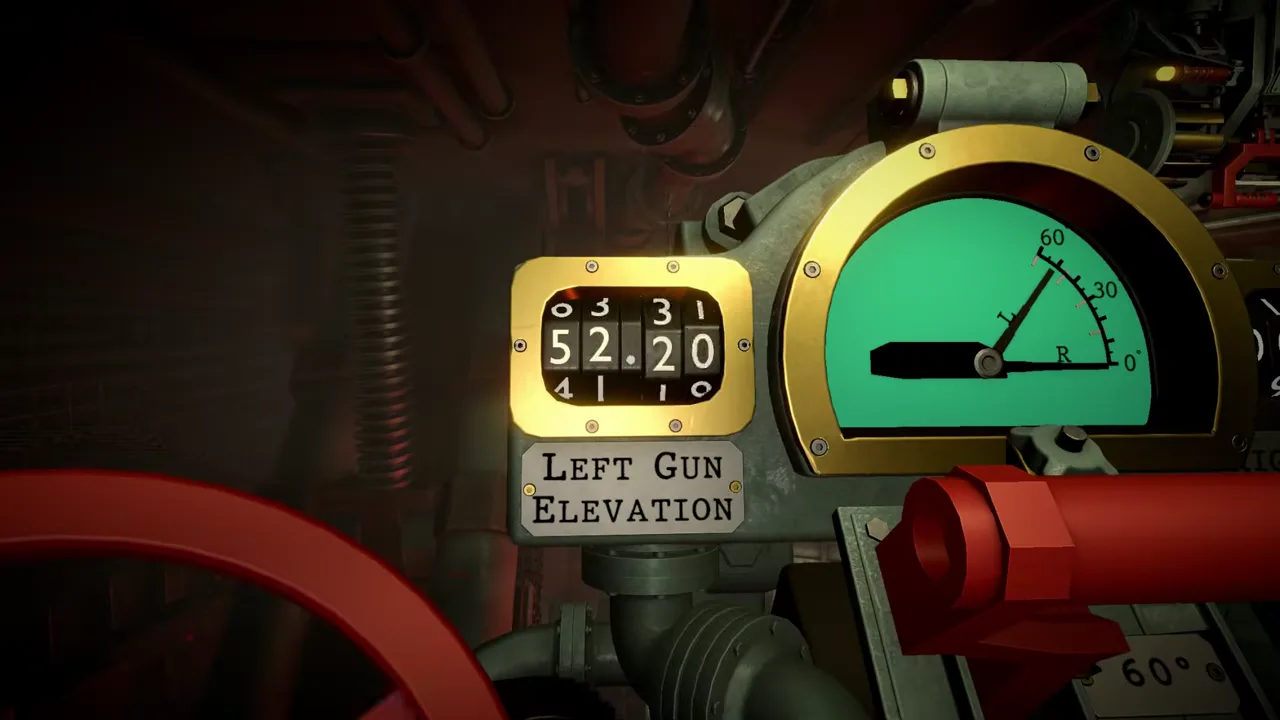
The frame above shows the left-gun elevation counter and analogue angle gauge. Under pressure, the difficulty is not discovering that elevation matters; it is reading the correct display and transferring a number without losing a digit.
Use consistent note placement. Put target, range, charge and elevation on one line. Cross out obsolete solutions rather than leaving several live values on the same page. If left and right guns can hold different states, label each explicitly.
This organization reduces cognitive load and makes a miss diagnosable. Challenge performance improves when the operator can find the broken step rather than restart the entire process.
Accuracy, speed and resource use
Do not assume which metric dominates a score until the mode states it. Speed can be valuable, but a missed shell may impose a larger cost. Accuracy may matter, but an overly cautious run can leave objectives unresolved. Ammunition choice may affect both target result and economy.
Practice each dimension separately. First complete clean solutions with no time goal. Then time the map-to-calculator transfer. Next measure how long gun laying and loading take. Improving a known slow stage is more effective than rushing the whole sequence.
When evaluating a run, record process notes beside the score: one map correction, one charge mismatch, unnecessary rotation or delayed observation. The leaderboard shows outcome; the notes explain how to improve it.
How to treat misses
A miss is useful only if the previous state is preserved. Wait for impact evidence, then classify the problem. A shot at roughly the correct distance but wrong lateral position suggests bearing or target plotting. A shot on the correct line but short or long suggests the range–charge–elevation chain. A hit with the wrong effect suggests ammunition selection.
These patterns are diagnostic clues, not guaranteed scoring rules. Change one demonstrably wrong value and repeat. Randomly spinning several controls may rescue a run but will not create a reproducible leaderboard strategy.
Our detailed firing-solution troubleshooting guide covers that audit process outside a timed context.
Competing with friends today
The confirmed path is simple: play a challenge as a single operator and compare the result through its leaderboard. Friends do not need to be online together for that competition. Agree on the same mode and, where the interface exposes relevant run conditions, compare like with like.
Do not advertise a cooperative turret crew or real-time duel unless a future update and current store metadata confirm one. If the developers expand multiplayer later, this page should record the patch and date rather than treating a 2026 Q&A idea as a launch commitment.
A dependable preparation checklist
Before pursuing a serious score, confirm that controls and sensitivity are comfortable, the current mode instructions are understood and the firing workflow can be completed reliably. Use the tactical-map guide and ballistic-calculator guide to isolate weak stages. Test improvements one at a time.
Challenge modes reward mastery because the machine remains demanding after its layout becomes familiar. The official feature count is two, not eight; the depth comes from performing a connected procedure against changing objectives, then finding small, evidence-based improvements that survive the next run.
Frequently asked questions
How many challenge modes does IRON NEST have?
The current version 1.0 Steam feature list confirms two challenge modes. Older references to eight are not supported by the released store page and should be treated as obsolete.
Does IRON NEST have leaderboards?
Yes. Leaderboards are listed as a current Steam feature. In the May 2026 Q&A, the developer said leaderboards were planned for all challenge modes.
Are challenge modes multiplayer?
The current Steam page lists IRON NEST as single-player. Leaderboards support asynchronous competition, while pre-release discussion of simple cooperative or competitive ideas was not a confirmed shipped multiplayer mode.