A Cat on Deck: Iron Nest Reveals an Unexpected Companion 3 Days Before Launch
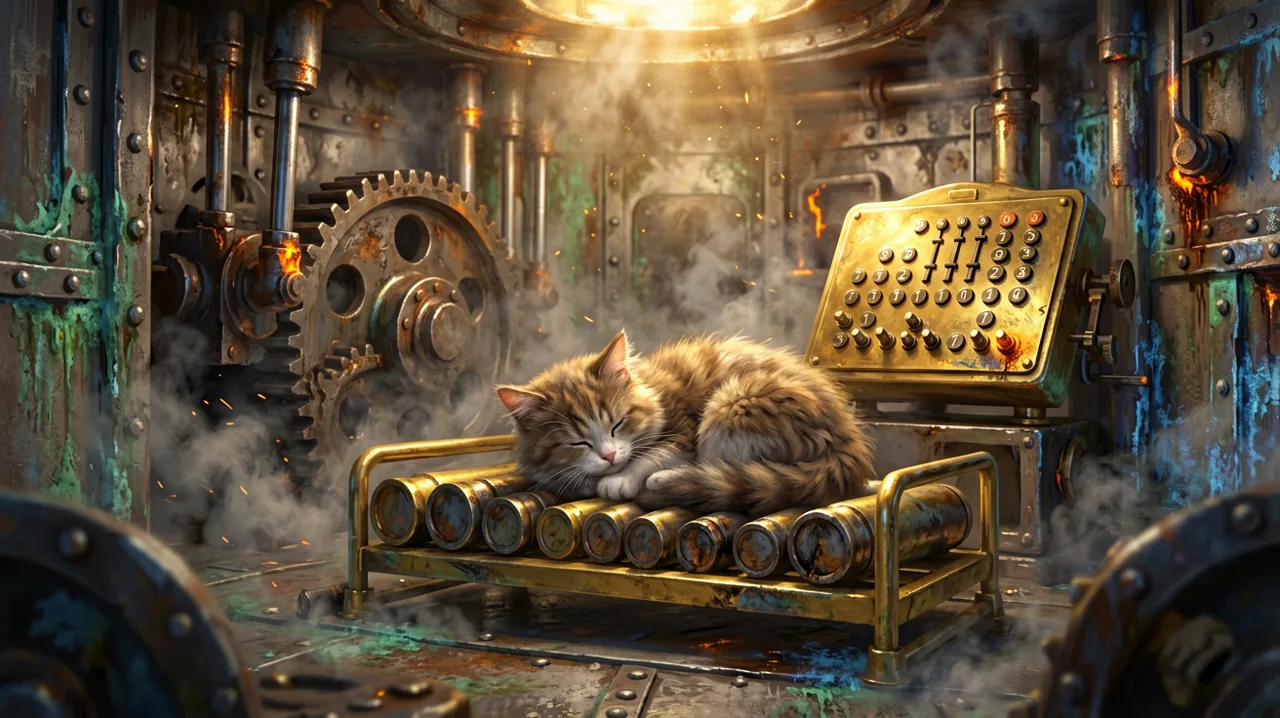
Just 3 days before the release of Iron Nest: Heavy Turret Simulator, a new Reddit post reveals a feline companion inside the grim dieselpunk artillery.
The Final Approach to Launch
The wait is almost over. We are currently sitting just three days away from the highly anticipated August 6 release of Iron Nest: Heavy Turret Simulator on Steam. For months, the two-person development team of Nick Nieuwoudt and Dominik Latos has been cultivating an atmosphere of absolute dread, mechanical complexity, and heavy industrial isolation. The game drops players directly into a grim, alternative-history Spanish battlefield, confining them within the thick steel walls of a massive, fixed artillery turret. It is an experience defined by cold calculations, the deafening roar of cordite, and the blind obedience of following orders from a faceless command. Yet, as the final countdown begins, a surprising new detail has surfaced on social media—one that adds a completely unexpected layer of warmth to this brutal simulation.
A recent post by Reddit user Scream_Wattson on the r/IndieGaming subreddit caught the attention of eager fans who are meticulously tracking every scrap of pre-release information. The post was titled: “With a cat on deck, even the heaviest artillery feels a little less terrifying!” This brief glimpse into the game has sparked a massive conversation among players who have spent the last few months stressing over wind speeds, target distances, and the physics of heavy shell trajectories. The idea that you are not entirely alone in this 5,000-ton steel beast changes the psychological texture of the game quite significantly.
Contrasting Atmospheres: Dieselpunk Meets Feline Comfort
In a title so strictly focused on the harrowing reality of war and the immense, terrifying power of a fixed heavy cannon, the presence of a small feline companion is a brilliant stroke of artistic contrast. To understand the full context of this world, you can review our summary of everything-we-know about the game’s uncompromising setting. The dieselpunk aesthetic of Iron Nest is overwhelmingly bleak. Your immediate environment consists entirely of brass dials, leaking hydraulic fluids, industrial grease, and heavy iron gears. The primary interaction you have with the outside world is through the sheer destruction you rain down upon it from afar. Having a cat wandering around the deck or sleeping quietly on a crate of ammunition grounds the experience in a very human reality.
Historically, the presence of animals in active combat zones is well-documented, adding a fascinating layer of authenticity to the alternate history setting. Trench cats in the First World War and ship cats in the various navies of the 20th century were incredibly common. They served highly practical purposes, such as pest control, keeping rats away from vital food supplies, electrical wiring, and sensitive equipment. More importantly, however, they served as crucial morale boosters for soldiers stationed in miserable, highly stressful conditions. By including a cat in the turret, Nieuwoudt and Latos are tapping into this historical truth, enriching the iron-nest-lore with a detail that makes the bleak Spanish coastal batteries feel lived-in and tangible.
Mascot or Mechanic? Unanswered Questions
Naturally, the community is already speculating wildly about the mechanics surrounding this feline companion. Will the cat react to the environment? Operating the turret is a loud, incredibly violent affair. When you pull the firing lever and send a massive projectile hurtling toward the horizon, the screen shakes violently, and the sound design is reportedly deafening. It is not yet confirmed by the developers if the cat features complex AI behaviors—such as hiding or fleeing to a lower deck when the cannon fires, or emerging only during the quiet, tense moments between barrages.
It is widely expected by the community to be a purely visual Easter egg rather than a tamagotchi-style mechanic you need to actively manage. After all, the game is a heavy artillery simulator, not a pet care game. But even a static or minimally animated companion offers a powerful focal point of comfort during the grueling shifts inside the bunker.
Imagine the core gameplay loop with this new addition. You receive fresh coordinates from command via the teletype. You turn to the navigation desk, spending several minutes reading-the-tactical-map to decipher the grid references and identify the target type. You walk over to the brass rangefinder and the mechanical ballistic-calculator-guide to manually input the wind direction, relative humidity, and distance to generate a precise firing solution. All the while, a cat is quietly watching you from a perch above the ammunition hoist. It suddenly makes the cold, mechanical process of dialing in a firing solution feel a little less lonely.
Revisiting the Core Firing Loop
The contrast becomes even sharper when you consider the sheer destructive power at your fingertips and the physical labor required to unleash it. As a gunner, you have to select from over 30 different shell types based on the tactical situation, a system fully detailed in our ammunition-guide. Whether you are operating the crane to load a 1-ton Armor Piercing (AP) round to crack an enemy concrete bunker, calling up an incendiary shell to deny an area to enemy infantry, or utilizing an illumination flare to light up the night sky for allied spotters, the process is intensely manual and demanding. Balancing this heavy, consequential labor with the simple, innocent presence of a sleeping cat perfectly encapsulates the dual nature of Iron Nest’s design philosophy: immense industrial scale paired with intimate, tactile details.
As another Reddit post on the r/IndieGameWishlist subreddit reminded everyone today: it is exactly “3 Days to Release”. The momentum behind Iron Nest has been nothing short of staggering. Since its explosive debut during the Steam Next Fest, where it dominated the charts and garnered overwhelmingly positive ratings for its uncompromising vision, the game has been on a meteoric rise, surpassing multiple massive wishlist milestones. If you haven’t yet experienced the tactile chaos of the turret for yourself, the playable slice is still live up until the launch date. We highly recommend checking out our demo-guide to get a head start on mastering the manual loading sequences and understanding the basic instrumentation before the full campaign unlocks.
Final Pre-Deployment Checks
For those who are already veterans of the demo and have their Steam wallets ready, now is the time to finalize your pre-deployment checklist. Make sure your PC is ready for the heavy physics calculations and detailed volumetric environments by reviewing the official system-requirements. The developers have heavily optimized the game to handle the complex ballistic physics and the intricate mechanical animations of the massive turret, but ensuring your hardware is up to the task is always a good idea before stepping into the gunner’s seat for a prolonged campaign.
The journey of Iron Nest from a quiet passion project by two dedicated developers to one of the most anticipated indie simulation games of 2026 has been incredible to watch. The community has rallied strongly behind its unapologetic hardcore mechanics, the complete lack of modern UI hand-holding, and the sheer immersion of operating such a colossal machine entirely by hand.
The late reveal of a cat companion is just the cherry on top—a small, whimsical addition that shows the developers deeply understand pacing and atmospheric tone. It is not just about the endless, deafening grind of calculating trajectories and hauling heavy brass casings; it is also about the quiet moments in between. It is about waiting for the smoke to clear from the barrel, listening to the creaking of the metal hull under the stress of the recoil, and perhaps, hearing a soft purr over the low, constant hum of the diesel generators.
We will be covering the launch extensively here at the wiki, providing detailed breakdowns of the campaign progression, advanced firing techniques, and complete analyses of the various regional challenges the game throws at you. The alternative history Spanish battlefield is vast, and the targets will only get harder to hit as the war progresses and weather conditions deteriorate. But for now, as we watch the final 72 hours tick down on the clock, we can take a moment to appreciate the small things.
The heavy artillery is terrifying, the responsibility of the firing solution is immense, but at least we won’t be facing the darkness entirely alone. Prepare your firing tables, double-check your windage dials, and maybe leave out a little extra ration of milk on the deck. Deployment is imminent.