Teleprinters and Radio Intelligence
High Command directives and frontline calls
How IRON NEST's two teleprinters separate High Command orders from frontline radio traffic, what information reaches the map, and which refusal mechanics remain unverified.
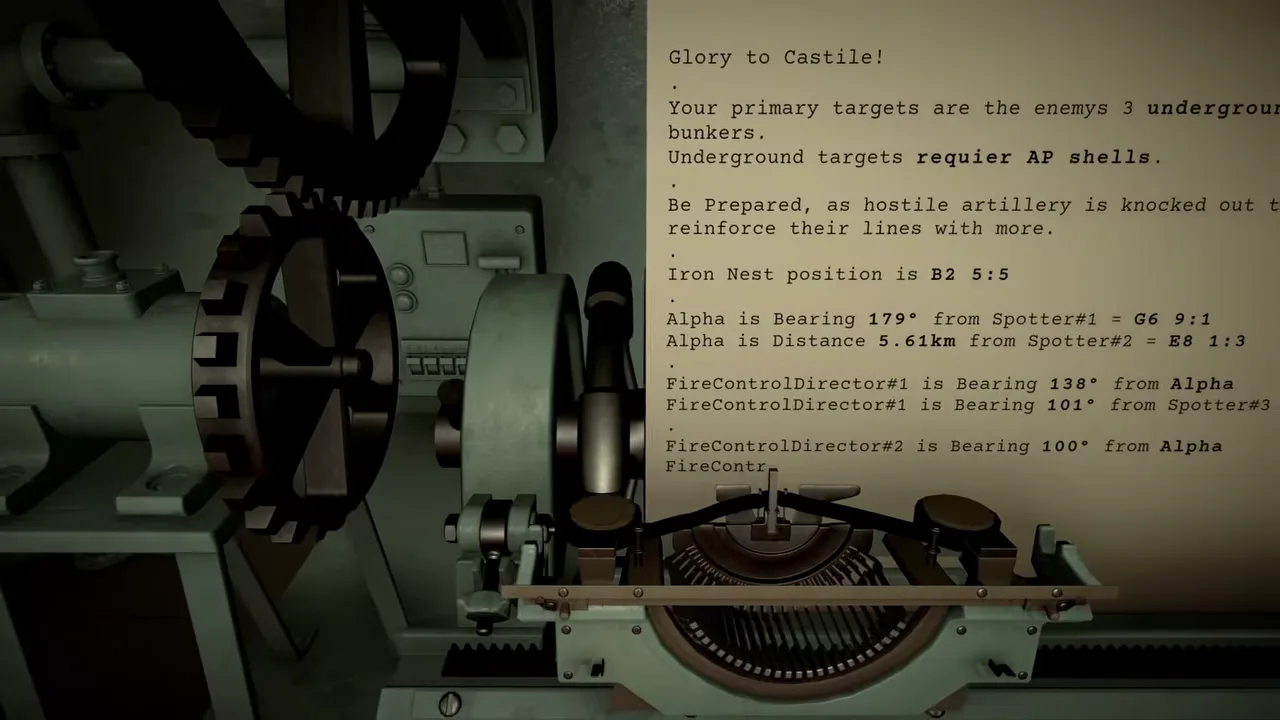
One channel carries priority; the other can carry context that changes what priority means.
IRON NEST’s official description identifies two teleprinters with different information roles. One delivers top-priority directives from High Command. The other relays direct calls from the frontline by monitoring local radio traffic. Together they form the first stage of the firing chain, but they do not necessarily tell the same kind of story.
The official video frame above makes the system concrete. A typed message names primary targets, specifies AP shells for underground targets, gives the Iron Nest position, and lists bearings and distances associated with spotters and fire-control personnel. The machine does not hand the operator one glowing target marker. It provides text that must be interpreted.
Two channels, two authorities
High Command has formal priority. Its printer frames what the operation is supposed to accomplish and can identify targets, ammunition or urgency. The frontline channel carries information from people closer to events. It may add observations, location constraints or consequences that distant command language does not contain.
The current official text says every piece of information can determine success. That statement prevents the operator from treating frontline traffic as decorative flavor. A high-priority directive can define the goal while a lower-status report supplies the geometry or context needed to execute it correctly.
The sources do not publish a universal rule for resolving contradictions. The campaign can frame choices through authored situations, and the operator bears consequences, but the exact interaction available in each mission must come from the current build.
What a message can contain
The demonstrated order includes several categories:
- objective language: what targets matter;
- effect requirement: AP shells for underground targets;
- own position: the Iron Nest’s map reference;
- observer information: spotter positions or measurements;
- bearings and distances: constraints used to reconstruct targets;
- situation context: what hostile or friendly forces may do next.
These categories should be copied separately. A bearing from a spotter is not automatically the gun bearing. A distance from one observer is not the turret-to-target range. The tactical map exists to transform source-relative reports into geometry from the current Iron Nest position.
A reading protocol
Before leaving the teleprinter, create a message header with source, time or sequence, objective and confidence. Then extract facts without solving them prematurely.
For each number, record its origin and object: “bearing from Spotter 1 toward Alpha,” not merely “179°.” For each coordinate, record whether it is the turret, observer, target or reference point. For each shell instruction, record whether it is mandatory, recommended or simply visible in the message.
Finally, list unresolved questions. If two lines appear inconsistent, preserve both until the map or a second report resolves them. Quietly choosing the more convenient value creates an invisible error.
The teleprinter does not calculate
Typed information is input, not a finished solution. The message can name a target and provide measurements, but the operator must plot those constraints, measure from the Iron Nest, select the correct shell card, calculate charge and elevation, and lay the gun.
This separation makes diagnosis possible. If the typed report was copied incorrectly, the calculator can operate perfectly and still produce a miss. If the report was correct but the map construction was wrong, rereading the printer alone will not fix the geometry.
Keep the original ribbon or a faithful transcription available until the outcome is confirmed.
High Command, choice and responsibility
The product description says High Command sends orders but the chain of command ends at the operator’s fingertips. It emphasizes that distant authorities do not carry the consequences; the operator does. This clearly establishes responsibility as a theme.
It does not by itself establish a universal “refuse order” button available for every objective. The old version of this page stated that orders could be refused as a general mechanic. Current public sources support a narrower claim: the handcrafted story puts action and consequence in the operator’s hands, and different information channels can complicate directives.
When documenting a particular refusal, delay or alternative action, cite the current mission or official description that demonstrates it. Do not promote thematic language into an undocumented global control.
Calibration language
The official text says the teleprinters are calibrated to monitor local radio traffic. It does not describe a maintenance minigame, tuning failure, garbled-message probability or routine recalibration sequence.
The former page treated calibration as a confirmed readiness task. That detail has been removed. If the released build includes an interactive calibration procedure, it should be documented with exact controls, failure states and version evidence. Until then, “calibrated” describes the fictional system configuration.
Handling updated or conflicting reports
When a later message changes the situation, do not overwrite the first report without marking the revision. Timestamp or sequence each message and identify what changed: target position, observer position, priority, ammunition or deadline.
A new target position invalidates range and bearing. A new shell requirement invalidates charge and elevation even if the target stays fixed. A turret reposition invalidates the geometry from the old Iron Nest origin. A priority update may change firing order without changing any numbers.
This versioned approach is essential in multi-stage missions, where a correct early solution can become stale rather than wrong.
Connecting messages to the map
Use a consistent label and color for every entity carried from the printer to the tactical map. If the message names Alpha, Spotter 1 and Spotter 2, those same labels should appear on the map construction.
Plot known positions first. Add each bearing as a ray from its source and each distance as an arc or circle from its source. Use intersections to identify candidate target positions, then measure the final bearing and range from the Iron Nest.
The reading the tactical map guide provides the full geometry. The teleprinter’s role is to preserve the provenance of every constraint.
Connecting messages to ammunition
The demonstrated order explicitly says underground targets require AP shells. That is first-party visual evidence of information passing directly from the message to shell selection.
Do not infer that every message names the correct shell. Some operations may describe an effect or target and expect the operator to select from available task cards. Use the verified ammunition framework and current mission text.
After selecting a new shell, use the shell-change checklist so the calculator and physical loader match the order.
A practical teleprinter checklist
Before moving to the map, confirm:
- Which printer or information source produced the message?
- What is the primary success condition?
- Which positions are explicitly known?
- From whose position is each bearing or distance measured?
- Is an ammunition effect specified?
- Is there a timer, threat or sequence constraint?
- Does another report add or contradict context?
- Have uncertain fields been labeled rather than guessed?
This checklist prevents information errors before they become ballistic errors.
The dependable conclusion
IRON NEST confirms two teleprinter roles: High Command’s top-priority directives and direct frontline calls derived from local radio traffic. Official footage shows messages carrying objectives, ammunition requirements, own position, observer data, bearings and distances.
The system’s depth comes from interpretation and provenance. Read the full message, preserve the source of every number, distinguish observer-relative measurements from gun settings, and version later updates. Responsibility and competing information are confirmed themes; a universal refusal button and an interactive calibration mechanic are not established by the current sources cited here.