The Cold Calculus of Devastation: Why Iron Nest's Artillery Strikes Feel So Satisfying
A recent review declared 'It's not a war crime if you had fun,' perfectly capturing the moral disconnect and mechanical satisfaction of calculating the perfect artillery strike in Iron Nest.
A recent review by ixbt.games carried a headline that perfectly captures the underlying appeal of IRON NEST: Heavy Turret Simulator: “It’s Not a War Crime If You Had Fun.” While humorous and slightly morbid, this statement hits at the absolute core of what makes the PC and Steam hit by developers Nick Nieuwoudt and Dominik Latos so exceptionally engaging. The game places you in command of a massive, stationary artillery piece in a grim, alternate-history conflict. Your job is not to shoot enemies on screen in a traditional first-person shooter format. Instead, you are tasked with interpreting raw data, executing complex mathematics, and operating massive, punishing machinery to deliver payloads to grid coordinates you will never personally lay eyes on.
This creates a profound psychological disconnect. The player is insulated from the visceral horror of the battlefield, surrounded entirely by the cold logic of brass, steel, and trajectory tables. We find immense satisfaction in the procedural execution of the firing sequence, entirely divorced from the explosive consequences happening miles away. This analysis explores exactly how the game achieves this sterile, yet intoxicating, gameplay loop, turning the horrors of indirect fire into one of the most rewarding mechanical puzzles of the year.
The Sterile Reality of the Iron Nest
The genius of the game’s design lies primarily in its environment. When you spawn into your assigned turret, the sheer claustrophobia is palpable. You are sealed within feet of hardened armor plate, enveloped by a dizzying array of manual levers, hydraulic pressure dials, pneumatic tubes, and exposed gearing. The outside world is effectively non-existent, save for the narrow, restricted views through your optical periscopes and the static-laced reports filtering in through the communications array. By physically isolating the player from the immediate visual consequences of their actions, the developers force operators to focus exclusively on the procedure itself.
Every time a fire mission comes across the radio, your brain immediately shifts away from the human element of warfare and firmly into an analytical, problem-solving state. You are not picturing the infantry trenches or the supply depots in that distant grid square; you are envisioning the parabolic arc of a heavy projectile. You consult your reference tables, noting the barometric pressure, factoring in the current crosswind speed, and feeding these variables into your manual instruments. It transforms warfare into a rigorous mathematical equation.
The moral ambiguity highlighted by the ixbt.games review stems directly from this brilliant disconnect. Operators find genuine, unadulterated joy in solving the complex puzzle of their first-firing-solution, pulling the massive firing lanyard, and feeling the turret shake, without ever having to confront the devastation on the receiving end.
Ordnance Selection: A Menu of Devastation
To truly grasp the mechanical appeal of the game, operators must master the tools provided in the magazine. The game does not offer a simple, universal solution for every problem; it requires a nuanced understanding of a vast arsenal of specialized munitions, each demanding a distinct tactical application. Choosing the correct shell type from the automated ammunition racks is the fundamental first step in any successful fire mission.
The High Explosive (HE) round is the undisputed workhorse of your battery. Designed to maximize blast radius and shrapnel dispersion, HE shells are the optimal choice for suppressing entrenched infantry positions, shattering unarmored supply convoys, and clearing light fortifications. When forward observers call for a sweeping barrage across a wide coordinate sector, HE is the reliable answer.
However, when reports indicate heavy enemy armor or reinforced concrete bunkers moving into the sector, HE will prove woefully inadequate. This is where Armor Piercing (AP) shells become necessary. Unlike HE, AP rounds rely entirely on immense kinetic energy and a solid metallic penetrator to defeat their targets. Because they lack a massive explosive filler, your precision must be absolute. A near-miss with an AP round is a total failure, demanding flawless execution using your ballistic-calculator-guide.
Then there are the Incendiary shells, perhaps the most ethically fraught munitions in the game’s repertoire. These rounds saturate broad areas with an unquenchable chemical fire, functioning as brutal area-denial weapons. Utilizing incendiaries often triggers noticeably different, more somber radio chatter from friendly units observing the strike, subtly reminding the operator of the terrifying nature of the payload they just delivered.
Beyond direct damage, operators also handle Smoke and Illumination rounds. Firing smoke screens to conceal friendly troop movements or illuminating the battlefield during night operations adds a deeply rewarding layer of tactical support to your role. For an exhaustive breakdown of shell ballistics, fuse settings, and material penetration values, operators should reference our dedicated ammunition-guide.
Target Acquisition: Interpreting the Tactical Map
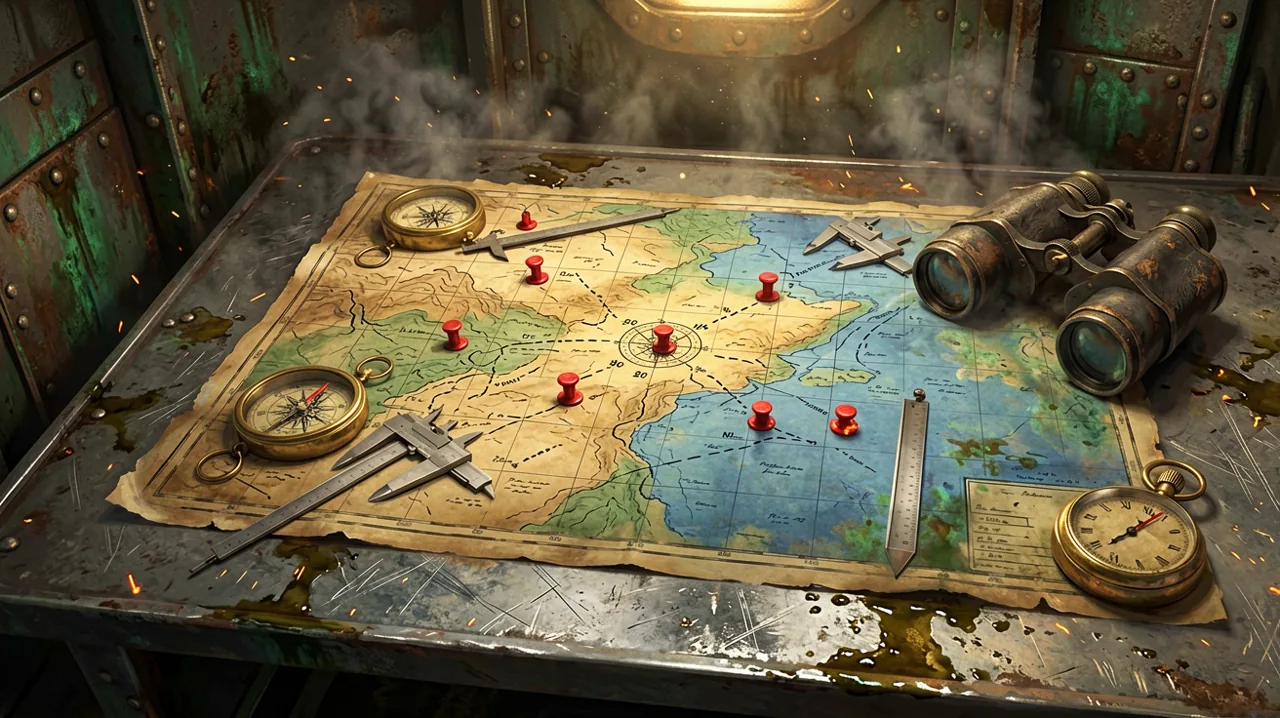
Because operators are blind to the active combat zone, they must construct a mental image of the battlefield entirely through abstraction and intelligence reports. The map table serves as your singular window into the conflict. It is a meticulously detailed, heavily worn topographical map where you must physically place markers, draw trajectory lines, and carefully interpret grid references. When a target request comes in, you are not scanning the horizon; you are studying contour lines.
Understanding the elevation difference between your firing position and the target coordinate is absolutely critical. A hostile battery located in a deep ravine requires a drastically different elevation setting and time-to-target calculation than a radar station situated on a high ridgeline, even if the flat linear distance is identical. This abstraction turns the chaos of warfare into a strict exercise in geometry and spatial reasoning.
The true tension of the game does not come from dodging enemy fire, but from the agonizing, silent wait after you pull the lever. The projectile is in the air for twenty to thirty seconds. You stand over the map, watching the brass stopwatch tick down, waiting for the radio operator to report the splash. The outcome is binary: either a satisfying confirmation of target destruction or the frustrating order to adjust your fire. Mastering this level of abstraction is the defining characteristic of a veteran gunner, a skill that requires patience and careful study of our reading-the-tactical-map documentation.
The Tactile Weight of the Machinery
Beyond the mathematics and the maps, the game excels because of its profound physicality. It is never enough to simply calculate the correct numbers; you must physically execute the entire sequence within the game’s incredibly immersive, highly interactive interface. The loading and firing loop is a deliberate, exhausting, and methodical process.
You must manually operate the heavy hoists to bring a shell up from the deep magazines. You have to carefully guide the massive projectile onto the loading tray, ensuring it is properly aligned. You must activate the pneumatic rammer to force the shell into the breech, followed by loading the correct number of propellant bags based on your required range.
The sound and visual design during this sequence are spectacular. The heavy clanking of iron chains, the sharp hiss of hydraulic valves releasing pressure, and the terrifying, solid thud of the massive breech block sliding shut all contribute to an atmosphere of immense industrial power. This physicality, which we have detailed extensively in our iron-nest-controls-and-interface breakdown, ensures that every single shot feels earned. When you finally grasp the firing lanyard and pull, the entire screen shudders violently, dust shakes loose from the turret ceiling, and a deafening roar completely overwhelms your headset. The satisfaction is visceral. The “fun” described by reviewers is not rooted in sadism; it is the pure, unfiltered joy of achieving total mechanical mastery over a terrifyingly powerful machine.
Conclusion
IRON NEST: Heavy Turret Simulator has successfully defined its own unique genre by merging the obsessive, granular detail of a hardcore simulator with the oppressive, heavy atmosphere of a dieselpunk war story. By confining the player entirely within the steel walls of a stationary turret and forcing them to interact with the broader conflict strictly through mathematics, topographical maps, and heavy industrial machinery, the two-person development team has crafted an experience that is equally intellectually demanding and mechanically thrilling.
The recent critical praise, which openly celebrates the unapologetic satisfaction of orchestrating massive destruction via complex calculations, demonstrates a strong audience appetite for games that refuse to hold the player’s hand. It is undeniably a grim setting, and the indirect actions you take are devastating in their scope, but the sheer reward of executing a flawless firing solution is profound. As you log in for your next shift in the battery, remember to double-check your barometric pressure, respect the sheer power of the breech mechanism, and always trust the coordinates from your forward observers. The heavy artillery awaits.