Beyond the Heavy Turret: Players Discover Extensive Cat Customization and an Unofficial Feline 'Hard Mode'
Community reports reveal an incredibly deep cat customization suite in Iron Nest, allowing players to create an unofficial hard mode by placing their feline on the tactical map.
The grim, grey alternate-history battlefields of Iron Nest: Heavy Turret Simulator are typically defined by the deafening roar of 5,000-ton artillery platforms, the suffocating smell of cordite, and the intense, high-stakes pressure of executing manual mathematics under fire. Developed by the two-person independent team of Nick Nieuwoudt and Dominik Latos, the simulator has captivated the PC and Steam audience with its uncompromising dedication to tactile, mechanical realism since its launch earlier this month. However, as players continue to push the boundaries of their massive dieselpunk war machines, a wildly unexpected and wholesome feature has taken the community discussion by storm.
While the developers teased the addition of a cat companion just days before the game’s release, early adopters are now discovering that the feline comes with an astonishingly deep customization suite. More importantly, players have uncovered a physical interactive element with this pet that creates what the community is affectionately calling an unofficial, self-inflicted “hard mode.”
The Unexpected Depth of Feline Customization
When operating a colossal heavy artillery installation, your primary concerns usually revolve around hydraulic pressure, barrel temperature, weather conditions, and ammunition logistics. The introduction of a companion animal was initially perceived by many as a simple, atmospheric addition—a small nod to the historical reality of trench cats and naval mascots meant to boost morale in bleak combat conditions.
According to recent community reports pouring in on platforms like Reddit, the implementation of this companion is anything but a mere cosmetic afterthought. Players have stumbled upon a customization system for the bunker cat that rivals the character creators found in massive, story-driven role-playing games. One active player humorously described the feature as having an almost absurd amount of customization sliders, highlighting the sheer shock of finding such an intricate pet system buried within a hardcore military simulator.
Reportedly, operators can tweak dozens of specific color choices for the cat’s fur, alongside an equally expansive wardrobe of different hat colors and styles to match your gunner’s aesthetic. But the mechanics go far deeper than simple color palettes. The sliders allow you to meticulously sculpt the feline’s physical characteristics. Players are reporting the ability to adjust the core head shape, modify the contours of the muzzle, alter the specific ear shape, and fine-tune the eye shape.
Perhaps most surprisingly, the community has highlighted specific sliders dedicated to adjusting the “chonkiness” or “thinness” of individual body parts. This allows players to create everything from a sleek, battle-hardened alley cat missing a patch of fur, to a hilariously overfed bunker guardian that looks like it has been eating the crew’s entire ration supply. Furthermore, players have noted a specific toggle that instantly reverts the companion into a kitten, drastically changing its size, audio cues, and physical presence within the dark corridors of the turret.
The Tactical Table: A Hub of Mathematical Warfare
To fully grasp why this highly customizable cat is causing such a wave of amusement and frustration in terms of actual gameplay, we must first look at how Iron Nest handles its core engagement loop. The game strictly refuses to hold your hand; there are no floating crosshairs, no automatic target locking, and no minimaps that instantly highlight enemies in bright red. Instead, every single shot fired from your massive gun requires a rigorous, manual mathematical process.
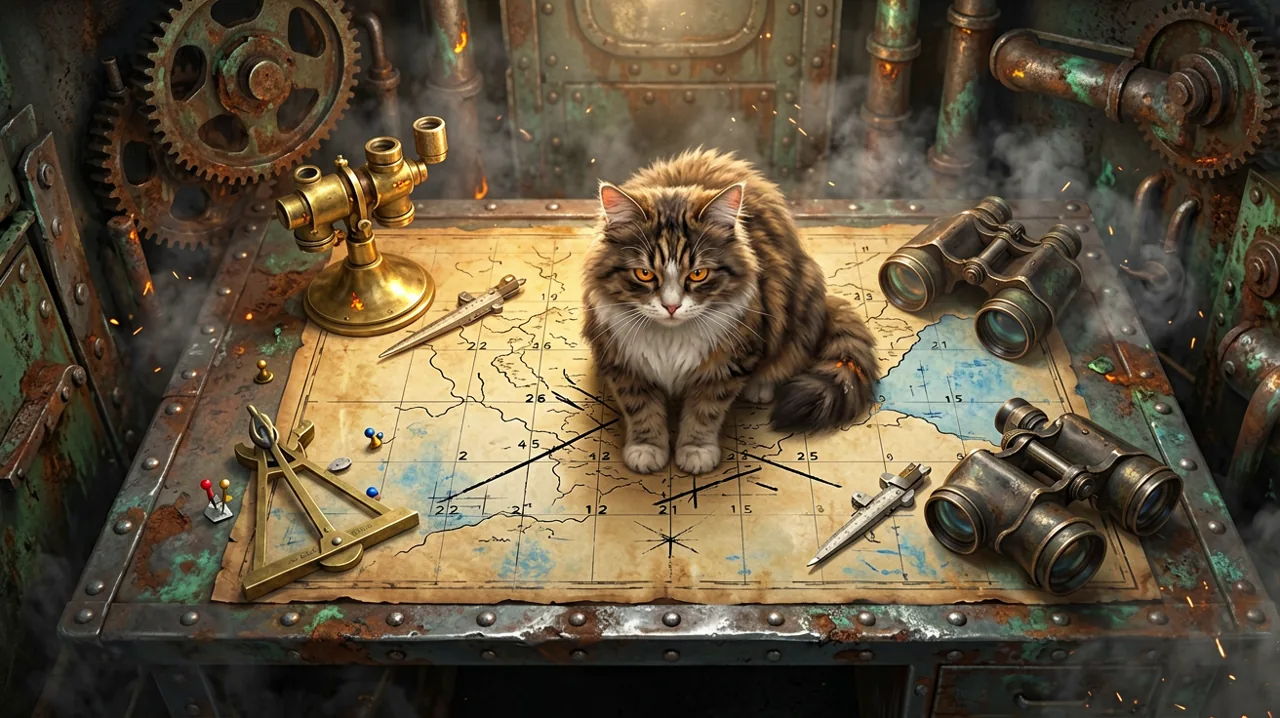
Your primary workstation inside the turret is the fire solution table. This physical, in-game desk is where you spend a significant portion of your time deciphering scout reports and reading the tactical map. The desk is a beautiful, cluttered mess of specialized tools: vintage brass compasses, grease pencils for marking coordinate lines, weather reports indicating current wind direction and velocity, and vital intelligence briefs.
When a spotter on the front lines radios in the position of advancing enemy armor across the coastal batteries or the industrial wasteland, you must sprint to this table and cross-reference their reported grid coordinates with your map. From there, you transition to utilizing your manual calculation tools. Mastering the intricate dials of the ballistic calculator is absolutely essential to ensure that your massive, expensive projectiles actually hit their intended targets. You have to physically dial in the range, factor in the current windage, and calculate the exact elevation and traverse angles for the massive gun barrels based on the weight of your selected ordnance.
Only after meticulously computing your first firing solution can you lock in the coordinates, sprint across the grating to the loading mechanisms, ram the shell home, and prepare to fire. It is a tense, highly stressful process where visibility and precision are paramount. Every line drawn on the map and every tiny number read off the brass dials can mean the difference between a direct hit that halts an enemy advance and a wasted shell that lands harmlessly in a muddy crater.
The Feline “Hard Mode”: Obscuring the Firing Coordinates
This brings us to the most brilliant, albeit chaotic, interaction players have discovered over the past week. The cat companion is not simply a static prop that paces idly in the background near the radiator. It is a fully physical entity within the game world, and you can pick it up with your hands.
Players have found that you can carry the cat around the interior of the turret and place it down in various designated spots. Unsurprisingly, one of those spots happens to be directly on top of the fire solution table.
According to extensive community feedback, when the cat is placed on the table, it doesn’t just sit politely in the corner out of the way. Instead, it sprawls out, often parking its meticulously customized, specifically “chonky” body right over the most critical grid squares of your tactical map. When you attempt to draw lines with your grease pencil to calculate the distance to an incoming target, the cat is physically in the way. It obscures the coordinates, covers up the terrain elevation lines, and makes it incredibly difficult to accurately read the map’s typography.
In a title where the official challenge modes task you with surviving relentless waves of enemies, managing extreme weather conditions, or operating with a damaged breech, the community has collectively decided that trying to compute complex trigonometry while a fluffy cat blocks your view is the true ultimate test of skill. Working around your pet to quickly determine firing coordinates has rapidly been dubbed the unofficial “feline hard mode.”
The Tactical Impact on Ammunition and Engagement
The interference caused by a resting feline on your workspace is more than just an entertaining visual gag for streamers; it has genuine, severe tactical implications for your survival. The rhythm of combat in Iron Nest relies heavily on the quick and accurate processing of geographical information. When an armored column is spotted approaching your sector, you must rapidly decide on the correct ordnance.
Selecting the appropriate shell—whether it be Armor Piercing (AP) to punch through heavy plating, High Explosive (HE) to deal with softer targets, or specialized shells like Smoke or Illumination—is a process covered extensively in our ammunition guide. Your choice of ammunition dictates the trajectory and the required charge bags. A heavy AP shell behaves very differently in the air compared to a lighter HE shell.
If your cat is sitting directly on the ballistic table, forcing you to guess the exact range or misread a coordinate by a few vital millimeters because a tail is in the way, your calculations will be inherently flawed. You might load an incredibly expensive, heavy AP shell, manually crank the massive elevation wheels based on a compromised reading, and watch through the periscope as the shell harmlessly overshoots the enemy armor by a hundred meters.
This introduces a hilarious layer of self-inflicted chaos to the simulator. When the radio crackles with an urgent request for fire support, you are faced with a terrible dilemma. Do you waste precious seconds picking the cat up and moving it back to its bed, or do you try to lean around it, squinting at the partially covered numbers to get a shot off before the enemy breaches your defensive line? Many veteran players on Reddit are actively choosing to leave the cat on the table, forcing themselves to memorize grid layouts and calculate estimates purely based on partial visual information.
A Masterstroke of Immersive Simulation
What makes this community discovery so fascinating is how perfectly it highlights the developers’ commitment to immersive simulation. In many mainstream games, a companion animal is purely a cosmetic overlay—a ghost that lacks collision or meaningful interaction with the game’s actual mechanical systems. By making the cat a physical object that can interfere with the physical tools of the simulation, the developers have heavily reinforced the tactile reality of the heavy turret.
The contrast between the grim, high-stakes nature of artillery warfare and the mundane, indifferent behavior of a housecat adds an incredible amount of texture to the game’s atmosphere. It constantly reminds the player that they are occupying a physical space, working with physical analog tools, and dealing with physical, everyday interruptions.
The wildly extensive customization options—allowing players to fine-tune the chonkiness, muzzle shape, and hat color—only serve to make the disruption feel more personal. When a critical shot is missed because you couldn’t read the map, it’s not just a generic game asset blocking your view; it is your highly specific, custom-built companion actively sabotaging your war effort.
Looking Ahead to Future Deployments
As the player base continues to experiment with Iron Nest: Heavy Turret Simulator in the weeks following its successful global launch, it is highly likely that we will see even more undocumented features and emergent gameplay interactions come to light. The community is already wondering if the developers will lean into this organic trend. Will we see official achievements added for successfully hitting targets at long range while the cat is parked on the table? Might future patches introduce new, unlockable outfits, or even more interactive zones where the feline companion can playfully interfere with the turret’s mechanics?
For now, commanders looking to test their skills in the most demanding conditions possible don’t need to look for a specific difficulty slider in the main menu. They simply need to boot up the game, meticulously sculpt their maximally-chonky kitten, place it gently on the tactical map, and wait for the enemy spotter reports to roll in.
It is a true testament to the game’s robust physical design that such a bizarre, heartwarming, and infuriating challenge can emerge completely naturally from the core mechanics. Stay tuned to the Iron Nest Wiki as we continue to document both the hardcore mathematical strategies and the delightful community discoveries that make this heavy turret simulator an unforgettable experience on the battlefield.