Turret Traverse and Gun Elevation
Manual laying of the 5,000-ton turret
How bearing, elevation, rotation time and independent gun state turn a calculated IRON NEST solution into physical weapon alignment.
A solution is only information until the machine physically matches it.
IRON NEST’s current official description advertises manual control of a 5,000-ton turret. It says operators haul the elevation wheel, watch the guns climb, and drag a heavy lever to rotate the structure. The machine does not spin instantly; skilled operators use rotation time to handle other tasks.
Traverse and elevation are related but separate. Traverse aligns the turret horizontally to a bearing measured on the map. Elevation aligns a gun vertically to an angle produced for a particular shell and propellant charge. A complete solution requires both states to match the active target.
Bearing becomes traverse
The tactical map provides a bearing from the current Iron Nest position to the accepted target point. That value defines horizontal alignment.
Do not confuse it with an observer bearing used to construct the target. A ray from Spotter 1 toward a target is not automatically the direction the turret should face. The tactical map system performs the final turret-to-target measurement.
After movement, measure again. The target may stay fixed while bearing from the new turret location changes.
Range becomes elevation through the calculator
Elevation is not measured directly from the map. Range, shell type and charge enter the ballistic calculator, which produces required elevation. The physical gun control must then be brought to that value.
Changing shell or charge requires a new elevation. Adjusting the wheel to an old value because the target appears similar creates a silent mismatch.
Record shell, charge and elevation as one labeled solution block.
Independent left and right state
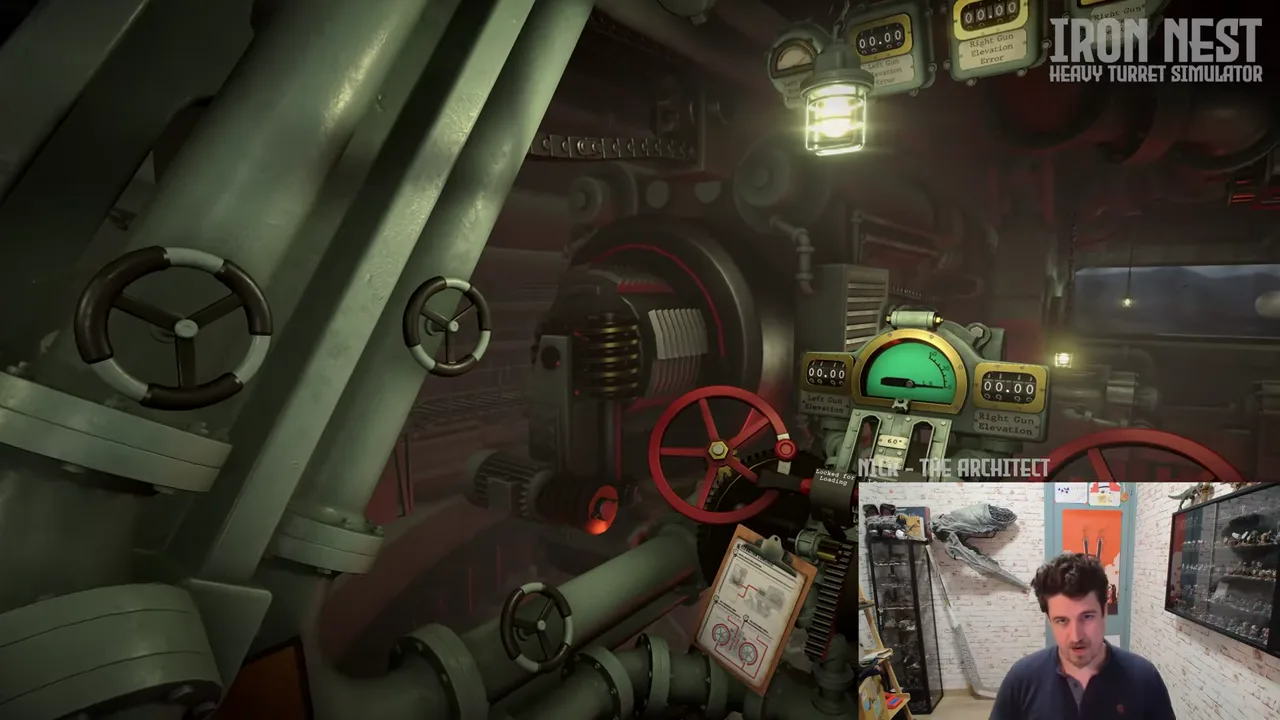
Official imagery shows separate left and right gun elevation counters and controls. That visual evidence supports independent verification even when the two guns share a target.
Do not assume changing one side automatically changes the other. Confirm which gun is loaded, which solution belongs to it and which counter you are reading. If a simultaneous-impact or twin-shot mission uses both, preserve a full state record for each side.
The page image shows why “the turret elevation” can be an oversimplification: two labeled gun controls coexist in the same station.
Rotation is a scheduling problem
The official description explicitly says a machine like IRON NEST takes time to swing and that skilled operators use the interval for other tasks. Rotation therefore belongs in mission planning, not merely aiming.
Estimate the direction and scale of the required move as soon as the target bearing is known. Begin rotation according to the current procedure, then use safe waiting time for calculator work, notes or another permitted station. Return before the bearing is reached so momentum or delay does not carry the turret past it.
The sources do not publish a fixed degrees-per-second value. Avoid permanent timing tables without current-build testing.
Coarse movement and final alignment
Large alignment changes and precise final settings have different goals. During coarse movement, reduce the distance to the target bearing efficiently. Near the target, prioritize readable final alignment.
The old page advised a universal “bearing first, then elevation” order. Current official sources do not mandate that sequence. Depending on controls and time pressure, tasks may overlap. What matters is that both final states are verified before firing.
Use the current machine’s indicators and tutorial rather than an assumed real-turret procedure.
Overshoot and machine response
Heavy machinery can have input delay or continued motion, but the public sources do not specify an inertia model. Official language emphasizes weight and time, while the exact stopping behavior requires build observation.
Approach the target value carefully and confirm the counter after releasing the control. If overshoot occurs, correct deliberately rather than oscillating around the mark. Record whether the error came from operator input or observable machine response before writing a general rule.
Do not publish a braking distance from one uncontrolled attempt.
Traverse during other tasks
Using rotation time productively does not mean abandoning the control without awareness. Choose tasks that can be safely interrupted and that do not create a new stale solution.
Good candidates include checking the order, confirming shell type, organizing target notes or preparing the calculator. Loading and interlock sequences may demand continuous attention depending on the current build.
Before leaving the station, note the target bearing and current direction. On return, verify actual bearing rather than assuming elapsed time equals a known angle.
Movement is not traverse
Turret traverse rotates the weapon around its current location. Repositioning moves the Iron Nest to a different location. The two actions have different consequences.
Traverse changes bearing state but not the map origin. Repositioning changes the origin, invalidating old range and bearing. Pre-release developer discussion also distinguished selected-location movement from emergency repositioning under counter-battery pressure.
See counter-battery and repositioning for the evidence-qualified movement rules.
Pre-fire laying checksum
Before firing, verify:
- The active target matches the objective.
- Bearing was measured from the current turret position.
- The turret’s actual horizontal counter matches that bearing.
- Shell and physical charge match the calculator solution.
- Required elevation was copied to the correct gun.
- The gun’s actual elevation counter matches the required value.
- Rotation and elevation mechanisms have settled.
- Loading and readiness state is complete.
This checksum connects geometry, calculation and machinery.
Diagnosing lateral misses
A shot that lands at roughly correct distance but left or right of the target suggests target construction, bearing transcription or traverse alignment. Recheck those before changing elevation.
Confirm direction convention and current Iron Nest position. Confirm the correct target marker was used. Then compare written bearing with actual turret bearing.
One lateral correction should test one cause. The miss troubleshooting guide keeps downstream corrections from hiding upstream errors.
Diagnosing short or long misses
Short or long error is less likely to be fixed by traverse. Check target range, shell type, charge, calculator output and physical elevation. Verify that the elevation was applied to the loaded gun.
A gun can point in the correct horizontal direction while carrying the wrong vertical solution. Twin controls make this especially easy to overlook.
Preserve the fired counters so the next observation can be compared with actual, not intended, settings.
Multi-stage target changes
When a new objective arrives, record current orientation before selecting the next order. Compare bearings and rotation cost alongside urgency, ammunition and confidence.
A nearby secondary target may be inexpensive to service; a large rotation can delay the primary objective. The primary and secondary objectives page treats bearing change as a real switching cost.
Archive old elevation even when the next target lies at a similar bearing. Horizontal similarity does not imply the same range or shell solution.
What the sources do not establish
Current public sources do not publish:
- fixed traverse speed or acceleration;
- a universal stopping-distance formula;
- mandatory ordering of traverse and elevation tasks;
- automatic synchronization of left and right guns;
- exact rotation penalties by mode;
- whether every upgrade changes laying speed.
These details require current-build verification.
The dependable conclusion
Manual traverse and elevation are confirmed core systems. The 5,000-ton turret takes time to rotate, creating an opportunity and a scheduling cost. Bearing comes from the current turret-to-target map line; elevation comes from the shell-and-charge-specific calculator solution.
Treat left and right gun states independently, distinguish traverse from relocation, use rotation time deliberately and verify actual counters before firing. A perfect written solution remains inert until thousands of tons of machinery physically agree with it.