From Dieselpunk Turrets to Superheavy 'Mechs: Why BattleTech Fans Are Flocking to Iron Nest
A recent Reddit discussion reimagining the Iron Nest turret as a BattleTech Superheavy 'Mech reveals why this gritty artillery simulator is capturing the attention of hardcore mecha fans.
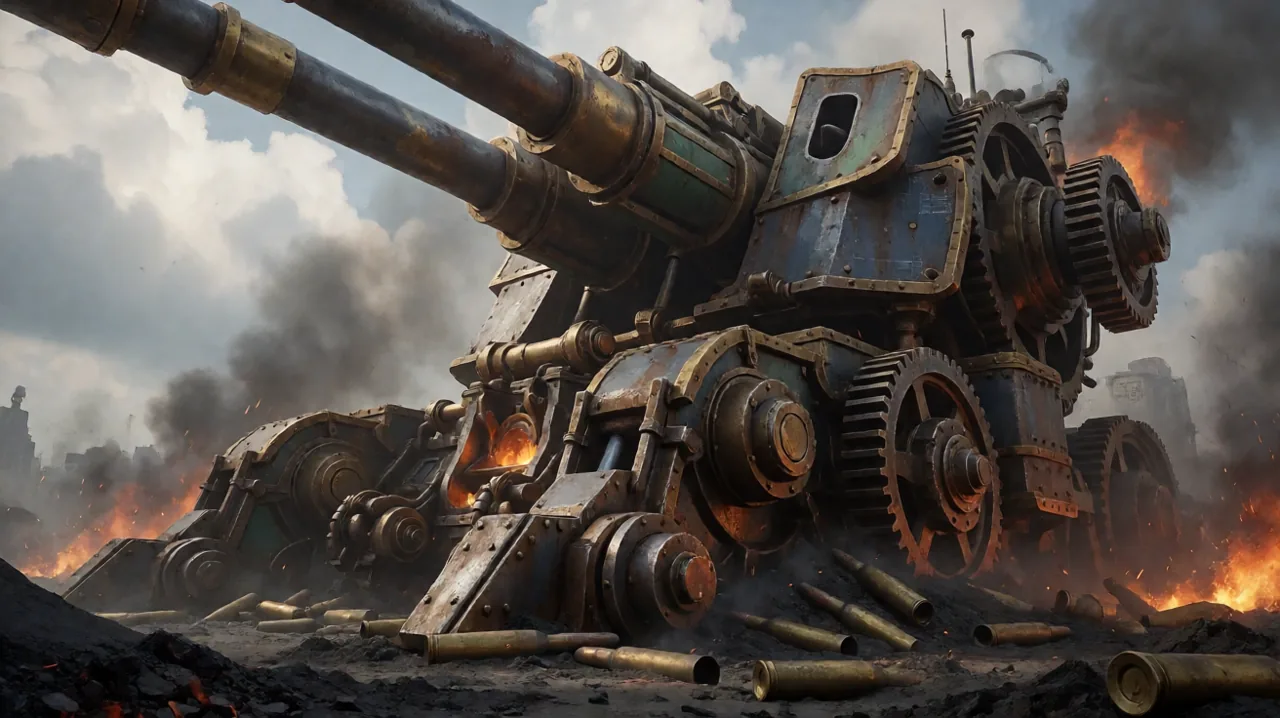
When two distinct but equally passionate hardcore gaming communities collide, the results are usually spectacular. IRON NEST: Heavy Turret Simulator, developed by the two-person independent team of Nick Nieuwoudt and Dominik Latos, has been making significant waves since its highly anticipated launch on PC via Steam (App ID 2950790). While the game is strictly a dieselpunk artillery simulator set in a grim, alternative-history Spanish battlefield, its deep mechanical complexity and sheer industrial scale are beginning to attract a completely unexpected audience: the tabletop wargaming and mecha simulation community.
Recently, a fascinating discussion erupted on the popular /r/battletech subreddit. User /u/Attempt_Gold posted a concept that immediately captured the imagination of the community: what if the massive, stationary gun emplacement from Iron Nest was internally redesigned to fit the BattleTech universe’s technology base as a Superheavy ‘Mech? The post specifically suggested outfitting this hypothetical titan with twin Long Tom artillery pieces, reasoning that it would perfectly fit the deep pockets of the Lyran Commonwealth or the monarchist grandeur of the Federated Suns.
This crossover thought experiment might seem unusual at first glance—one game is about manning a static bunker in a grimdark 20th-century war, while the other is about 31st-century walking tanks. However, when you look closely at the underlying gameplay mechanics, the obsession with heavy industrial machinery, and the punishing reality of complex firing systems, it becomes incredibly clear why mech aficionados are finding a comfortable second home inside the claustrophobic steel walls of the Iron Nest.
The Appeal of the Industrial Behemoth
For fans of giant robots, the appeal of Iron Nest begins with its overwhelming sense of scale. You are not playing as a fast, agile infantryman; you are a tiny cog inside a massive, 5,000-ton machine of war. The turret itself feels like an immobile Superheavy ‘Mech. The interior is a labyrinth of exposed hydraulic lines, massive brass gears, analog dials, and thick steel bulkheads. Every time the main gun fires, the entire structure shudders violently, kicking up dust and deafening the operator.
In games featuring heavy armor and walking tanks, players are accustomed to managing complex internal systems. Iron Nest strips away the mobility but magnifies the internal operation to an unprecedented degree. You must manually control the elevation cranks, monitor hydraulic pressure, and physically orchestrate the loading sequence. It is the ultimate realization of the “heavy metal” fantasy. The idea of strapping legs to this facility and walking it across a battlefield—as the Reddit community envisioned—is a testament to how aggressively powerful the turret feels to operate.
Furthermore, the game’s alternative-history dieselpunk aesthetic resonates strongly with the “used future” vibe of many traditional wargames. There is no sleek, magical sci-fi technology here. If a system fails, it fails because a valve burst or a gear jammed. This tactile, grounded approach to warfare is exactly what draws players to complex simulation titles in the first place.
The Mathematics of Destruction: Firing Solutions
The core gameplay loop of Iron Nest revolves around mathematics, patience, and execution. If you are familiar with calculating scatter tables, flight times, and indirect fire penalties in tabletop wargaming, you will feel an immediate sense of familiarity when calculating your first-firing-solution in this simulator.
You cannot simply point your crosshairs at an enemy and pull a trigger. Engaging a target requires a multi-step process that demands total concentration. First, you must identify the target’s coordinates. Then, you must utilize your rangefinder to determine the exact distance. But distance is only the beginning. The atmosphere plays a critical role in your shot’s accuracy. Operators must read analog meteorological gauges to account for wind speed and direction, which will dramatically affect the shell’s lateral drift over long distances.
Once these variables are known, the player must consult their ballistic tables or use the built-in mechanical calculators to determine the correct gun elevation and azimuth adjustments. This is not a fast process. It requires methodical precision. You dial in the exact degrees of elevation, lock the gears, double-check your windage compensation, and only then do you yank the firing lanyard. The satisfaction of watching a massive high-explosive shell arc gracefully through the sky and obliterate a target three miles away after two minutes of pure mathematical setup is unmatched. For those struggling to master the analog systems, reading up on our ballistic-calculator-guide is practically mandatory for survival in the later challenge modes.
Logistics and the Art of Ammunition Selection
Another major point of intersection between mecha combat simulators and Iron Nest is the critical importance of ammunition management. In a mech simulator, bringing the wrong type of autocannon ammunition to a firefight can spell disaster. Iron Nest amplifies this concept by giving you physical, manual control over a massive armory of different shell types, each with highly specific tactical applications.
Choosing the right round is just as important as aiming it. Players must familiarize themselves with the comprehensive ammunition-guide to effectively counter the varied threats rolling across the gray landscapes. The current arsenal includes:
- Armor-Piercing (AP): Heavy, dense kinetic penetrators designed specifically to crack open heavily armored vehicles, fortified bunkers, and opposing heavy artillery emplacements. They have a smaller blast radius but will punch straight through concrete and steel.
- High-Explosive (HE): The bread and butter of your artillery barrages. These shells fragment upon impact, creating a massive shockwave and shrapnel cloud. They are ideal for suppressing infantry advances, destroying light vehicles, and clearing wide areas of the map.
- Smoke Shells: Tactical rounds used to create massive screens of thick white smoke. These are essential for blinding enemy spotters, protecting allied movements, or forcing enemy armor to reposition out of their defensive lines.
- Incendiary: Devastating area-denial weapons that coat the impact zone in burning chemicals. Highly effective against entrenched infantry and unarmored convoys, creating lingering hazards on the battlefield.
- Illumination / Flares: Crucial for night operations. These shells deploy bright flares on parachutes high above the battlefield, stripping away the darkness and revealing enemy movements that would otherwise remain hidden from your optics.
The loading process itself is a deliberate, heavy task. You must operate the hoist to lift these massive, hundreds-of-pounds brass shells from the magazine rack, slide them onto the loading tray, ram them into the breach, and lock the massive steel door. Doing this under the pressure of incoming fire or a rapidly closing enemy convoy creates a frantic, sweat-inducing rhythm that fans of high-stress resource management absolutely adore.
Information Warfare: The Tactical Map
Finally, a heavy turret is completely useless if it doesn’t know where to shoot. Much like commanding a lance of mechs or a battalion of tanks, spatial awareness and intelligence gathering form the backbone of your success. Iron Nest does not hand you magical waypoints on a heads-up display. Instead, players must rely on reading-the-tactical-map—a physical paper map spread out on a table within the turret.
You receive target intelligence via radio chatter and reports from forward observers. You must translate these grid coordinates onto your map, use compasses and protractors to determine the bearing from your fixed position, and anticipate the movement of enemy armor columns. If a convoy is moving south at 30 kilometers per hour, you cannot aim where they are; you must calculate the shell’s flight time and aim where they will be in twenty seconds. This predictive, cerebral style of gameplay heavily rewards players who treat combat as a puzzle of logistics and geometry rather than a simple test of reflexes.
The fact that the BattleTech community is actively daydreaming about porting the Iron Nest design into their own universe is a massive compliment to developers Nick Nieuwoudt and Dominik Latos. It proves that the team has successfully captured the heavy, brutal, and mathematically beautiful essence of industrial warfare. Whether you envision yourself defending a grim Spanish coastline in the 20th century or bombarding a Clan invasion force from the cockpit of a 200-ton mechanical walker, Iron Nest: Heavy Turret Simulator delivers the complex, tactile artillery experience that hardcore simulation fans have been waiting for.