Repositioning, Turret Location and Regional Operations
Position changes across an operational campaign
Why the Iron Nest's current map position matters more than an assumed regional route, how relocation changes a firing solution, and what remains unverified about campaign travel.
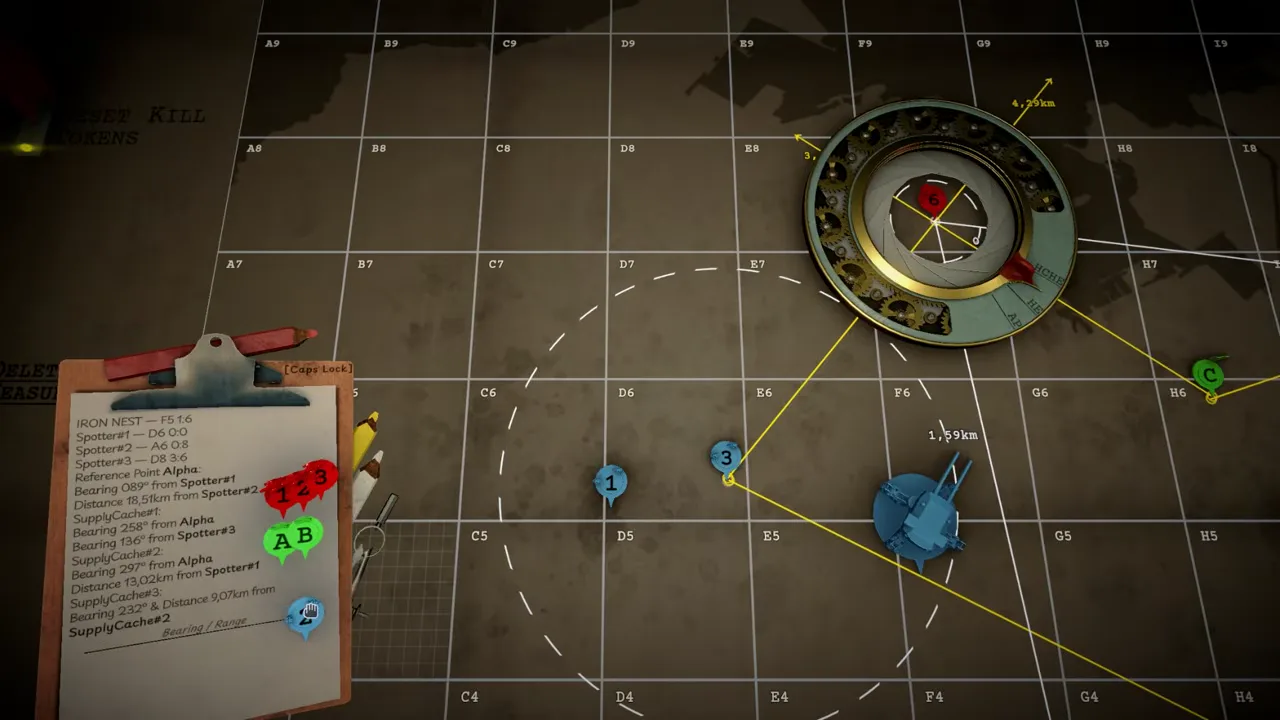
A campaign can change regions; a firing solution changes whenever its origin changes.
IRON NEST is marketed as a campaign across 15 regions, so it is natural to picture a journey from one theatre to another. The official public material reviewed here confirms the campaign scale and a map-based battlefield workflow. It does not publish a canonical travel route, a list of region transitions, a timetable for relocation, a menu of movement choices, or a region-by-region rule for when the turret moves.
That lack of a route map does not make position unimportant. It makes the current Iron Nest position more important. The turret is the origin for gun range and bearing. Whenever that origin changes, an old target point can remain correct while every gun-relative value derived from it becomes stale. This is a stable geometrical fact of the confirmed map-and-measurement workflow, independent of exactly how the campaign presents travel.
Campaign movement versus firing-solution movement
There are two different meanings of movement that should not be blended.
Campaign movement means passage between larger places, chapters, regions or operational contexts. The current public feature list establishes that the campaign includes 15 regions, but it does not document the route or the exact mechanics connecting them. A regional transition might be story-led, menu-led, mission-led, implicit, or some combination. Until a current source shows it, do not state which.
Firing-solution movement means that the Iron Nest’s position relative to a target changes. The target may be stationary in the world, but its range and bearing from the gun are no longer the same. The map must show or establish the turret’s current position before a new solution can be trusted.
The first is a campaign-research question. The second is an immediate operator discipline. A site can give useful advice about the latter without inventing the former.
The origin check after any position change
After a confirmed or suspected position change, do not begin by adjusting charge or elevation. Begin at the map.
First, verify that the Iron Nest marker or stated location is current. If the game presents a new coordinate, map icon, grid position, or other direct reference, write it down. If the current position is unknown, treat all old turret-relative measurements as untrusted.
Second, preserve the target record separately. Was the target an explicit coordinate, a bearing intersection, a distance construction, or a mission marker? If the target itself moved or the report changed, rebuild it from current evidence. If it did not move, retain the point but do not retain the old range and bearing.
Third, measure again from the new gun origin to the target. Record the new range and bearing, then pass range through the calculator and bearing through traverse. Reconfirm the active shell or task-card state before firing. The tactical map system gives the plotting procedure; the shell-change checklist protects the ammunition side of the handoff.
Fourth, use outcome evidence to validate the new chain. Aerial photos and the map’s persistent scars can help compare the intended point with the result. They should be read alongside the objective and current position, not as a substitute for them.
Why a precise old solution can still miss
Old solutions can feel persuasive because their numbers were carefully calculated. That precision belongs to the old geometry. The calculator may receive a perfectly entered range, charge and shell state while the measured range itself comes from an outdated turret origin. In that case the output is internally consistent and externally wrong.
This is why the recommended troubleshooting order starts upstream. Check the target construction, source reports, current Iron Nest marker, range and bearing before changing a downstream control. Aiming higher or selecting more charge to compensate for a stale origin can produce a second error that looks like a terrain or calculator problem. See why firing solutions miss for the complete diagnostic sequence.
The same principle applies to regional notes. A mission title may tell you where the story currently places the operator. It does not replace a current map measurement. Conversely, a precise grid point tells you where a local task is plotted but does not establish the name or sequence of the entire campaign region.
What the pre-release Q&A contributes
In the developer Q&A published before release, the team discussed movement and counter-battery concepts. That material is useful historical context for the intended pressure around changing position, but it predates the August 2026 version 1.0 release. It must not be read as a definitive specification of current movement behavior, timers, penalties, relocation methods, or mission triggers.
Use current official product text and current-build observation for such claims. If a player documents a release-build movement event, record the version, mode, prior marker, new marker, prompt or order text, and the before-and-after firing measurements. A single account of an emergency move can establish an occurrence in that context; it does not automatically establish a universal campaign rule.
This distinction is especially important because game development often changes sequencing, interface names and edge cases late in production. Pre-release statements can explain design intent, while released evidence determines the present-tense wiki.
A relocation field record
Use this evidence-oriented record whenever the game appears to move the turret:
- Capture the mission name, displayed location and build version.
- Record the previous Iron Nest position and active target point.
- Preserve the message, event or menu state that indicates movement.
- Record the new position exactly as shown, or explicitly mark it unknown.
- Measure fresh range and bearing to any continuing target.
- Record new calculator, traverse and shell-state inputs.
- Compare the outcome with the previous solution only after verifying target identity.
- Mark which observations are direct and which are interpretation.
This record is more useful than a hand-drawn regional route because it can be checked by another player in the same build. It also provides the foundation for future named-region pages if the game reveals the labels during travel.
Regional progression and operational continuity
The 15-region claim tells us that the campaign has breadth. The handcrafted-story and procedural-objective claims tell us that authored and repeatable content coexist. Neither source says that crossing a regional boundary resets every operational state, carries every target forward, or uses a fixed linear order. Do not infer continuity or discontinuity from the count alone.
For now, treat the gun station as the continuous operational anchor. Reports, map constructions, physical controls and outcome evidence are the common vocabulary across missions. A region can change the narrative and visual context while the operator’s core discipline remains: establish current position, plot the target from stated sources, measure from the gun, calculate, set, fire, inspect, and record.
The dependable conclusion
IRON NEST officially confirms a 15-region campaign but does not publicly document its route or a complete travel model in the reviewed sources. It does confirm a map-centered workflow in which the turret’s current position determines gun-relative range and bearing.
After any position change, preserve the target if it remains valid but rebuild the gun-relative solution from the new origin. Treat pre-release discussion of movement as dated design context, and let current interface evidence define specific behavior. This is how regional operations stay operationally precise without pretending the campaign map is more public than it is.