Physical Station Handoffs: Why IRON NEST Separates the Work
A mechanics analysis of IRON NEST's confirmed multi-station workflow: how reports, map work, calculation and gun controls create verifiable handoffs rather than one abstract aiming action.
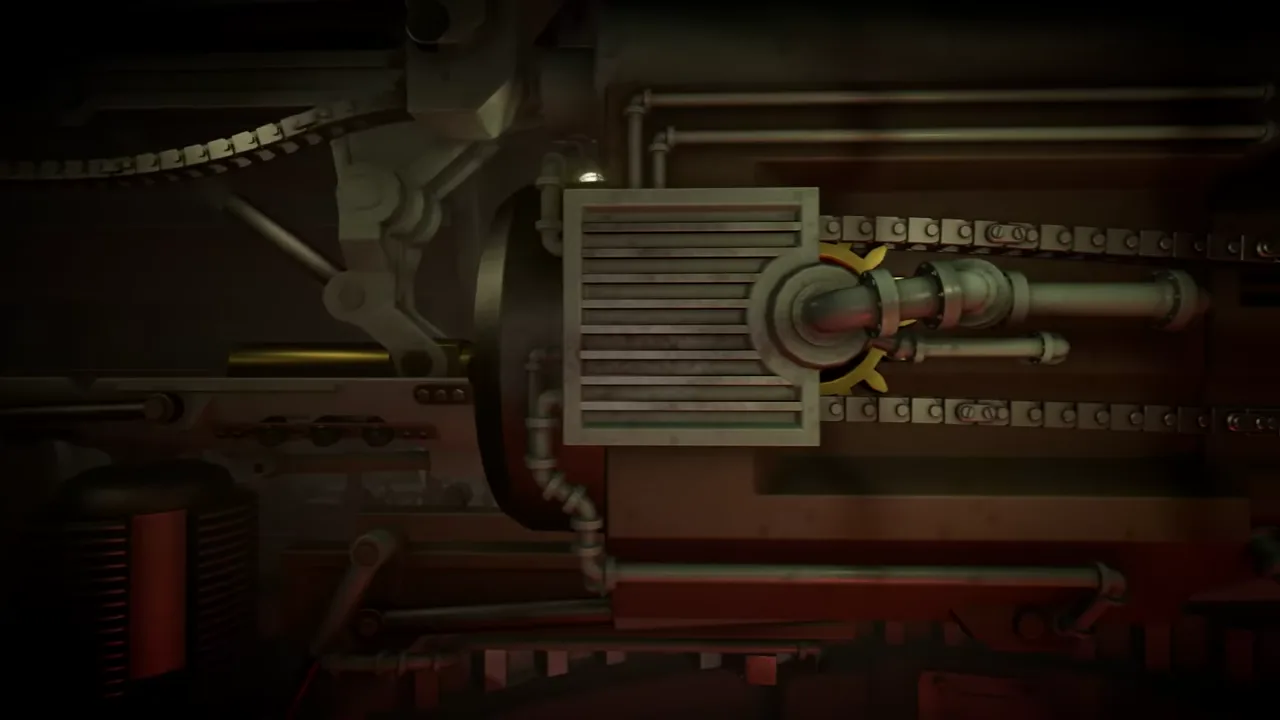
IRON NEST does not present artillery as a single aim-and-fire control. Its official description moves the player through an operator chain: teleprinters deliver information, an interactive map transforms reports into a plan, a ballistic calculator works toward a firing solution, charges and elevation are matched, and heavy controls rotate and fire the guns. The physical separation between these steps is one of the game’s central mechanics.
This page is not a claim that the game simulates every real artillery role or a full crew doctrine. It explains what the public workflow supports: each station receives a different kind of information, produces a different kind of output and gives the player a chance to validate or corrupt the transfer. The machine’s scale turns those handoffs into gameplay.
A handoff is a state change
At a station, you begin with one form of state and leave with another. The teleprinter gives a directive or observation in language. The map turns source-relative statements into a candidate target. The map then outputs gun-relative range and bearing. The calculator turns a clean range and shell state into an elevation-related result within the game’s toolset. Traverse and elevation controls turn numerical outputs into physical alignment. Firing produces an outcome that can be inspected through aerial evidence and map scars.
This chain is more than a thematic tour of props. It provides a way to locate mistakes. If the final shot is wrong, ask at which handoff the state became unreliable. Was a report copied incorrectly? Was a bearing plotted from the gun rather than the observer? Did the turret move after range was measured? Was a calculator value written down incorrectly? Did the gun readout match the note?
Each question belongs to a specific transfer. That is why the system can feel demanding but fair: it gives a result enough history to be investigated.
The teleprinter-to-map handoff
The official product page distinguishes High Command directives from frontline calls. These sources can present objective language, coordinates, bearings, distances or context. The map cannot use a message as raw atmosphere; the player must decide which parts identify a target and which parts identify the source of a report.
The key mechanic is provenance. A bearing is not “the direction to shoot” until you know whose bearing it is. A distance is not “gun range” until you know where it begins. The map therefore receives the report’s source alongside its number. If the source is lost during the handoff, the player can draw a plausible but false solution.
This makes note-taking or deliberate reading meaningful without requiring the game to publish a universal report grammar. The current interface defines exact formats; the official description defines why the information matters.
The map-to-calculator handoff
Once a target is accepted, the map can produce two different gun-relative outputs: range and bearing. Range is a distance. Bearing is an orientation. They should not be written in one unlabeled line or treated as interchangeable map facts.
The calculator receives range because the official page associates charges and elevation with trajectory. It does not receive the entire mission briefing. A calculator can make a correct relationship from a wrong range, so the map output must remain traceable. The ballistic calculator input mistakes page shows how an apparently valid calculator result can still be downstream of an incorrect construction.
This separation prevents a common conceptual mistake: assuming that the map already “aimed” the gun. The map establishes geometry. The calculator establishes part of the ballistic setup. The physical station still needs the outputs applied.
The calculator-to-gun handoff
The current official wording asks the player to match elevation with an exact propellant charge and to operate heavy controls that do not rotate the turret instantly. This gives the calculator output a physical destination. It must be copied or remembered, then verified against a visible control state.
The important mechanic is not an undocumented turning-speed figure or a specific animation duration. It is the delay and opportunity for cross-check. While a large machine moves, the player can compare notes, review an objective, prepare another state or recognize that the map origin has changed. The store copy even notes that skilled Operators use rotation time to handle other tasks.
That does not prove every task can be safely performed simultaneously. It supports a practical lesson: physical movement creates a window for verification, not a reason to abandon the information chain.
The gun-to-outcome handoff
The trigger does not end the loop. The official page says aerial photos reveal outcomes and that the map preserves scars even as markers move. The player can compare a shot with the intended target and objective rather than treating the firing animation as the sole feedback.
This is a new kind of state: not a number to enter, but evidence to inspect. A photo can show an outcome; it does not expose every internal variable, objective requirement or damage rule. Keep the result tied to the shot record. The after-action objective review page offers a method for doing so without claiming a hidden scoring model.
The outcome can produce a new message, a new target, a correction or a simple confirmation. The workflow then begins again, but with the previous action’s record available in the map and notes.
Why physical distance matters
If all inputs lived in one pop-up menu, a player could change them rapidly and forget why. By separating the stations, IRON NEST makes the transfer itself part of play. Walking, turning, carrying a note, looking at a dial and waiting for a mechanism all create small costs. Those costs make a premature assumption visible.
The game’s official marketing calls this “hands-on massive mechanisms.” The phrase does not tell us the exact internal simulation. It does establish an intended contrast with an abstract artillery interface. The operator is responsible not only for deciding to shoot but for preserving correct information across a physical room.
This is also why an ergonomic learning strategy works: do not memorize objects by visual location alone. Learn what each station accepts and what it outputs. A map gives geometry; a calculator gives a ballistic relationship; a gun executes orientation and elevation; an outcome view gives evidence. The layout can then be rediscovered even if the player changes input device or returns after a break.
A handoff audit card
Before firing, audit the chain:
- Do I know which source supplied each report value?
- Does the map target satisfy those values?
- Is the Iron Nest marker current?
- Are range and bearing separately recorded from gun to target?
- Does the calculator display the intended range and shell state?
- Do charge and elevation match the calculator output?
- Does traverse match the current bearing?
- Can I associate the coming outcome with this exact solution?
The card is not a fake tutorial script. It is a way to use the multi-station design as its own error checking.
The dependable conclusion
IRON NEST confirms a multi-station operator workflow. Its mechanics emerge from the handoffs: language becomes geometry, geometry becomes ballistic input, input becomes physical state and physical state becomes visible consequence. Each handoff can be checked, which is why a careful player can diagnose a wrong shot rather than merely retry it.
Learn the purpose of each station, preserve the outputs between them and treat physical distance as a cue to verify—not a penalty to bypass. That is the mechanical logic of operating the Iron Nest.