After-Action Review in IRON NEST: Read the Outcome Before the Next Order
A mission-review method for IRON NEST that connects a fired solution, aerial evidence, map scars and objective state without inventing a hidden damage or scoring system.
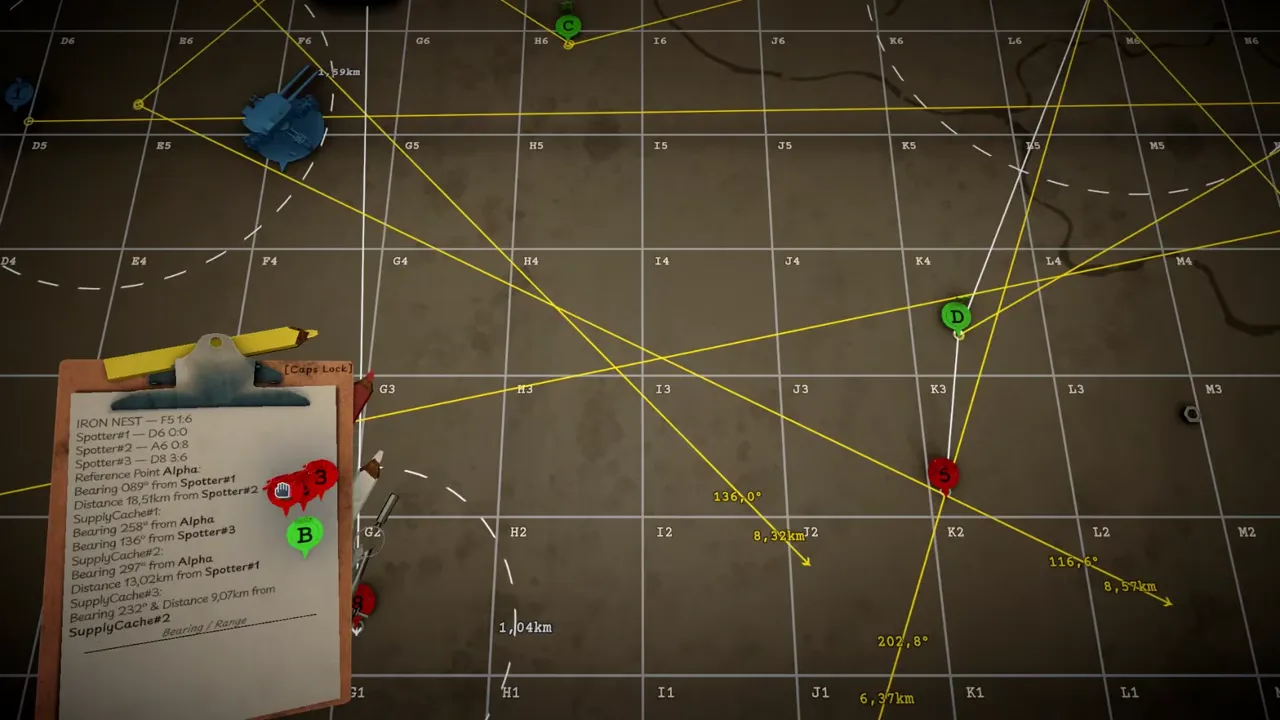
IRON NEST asks the player to live with the result of a firing solution. The official product description says aerial photos reveal the outcome of actions and that the map is a window onto the battlefield: markers can move, but scars remain. That is a powerful invitation to review what happened instead of immediately loading the next round.
An after-action review is not a demand to reconstruct a hidden damage simulation. The public sources do not publish universal blast radii, armor formulas, terrain deformation rules, score thresholds or objective-completion logic. It is a method for connecting the evidence you do have: the objective text, reports, plotted target, current turret position, selected state, calculator outputs, gun settings and visible result. When those records stay together, a miss, a partial result or a surprising outcome becomes something you can diagnose.
Preserve the shot before inspecting it
The review starts before you fire. Write down or retain the details that define the attempt: mission and objective text, target label, source reports, plotted point, current Iron Nest position, measured range, bearing, shell or task-card state, charge, elevation, traverse state and time of fire if relevant.
This is not paperwork for its own sake. An aerial image after the fact can be vivid but incomplete. Without the fired state, you cannot tell whether a visible result came from the intended target, an old marker, a changed gun origin or a different ammunition selection. A clear record lets you compare one attempt to another without relying on memory.
Keep the target point separate from the objective. A mission may require a specific effect, object, location, timing or follow-up rather than merely an impact near a grid coordinate. The exact mission interface defines its conditions; do not replace them with an assumed “destroy everything” goal.
Read the outcome at three levels
First, read the objective state. Did the game display completion, a changed instruction, a failure condition, a new report or no update? This is the strongest current signal about what the mission recognizes. Preserve its wording exactly.
Second, read the map and aerial evidence. Compare the visible outcome with the plotted target and nearby markers. Is the result near the expected point? Does a new scar, photo or status cue appear? The official page establishes that these features reveal consequences and retain marks; it does not tell us every graphical mark’s mechanical meaning.
Third, read the shot record. Compare the fired range, bearing, shell state, charge and elevation with what you intended. This lets you distinguish a possible execution error from a possible target-construction or objective-interpretation problem.
Do not collapse all three into “the shot looked good.” A visually close impact can miss an objective. An objective update can occur despite a photo that is hard to interpret. A correct target point can still be fired with stale gun-relative values.
Diagnose displacement before damage
If the result appears to be in the wrong place, diagnose location before discussing effect. Recheck the map construction: report sources, coordinates, bearing rays, distance centers, candidate intersection and current Iron Nest position. Then check range and bearing. Only after those are confirmed should you inspect shell, charge, elevation and traverse.
This order matters because a correct shell cannot fix a target that was plotted from the wrong observer. Similarly, increasing charge to “reach” a visible result may hide a stale range measurement rather than solve the problem. The tactical map plotting errors and ballistic calculator mistakes pages provide detailed upstream checks.
If the impact is consistently lateral, preserve that observation but do not declare a hidden drift or wind rule. First check bearing, map orientation and traverse. If it is consistently short or long, check current range, shell state, charge and elevation. A repeatable pattern is a question for testing, not a license to publish a new game constant.
Diagnose objective state separately
When an impact seems close but the objective remains incomplete, return to the exact directive. Did it name a target category, ammunition state, order of operations, time condition, second point or a later report? Was the visible object actually the specified target? Did the map reflect a new target after the shot? Does the game ask for confirmation or a follow-up action at another station?
The official material confirms a mix of handcrafted story and procedurally generated objectives. That tells us objectives can have broader structure; it does not tell us a fixed validation rule for every mission. Keep your conclusion local: “this observed objective did not update after this recorded shot.” Do not state “the game requires X” until the interface or repeated current-build observation establishes it.
This restraint is especially important for outcome photos. A photo can show damage, smoke or a scar without displaying whether a scripted or procedural condition has been satisfied. It is evidence, but not the entire referee.
Compare expected and actual state, not feeling
Use a simple table in your notes:
| Field | Expected | Actual |
|---|---|---|
| Objective | Exact directive | Current update or absence of update |
| Target | Accepted map point | Visible impact or aerial evidence |
| Turret position | Marker used for measurement | Current marker at time of shot |
| Range and bearing | Recorded outputs | Calculator and traverse state used |
| Ammunition and charge | Intended state | Visible/recorded selected state |
| Elevation | Calculator output | Gun readout at fire |
The table does not claim the game exposes every field in every mode. It gives you a way to show which comparison is missing. Missing evidence is a reason to observe again, not a reason to invent a precise explanation.
Make the next action one-variable smaller
After review, choose the smallest justified change. If the target construction is uncertain, rebuild it before changing ballistics. If target and range are clean but elevation was copied incorrectly, correct elevation without changing the shell. If the objective text changed, stop and record the new task rather than continuing to fire at the old point.
Avoid changing target, range, shell, charge and elevation together. A successful next shot would not tell you which correction mattered, and a failed next shot would create an even less interpretable record. Precision is not only a numerical property; it is a disciplined change process.
The store page’s language about consequences gives this method thematic force. The operator is not supposed to treat a shot as disposable feedback. The review makes the consequence legible, even when the game does not disclose every internal simulation variable.
An after-action checklist
Before accepting a result or repeating a shot, ask:
- What exact objective state did the game show?
- Which shot record produced this outcome?
- Is the visible result at the accepted target point?
- Was the target constructed from each report’s real source?
- Was the Iron Nest position current when range and bearing were measured?
- Did calculator, ammunition, charge, elevation and traverse match the record?
- Did a new report, marker or condition appear?
- What single variable is now justified to change?
This converts an emotional “that should have worked” moment into a question with evidence.
The dependable conclusion
IRON NEST officially confirms aerial outcome photos and persistent map scars, making review part of the operator loop. Use them with the objective state and your own fired-solution record. Do not assume a photo exposes a complete damage formula or that a close impact automatically completes the task.
Read outcome in layers, diagnose location before effect and change one justified variable at a time. A careful after-action review is how a firing solution becomes knowledge rather than a single irreversible guess.
Frequently asked questions
Does an aerial photograph provide a complete damage report?
No. Official material confirms that aerial photos reveal outcomes and map scars remain. It does not publish a universal damage, scoring or terrain-deformation specification.
My impact looks close. Why is the objective not complete?
Compare the exact objective state, target identity and shot record before changing ballistics. A visible impact alone may not prove that every required condition was met.