Propaganda, Dark Humor and the Voice of IRON NEST
How IRON NEST's official language combines High Command, censorship, propaganda and absurd machine-room details—and where interpretation should stop short of undocumented lore.
IRON NEST’s tone is not solemn military simulation all the way through. Its official product language pairs severe images—High Command orders, phosgene, artillery, consequences, destroyed landscapes and a spreading uprising—with deliberately absurd phrases: a customizable cat companion, a fully operational warhorn, “military-grade hearing loss” and an acknowledgement that “unauthorized thoughts” belong to High Command. The result is a dieselpunk voice that mixes intimidation, bureaucracy and black comedy.
That mixture is worth analyzing, but it is not a license to invent a complete propaganda apparatus or character history. The official sources establish the tone of the product page and the player’s relation to High Command. They do not publish every slogan, all faction doctrines, the exact meaning of every joke or a definitive outcome system. This page separates textual evidence from thematic interpretation.
High Command as a voice, not a complete dossier
The official description frames the player as an Operator receiving top-priority directives from High Command. It says a second teleprinter carries calls from the frontline and warns that every piece of information can determine an operation. The marketing copy asks whether the player will obey High Command and says the chain of command ends at the player’s fingertips, while consequences do not stay with the people giving orders.
These details support a clear reading of hierarchy. High Command is distant, authoritative and operationally influential. The player is close to the machine and bears out the physical act. Frontline information creates a second channel that can complicate a directive. This is enough to understand why the game’s language feels bureaucratic and morally uneasy.
It does not establish a full faction biography, named leadership, political program or automatic disobedience system. A reader can infer that the game is critical of remote command and propaganda; that is thematic analysis. They should not claim a specific choice tree, trial process or faction policy unless the current build or a first-party source shows it.
Censorship as presentation
The official Steam text describes a censored action involving phosgene and follows it with a line about witnesses. The typography of the censor bars is itself part of the presentation: it turns the product description into a voice that withholds and jokes at once. It signals that chemical violence is not being treated as neutral equipment flavor.
The strongest factual claim is narrow: the current official page names phosgene and uses censored language around its action. It does not explain the exact effect, target selection, duration, ethical branching or historical doctrine. The chemical-shell reference documents the evidence boundary. Do not turn a provocative marketing sentence into a complete mechanics specification.
The broader interpretation is still useful. Censorship can suggest institutional denial, propaganda, complicity or the gap between official language and damage. The map’s persistent scars and outcome photos provide a contrasting image: records can be hidden in text while visible consequences remain. That is a reading of the combined presentation, not an announced narrative algorithm.
Absurd objects in a brutal machine
The official feature list also advertises a customizable cat companion and a fully operational warhorn. Elsewhere it jokes about military-grade hearing loss and a coffee machine. These objects break the monotony of military procedure. They are not evidence that the setting is harmless; they make the machine room stranger by placing domestic, comic or boastful details beside artillery and command orders.
This is a familiar dark-comedy technique: the more sincerely an institution speaks in slogans, the more absurd its ornamental details can feel. A coffee machine can be a moment of relief and a reminder that the operator remains trapped at work. A warhorn can be comic bravado next to a weapon whose operation demands careful calculation. A companion animal can make the interior feel inhabited without proving a deep pet-management system.
The facts stop at the feature list and what the current build visibly allows. If the cat has customization options, record the specific menu and version. If the warhorn has a mechanical or narrative effect, test it. Do not fabricate buffs, penalties, names, dialogue or story consequences from a phrase chosen for tone.
Propaganda is also an interface problem
IRON NEST places information in teleprinters, maps, reports and newspapers. That design lets tone travel through the things the player must use to act. A directive can be authoritative before the player has verified it. A frontline message can provide a different perspective. A newspaper can turn aftermath into a mediated account. The game’s interface is therefore not only a control surface; it is a possible stage for institutional language.
This is not proof that all sources are unreliable or that every message is a deliberate lie. The official product text says information matters; it does not publish a deception percentage or a universal “trust no one” mechanic. The responsible player habit is simpler: preserve source provenance, compare constraints, plot carefully and distinguish what a report says from what the map establishes.
The teleprinter system and newspaper reports system discuss those confirmed roles. This lore page asks why the roles are thematically resonant, not how every mission adjudicates them.
Comedy does not erase consequence
The product page pairs its jokes with direct statements about consequences, aerial photos and landscape scars. It also says precision matters because paperwork and propaganda cannot erase guilt. That framing makes it unwise to read the humor as simple endorsement of the machine or its orders.
At the same time, readers should avoid substituting their own moral framework for a source-backed account of every outcome. The game may be satirical, critical or grotesque; a particular player may experience it differently. Use careful language: “the official copy frames,” “the presentation juxtaposes,” or “this suggests.” Do not state that the game forces a particular moral conclusion unless the source explicitly does so.
This approach gives the writing room to be intelligent without pretending that interpretation is telemetry.
A reading method for new lore fragments
When you find a phrase, prop or message, first ask what it literally establishes. Is it an item in a store feature list, a visible control, a mission instruction, a developer statement or a player report? Then ask how it is framed: earnest, censored, bureaucratic, humorous, threatening or contradictory. Finally, separate that reading from unproved details.
For example: “the official listing calls the warhorn fully operational” is a fact. “The warhorn functions as propaganda spectacle” is a plausible thematic reading. “The warhorn grants an intimidation bonus against a named faction” is unsupported unless current evidence shows it. Keeping all three levels visible makes a lore site credible.
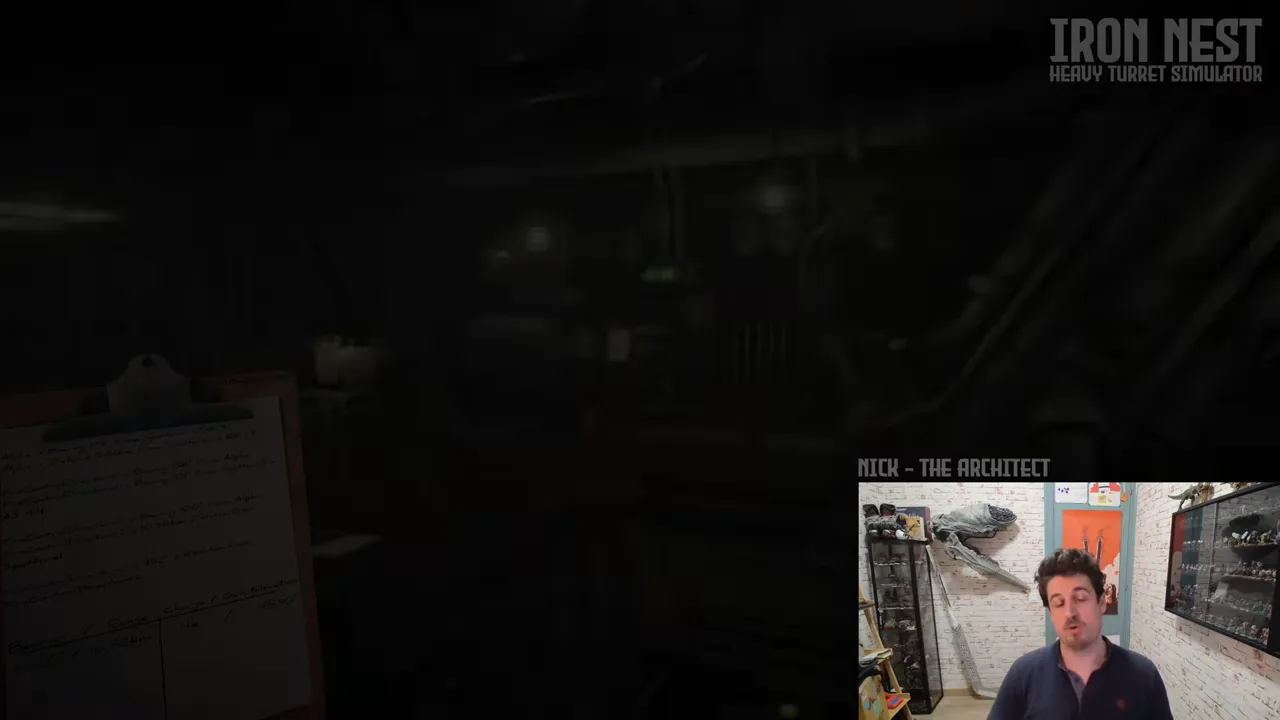
The official-video frame on this page is a credited illustration of the development and machine-workspace context. It does not reveal a character identity or a secret propaganda document. Its purpose is recorded in the image ledger so the image does not borrow authority it does not have.
The dependable conclusion
IRON NEST’s official voice combines High Command authority, censored chemical-war language, persistent consequences and deliberately comic feature-list details. This supports a strong thematic reading of propaganda, bureaucratic denial and dark humor inside a brutal operator fantasy.
What it does not provide is a complete lore dossier, fixed ideology chart or universal joke-to-mechanic conversion. Read the language closely, credit it accurately and let the current build establish what the cat, warhorn, reports or orders actually do. The tension between a ridiculous machine room and grave consequences is meaningful precisely because it does not need invented facts to make its point.
Frequently asked questions
Does IRON NEST officially explain every propaganda slogan or faction doctrine?
No. The product text supplies High Command framing and deliberately stylized language, but it does not publish a complete ideology manual, newspaper archive or universal branch chart.
Are jokes like the warhorn and hearing-loss line canon mechanics?
They are current official feature-list language. Their exact gameplay effects, if any, must be confirmed in the current build rather than inferred from the joke.