IRON NEST's 15 Regions: What Is Officially Confirmed
Campaign geography evidence record
A source-led record of IRON NEST's confirmed 15-region campaign scale, the names and terrain details that have not been published, and the standard for adding them responsibly.
Fifteen regions are confirmed; a public catalogue of fifteen names is not.
IRON NEST’s released feature list confirms that its campaign spans 15 regions. That is a useful, concrete promise of scale: the game is not presented as a single firing range or one fixed battlefield. It is a campaign set in an alternate-history version of late-1920s Spain, framed around a monarchy in power and a republican uprising. The official site and Steam page also pair that campaign with a handcrafted story, procedurally generated objectives, more than 100 unlockable medals, and a combined total of 30 ammunition types and abilities.
The same reviewed official sources do not publish a complete canonical list of all 15 regional names, their sequence, their real-world equivalents, or a terrain label for each one. That boundary matters. A plausible coastal front, a mountain district, an industrial basin, or a capital approach can make attractive fiction, but plausibility is not evidence that those are the game’s official region names or that they impose particular mechanics. This page records the confirmed part of the regional picture and the editorial rules used where public details end.
The confirmed campaign-scale claim
The current product listings explicitly advertise 15 regions. Treat this as a count of campaign geography or operational areas, not as a guarantee that every region has the same mission count, visual biome, objective pool, difficulty, unlock, or narrative role. Marketing numbers establish scale but rarely document implementation at that resolution.
The official setting language establishes the broad fictional context: late-1920s Spain in an alternate history, under a monarchy facing a republican uprising. It is appropriate to say that the 15-region campaign belongs to that setting. It is not appropriate to map an unnamed in-game area directly to a modern province, coast, mountain range, city, or historical battle without an explicit first-party source.
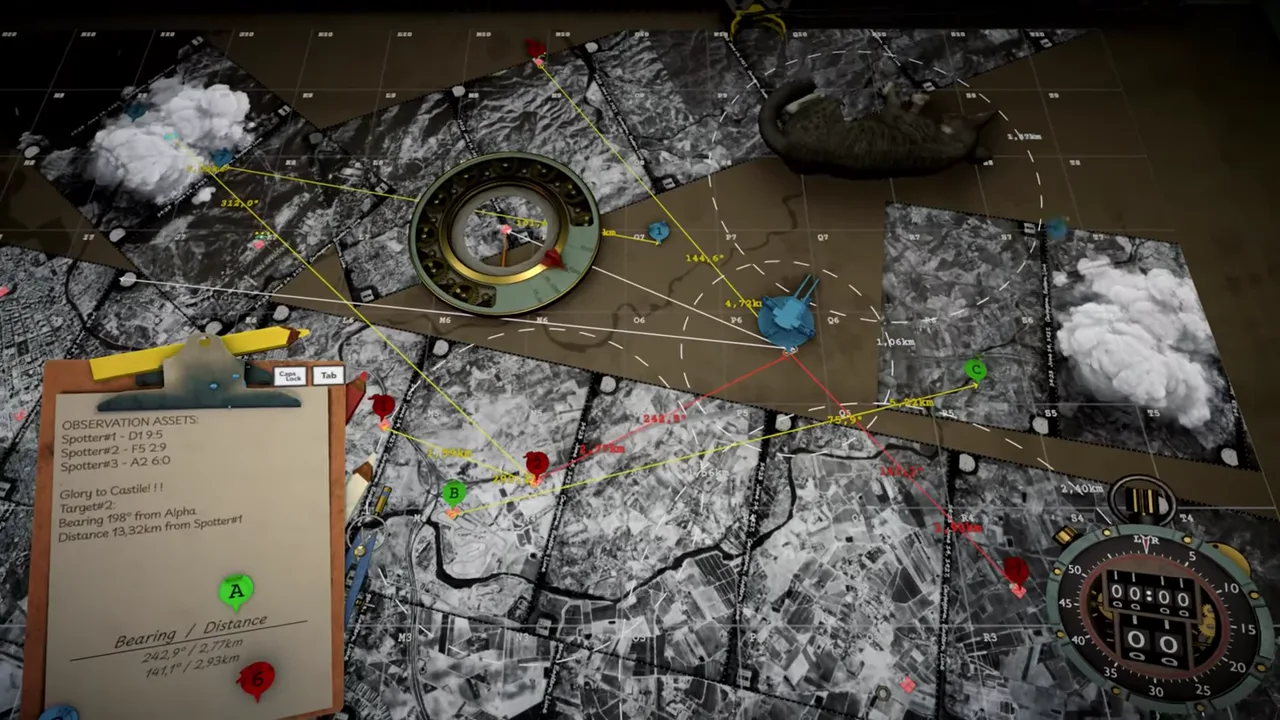
The launch trailer’s map imagery supports the existence of a map-centered operational workspace. It does not label fifteen regions in a way that can be transcribed into a catalogue. A marker, aerial photograph, target grid, or stylized landmass is evidence for interface and atmosphere; it is not automatically a proper noun or a campaign route.
What the sources do and do not identify
Current official text identifies several campaign-adjacent systems: manual control of a 5,000-ton heavy turret, a tactical map, teleprinter reports from High Command and the frontline, aerial photographs, ammunition and ability progression, medals, challenge modes, leaderboards, a handcrafted story, and procedural objectives. Together these features tell us that regions are part of a broader operational structure.
They do not publicly specify the following details in the material reviewed for this wiki:
- the canonical names of all fifteen regions;
- the order in which regions become available;
- an official terrain classification for each one;
- which missions, enemy formations, targets, medals, shells, or abilities belong to a specific region;
- whether a region is a literal geography, a chapter label, a theatre grouping, or a mix of those concepts;
- a public region-by-region campaign map.
Absence from these sources is not proof that the information is absent from the released game. It means only that this site has not verified it in an appropriate first-party source or recorded current-build observation. A player with access to a named region in version 1.0 can help establish it, but the record should capture the exact on-screen label, build date, mode or mission context, and a reproducible route to the screen.
Why the earlier named terrain pages were removed
Earlier versions of this gazetteer used labels such as a northern coast, Sierra highlands, a capital approach, an industrial basin, and southern plains. They were explicitly marked as expected, but their copy then described regional sightlines, shell choices, target types, movement, and narrative stakes as though those details were game rules.
Those pages had two problems. First, the names were not verified as official names. Second, terrain inference was allowed to become mechanics inference: a mountainous image became proof of high-angle rules, an urban setting became proof of a particular collateral system, and open ground became proof of mobile-target behavior. None of those follow automatically from the released feature list.
Replacing the pages does not make the campaign smaller or less interesting. It makes the reference more dependable. The new region pages discuss the documented relationship among position, map work, objectives, campaign scale, and verification rather than inventing a tour itinerary. When exact official names become available, each can receive its own focused page with evidence rather than inheriting a speculative placeholder.
An evidence hierarchy for regional claims
Use the following order when evaluating a claim about a region.
Current official product text is the strongest public source for broad facts such as the 15-region count and setting. It has priority over old promotional copy when the two differ.
Current official interface or released-build observation can establish an exact on-screen region name, its menu placement, and directly repeatable behavior. A useful observation records the version, location, player state, and any qualifiers. One screenshot of a map label does not prove its route, campaign order, or terrain effects.
Developer-owned pre-release video can document visible labels, visual direction, and stated development intent. It must retain its date caveat. The May 2026 Q&A, for example, is valuable for understanding the team’s story ambitions, but it predates the August 2026 launch and cannot override current release material.
Historical and geographic context can explain why an alternate Spain setting evokes certain questions. It cannot verify a fictional region name, a map boundary, or an in-game mechanic. The setting deliberately diverges from history, and the Iron Nest itself is a fictional 5,000-ton turret.
How to add a future named-region page
A future page should begin with the exact visible or officially written name. Preserve capitalization, accents, punctuation, and any parenthetical qualifier. Cite the source at the moment the name appears. If the evidence comes from a current build, state the build and how the reader can verify it; if it comes from an official article or video, link the precise page or timestamp.
Then distinguish three layers. The first is identity: the name, campaign placement if shown, and stated setting. The second is presentation: visible map art, weather, architecture, or briefing language. The third is mechanics: only rules that can be observed repeatedly or explicitly described by the developer. A valley-looking background should remain presentation until the game or source confirms that elevation, line of sight, target availability, or ballistic calculation responds to it in a defined way.
Every page also needs a unique credited frame from a public video on the developer-owned IRON NEST YouTube channel. The frame is an editorial illustration, not evidence for more than it visibly shows. Its video URL, title, channel, timestamp, capture date, and purpose are retained in the image ledger.
Reading the number responsibly
Fifteen regions suggests variety, but it does not prescribe how players should expect variety to arrive. The campaign could use different objective combinations, briefing contexts, map locations, story beats, visual themes, or progression gates. The official listing separately advertises handcrafted story and procedurally generated objectives, which is evidence that authored and repeatable structures coexist. It is not evidence that a particular region always contains a particular objective or that a procedural task is exclusive to one terrain type.
The best way to use the number as a player is practical: expect a campaign broader than the demo’s immediate slice, preserve mission notes by their actual displayed location, and avoid relying on unofficial route lists when deciding what unlocks next. Use the mission structure reference for the distinction between authored and procedural content, the abilities and progression reference for the separately advertised medals and combined ammunition/ability count, and the rest of this gazetteer for evidence-led context.
The dependable conclusion
IRON NEST officially confirms a campaign across 15 regions in an alternate-history late-1920s Spain. The reviewed public sources do not provide a complete authoritative list of those regions or their mechanics. That is a precise result, not a missing answer.
This wiki therefore records the 15-region claim, refuses to turn evocative scenery into a canon name or rule, and supplies a clear path for future additions. When a regional label or behavior is verified, it can be documented with an exact source, current context, a distinct credited official-video frame, and a claim no broader than the evidence allows.