IRON NEST Patch 1.0 (1547) Deployed: Localization Fixes, Launch Bugs, and Early Ballistics Meta
Reviewing the first post-launch patch for IRON NEST: Heavy Turret Simulator, emerging startup bugs, and how the community is mastering manual ballistics.
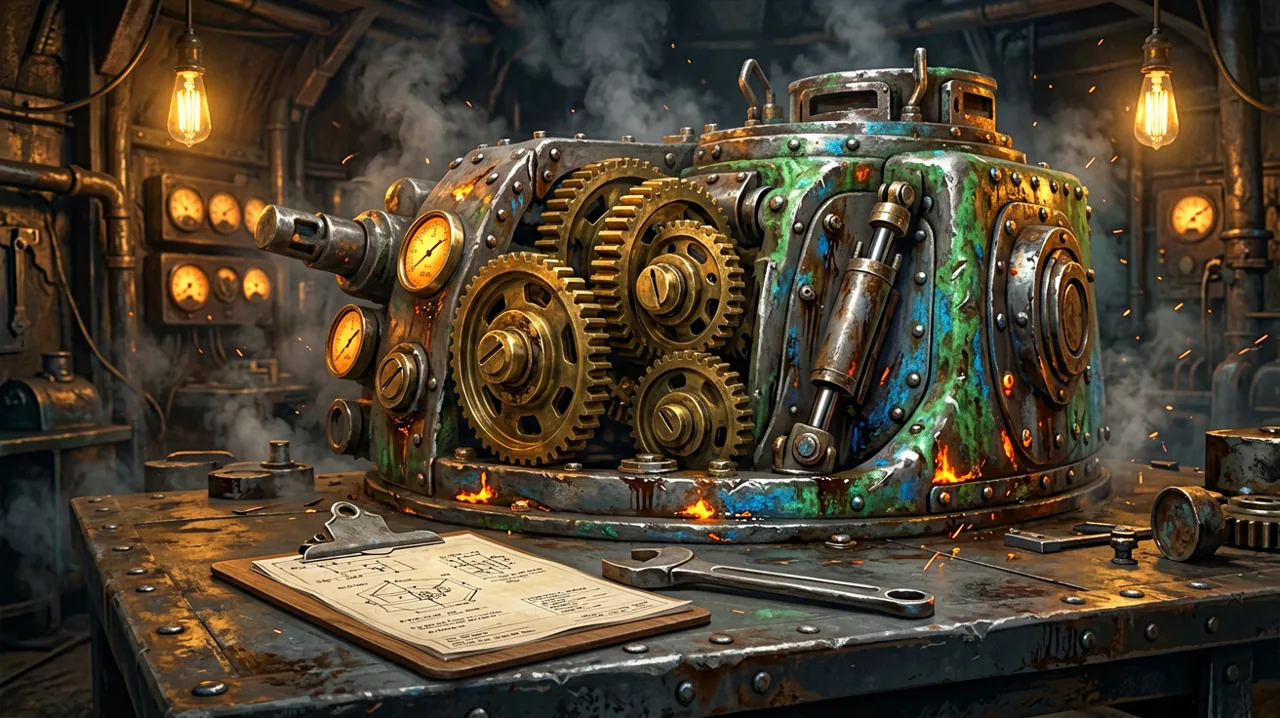
The opening bombardment has commenced, and the frontline reports are pouring in. IRON NEST: Heavy Turret Simulator launched yesterday to massive community reception, holding an overwhelmingly positive rating as thousands of virtual operators took control of their 5,000-ton dieselpunk artillery installations.
PCGamesN accurately described the core gameplay loop as treating “organization as a deadly skill.” You aren’t just clicking on a screen; you are managing a massive industrial machine, hauling heavy munitions, calculating complex firing solutions, and trying to maintain order amidst tactical chaos. The two-person development team, Nick Nieuwoudt and Dominik Latos, have been monitoring the launch closely. Today, they released the very first reinforcement to the frontlines: Patch 1.0 (1547).
This early update focuses on smoothing out the abrasive edges of the user experience, fixing critical mission intel bugs, and addressing some bizarre UI anomalies. At the same time, the community is already producing advanced strategy documentation and identifying a few lingering technical issues that require attention. Here is a complete breakdown of what you need to know on day two of deployment.
Patch 1.0 (1547) Breakdown: Fixing Intel and Interactions
In a game where missing a single coordinate number means dropping a high-explosive shell on an empty hillside rather than an enemy bunker, readable mission intel is non-negotiable. Patch 1.0 (1547) primarily targets critical localization errors that were entirely breaking the mission intel interface for certain languages.
According to the official Steam News dispatch, Czech and French localization errors have been squashed. Prior to this patch, operators utilizing these language settings found their incoming field reports completely garbled or entirely missing, making it mathematically impossible to chart targets on the tactical map.
Beyond the critical intelligence fixes, the developers addressed several highly specific, immersive-sim style interaction bugs. One of the primary fixes involves the newly introduced feline companion. Operators reported that the tooltip indicating how to drop the cat would permanently stick to the screen if the player looked away at other interactables inside the turret, cluttering the HUD. This has been resolved, allowing you to safely deposit your morale-boosting companion without permanently blinding your peripheral vision.
Another severe interaction bug involved the turret’s coffee machine—a vital piece of equipment for those long, dark nights waiting for spotter reports. Trying to interact with the coffee maker in specific, edge-case scenarios was forcefully returning players to the main menu. The developers have patched this out, ensuring your caffeine intake no longer aborts the mission.
Additionally, an issue with the pause menu submit button failing to respond under certain conditions has been corrected, alongside a fix for the High Tide mission, which was previously granting players duplicate newspapers and records upon completion.
The developers emphasized that this is just the beginning. “High Command is here for the long campaign, with frequent updates, patches and reinforcements,” the official post stated, urging players to continue routing their feedback through the dedicated Steam Community Hub threads.
Known Issue: The “Black Screen on Startup” Bug
While Patch 1.0 (1547) stabilized the intel system for French and Czech players, a different localization-related issue seems to be actively preventing some operators from even entering the turret.
Multiple reports have surfaced on the community subreddits regarding a severe startup crash. One notable report from Reddit user FireLion_FL_002 detailed an experience that seems to be affecting players using the German translation. After downloading the full release (following hours of flawless performance in the demo), the game presented a German translation popup right after the initial boot sequence. At this screen, all interactions ceased functioning. The “Weiter” (Continue) button became unresponsive, eventually leading to a hard black screen.
This issue is entirely community-reported and has not yet been confirmed as patched by the development team. Based on current reports, it appears deeply tied to the initial startup localization check. If you are experiencing this exact black screen sequence, the current community workaround is to temporarily force the game’s language properties to English via Steam before launching. Once past the initial boot sequence, you may be able to switch back, though operators are advised to monitor the official channels for a permanent hotfix.
Despite these isolated startup hitches, general performance reports are remarkably strong for an indie release of this visual fidelity. Benchmark testers on Reddit are reporting stable 4K 60fps performance on mid-range hardware like the RTX 3060 during the chaotic Mission 1 sequences, proving that the underlying dieselpunk engine is incredibly well-optimized.
The Academic Artillery Meta: Community Ballistics and Gold Medals
With the technical fixes rolling out, the hardcore simulation community is doing what it does best: turning math into a weapon. The core loop of IRON NEST is brutally tactile. You do not get an arcade crosshair. You get a map, a compass, wind gauges, and a massive set of elevation dials.
Less than 48 hours after launch, comprehensive manuals are already appearing across community forums. Threads dedicated entirely to manual aiming and ballistics are trending, breaking down the exact required mil-dot adjustments needed to compensate for sudden crosswinds over coastal terrain.
For new players struggling to translate raw map coordinates into actual turret movement, understanding the fundamental mechanics of the ballistics calculator is essential. It is highly recommended to consult our ballistic calculator guide before attempting the later scenarios. Reading the wind speed and direction is only half the battle; knowing how your chosen munition will behave in the air is the real challenge.
A heavy Armor-Piercing (AP) shell travels differently than a standard High-Explosive (HE) round due to weight and velocity disparities. Dropping a smoke screen or an incendiary payload requires different elevation math entirely. The community is currently compiling massive spreadsheets detailing the exact drop rates for all shell types at maximum ranges. If you are still trying to land your opening shots, checking out our walkthrough on securing your first firing solution will save you a tremendous amount of wasted brass.
Beyond just hitting the target, the community is fiercely competing for operational efficiency. Threads detailing the exact requirements for Gold Medals on every mission are circulating. Securing a Gold Medal in IRON NEST is an exercise in absolute perfection. It reportedly requires lightning-fast manual loading times, flawless interpretation of the tactical maps (avoiding any and all civilian casualties), and a 100% hit rate with zero wasted ammunition.
Players are mapping out the exact physical pathing required inside the turret to shave seconds off their reload times. Moving the heavy shells from the rack to the breech is a physically modeled action; learning how to optimize your movement around the hydraulic pistons and gear shafts is separating the average gunners from the Gold Medal operators.
A Strong Opening Salvo
The launch of IRON NEST: Heavy Turret Simulator has clearly struck a chord with simulation enthusiasts and strategy fans alike. The immediate deployment of Patch 1.0 (1547) demonstrates that the developers are closely monitoring the operational theater. While a few stubborn launch bugs—like the German localization black screen—remain a hurdle for a subset of players, the overall stability and performance are commendable.
The coming weeks will likely see further refinements to the user interface, deeper balancing of the ballistics model, and potentially more content. For now, the community is fully occupied with mastering the heavy machinery they have been given. Check your dials, read your intel carefully, and keep your coffee machine far away from your tactical maps.