The Cat Companion and Warhorn: What the Feature List Actually Says
A source-led reference to IRON NEST's customizable cat companion and fully operational warhorn: confirmed official feature wording, tonal role and the gameplay details that remain unverified.
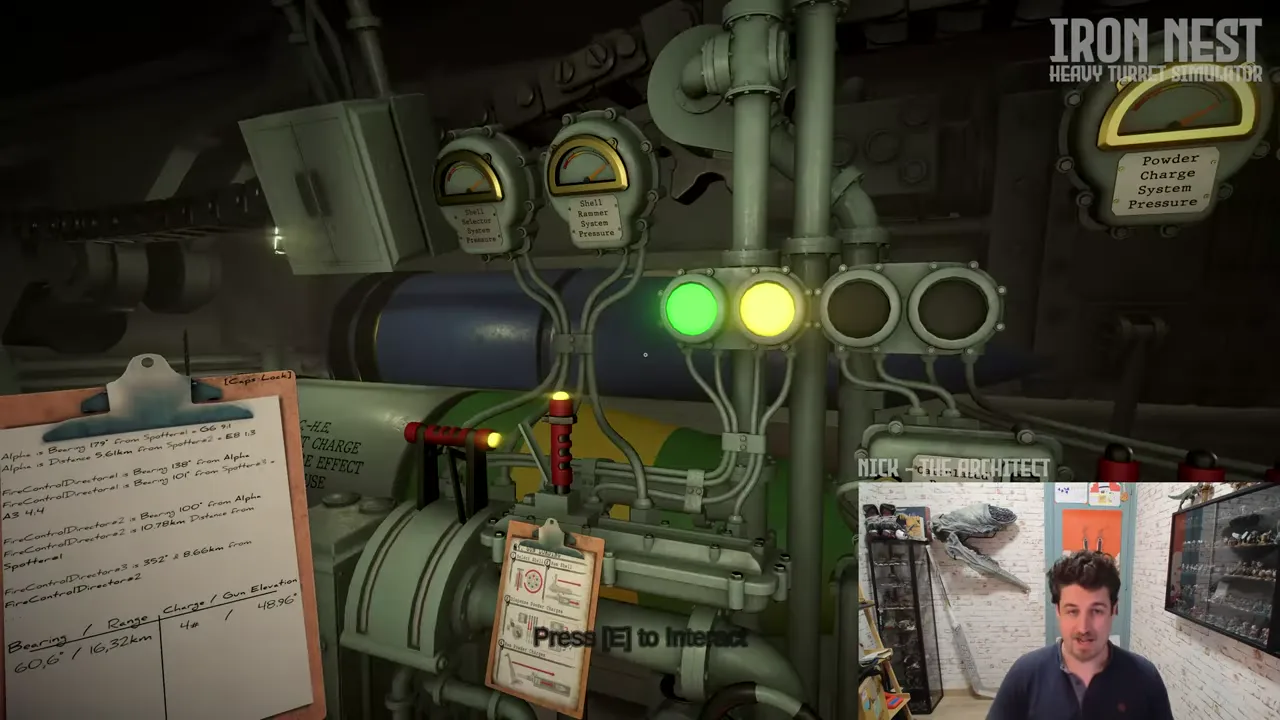
Among IRON NEST’s artillery, reports, map scars and heavy machinery, the official Steam feature list also promises a customizable cat companion and a fully operational warhorn. These two phrases are easy to repeat as jokes, but a useful reference needs to state exactly what they confirm and where the evidence stops.
The current product text confirms that the cat companion is customizable and that the warhorn is operational. It does not, in the reviewed public material, publish the cat’s name, a complete customization menu, behavior system, pet mechanics, a list of warhorn effects, a cooldown, an enemy-response rule, a story branch or an achievement trigger. Those details should remain unknown until the current build or a first-party source demonstrates them.
This page explains why the features matter as tone and operator-space design without turning marketing language into an invented system guide.
The confirmed facts
The official Steam page lists “Customizable Cat Companion” and “Fully Operational Warhorn” among IRON NEST’s features. The wording is clear on two points. The companion has at least some form of customization in the game’s advertised feature set. The warhorn has an operation, meaning it is presented as more than background decoration.
The wording does not state a count. We do not know how many cat appearance options exist, whether they unlock over time, whether the companion can be named, whether it appears in every mode, whether its behavior changes or whether it is a narrative character. We do not know whether the warhorn produces a sound only, changes another state, is available in every mission or interacts with objectives.
The correct wiki language is therefore simple: “the current official feature list advertises…” Anything more specific requires an exact current interface observation or official explanation.
Why these objects fit the operator space
IRON NEST’s central setting is an enclosed, manually operated war machine. The official text emphasizes physical controls, a coffee machine, teleprinters, maps, calculations and a turret that takes time to move. A companion animal and a warhorn make that space feel less like a generic cockpit and more like a workplace with rituals, comforts and absurdities.
This is an interpretation of the game’s presentation. A cat can signal domesticity inside an industrial interior; a warhorn can signal theatrical bravado. Together they sit beside lines about military-grade hearing loss, propaganda and consequence. The juxtaposition creates a distinctive dieselpunk voice: the machine is both intimidating and weirdly lived-in.
It does not prove that the cat is a morale system or that the horn changes combat. The tonal role can be discussed without promoting a mechanical effect.
Customization is not automatically progression
Players often see the word “customizable” and infer a reward track, collection system or paid cosmetic model. The feature list alone does not support any of those claims. Customization can be a selection screen, an unlocked option, a simple starting preference or another current-build implementation.
Do not connect cat appearance to medals, achievements, regions or challenge performance without direct evidence. The game separately advertises 100+ medals and 33 Steam achievements, but those numbers do not identify the cat’s options or their conditions. See Steam achievements and medals for why separate systems should not be merged.
If you encounter a cat-customization interface, document the exact screen, options, build version, mode and whether any prerequisite appears. A single screenshot can prove visible options in that context; it cannot prove that the list is exhaustive or that every player unlocks them the same way.
Operational does not mean tactically powerful
“Fully operational warhorn” is deliberately playful wording. It tells a player that the horn is intended to be used or activated. It does not tell us how its output is evaluated by the game. A sound effect can be operational as an interaction while having no tactical impact. A current mission can also restrict or contextualize an interaction in ways a feature list does not enumerate.
For a reliable test, activate it in a safe current-build context and record what the game visibly or audibly does. Check whether an interface field, objective, message or cooldown changes. Repeat in another appropriate context if possible. Report only what the evidence shows: “the horn plays an audible effect in this version,” for example, not “the horn distracts enemies” unless the game explicitly demonstrates that response.
This is the same evidence discipline used for ammunition and map mechanics. A memorable label deserves a memorable source record, not an imaginative effect table.
Humor and consequence coexist
The cat and warhorn do not cancel the rest of IRON NEST’s framing. The official product page also speaks of High Command, frontline messages, phosgene, aerial outcomes, map scars and guilt that paperwork or propaganda cannot erase. The game is capable of placing an absurd object next to a serious consequence.
That mix is why the features are worth documenting in lore rather than treating them as trivia. The companion and horn help define the texture of life inside the Iron Nest. They create small forms of personality and ritual in a setting built around orders and impersonal firepower. This does not determine how every player will interpret the tone, but it is a defensible reading of the official language.
The propaganda and dark humor reference places these objects alongside the wider feature-list voice. It remains important, however, to distinguish a thematic reading from a claimed game rule.
A safe documentation template
For future cat or warhorn discoveries, record:
- the exact in-game label and current build;
- where the object or customization screen appears;
- available options visibly listed at that moment;
- input/prompt required to interact;
- observable audio, visual, UI or mission effect;
- mode, mission and any prerequisite;
- what remains untested.
This template helps the wiki grow from a correct official feature claim to a current build reference. It avoids a common problem in game wikis: a funny marketing bullet becomes an elaborate but fictitious subsystem.
The credited image and its limits
The official behind-the-scenes video frame above illustrates the development and industrial-workspace context. It is recorded with source URL, channel, timestamp, date and editorial purpose in the image ledger. It does not show a complete cat menu or warhorn interaction, so it is not offered as evidence for either feature’s detailed behavior.
The product page is the source for the feature claim. Current build observation must supply any later mechanical detail. Keeping source and illustration roles separate makes the page transparent.
The dependable conclusion
IRON NEST officially advertises a customizable cat companion and a fully operational warhorn. Those are real current feature-list claims. Their exact options, effects, unlocks and mission behavior are not published in the reviewed product material.
Treat the cat and horn as part of the game’s distinctive operator-space tone until current evidence establishes more. That leaves room for players to enjoy the absurdity without converting a pair of memorable bullet points into false lore or mechanics.