Operational Time as a Resource in IRON NEST
How IRON NEST turns time spent reading reports, moving through stations and traversing a heavy turret into an operational resource rather than empty waiting.
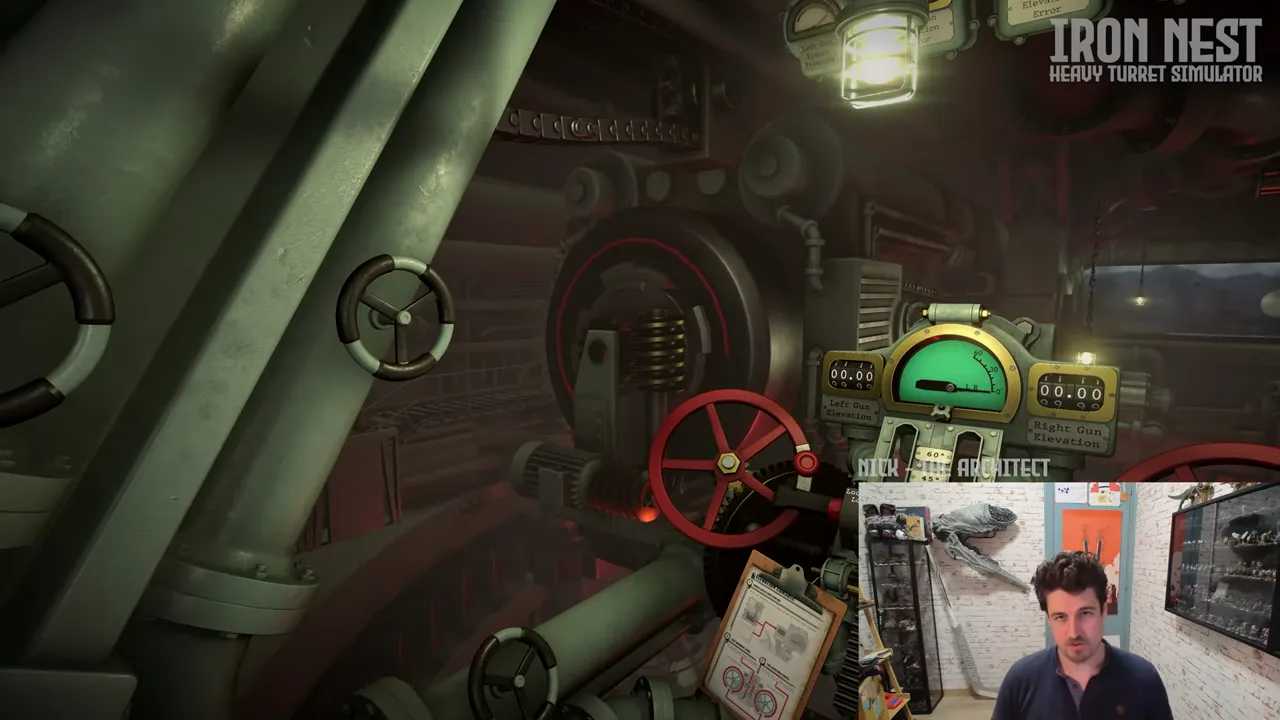
IRON NEST’s heavy-turret fantasy is built from sequential work. The official Steam listing describes an Operator receiving reports, using an interactive map and ballistic calculator, choosing ammunition, setting charges and elevation, moving a massive turret and reviewing aerial evidence. None of those actions happen in a vacuum. Each consumes attention and time, and a decision that is correct at the start of a sequence may need rechecking by the end. That makes time an operational resource, not simply the pause between satisfying interactions.
The game’s public page does not publish exact rotation seconds, action cooldowns or a full timing model. A pre-release developer Q&A discussed the broad idea that a heavy machine takes time to swing and that skilled operators use that period well, but that remains dated design context. The current build is authoritative for exact behavior. This guide uses the confirmed multi-station workflow to explain a durable planning principle: every task has an opportunity cost, and good operation uses unavoidable time to improve the next decision.
Every station creates a time commitment
An incoming report is not yet a shot. It must be read, assessed for source and placed into the current objective context. A map action must be translated into a spatial relationship. A calculator result must be matched to ammunition, charge and elevation. A turret movement must be reconciled with direction and readiness. Aerial review must be interpreted before the next correction. The official feature list presents all of these as parts of the experience, which means a player cannot safely treat the interval between them as meaningless.
This is not a request to hurry through the chain. It is an argument for making the chain intentional. If a turn or station transition gives the player a short period in which no new physical setting can be entered, use that period to reread the target card, check whether a report has changed, compare the next objective or prepare the next verification step. The time has value because it can reduce a later error.
The opposite mistake is doing several unrelated tasks at once without preserving their context. A player may open a new report while a prior solution is still in progress, then forget which target the earlier settings belonged to. Productive time use must retain configuration integrity, not simply maximize inputs per minute.
Plan around dependency, not animation
Players often describe waiting in terms of a visible animation or a slow mechanism. The more useful question is which tasks depend on the current action finishing and which tasks do not. If the turret is still moving, you may not be able to confirm final alignment. You can still inspect the current objective, review message provenance or stage a note about the next target. If a calculator result is being considered, you may not be ready to fire, but you can confirm that the planned shell and charge belong to the same solution.
This distinction turns “dead time” into a planning slot. It also prevents invalid work. Do not start a new target calculation that assumes a position you have not yet verified. Do not reinterpret a fresh report as a new plan while an old firing state remains ambiguous. The point is to use available time for tasks that do not depend on missing state.
The official description supports this approach because it separates information systems from gun controls. The map, teleprinters and calculator are not purely decorative; they provide things to check while the physical machine remains in motion.
Time changes the freshness of information
The longer a plan takes to execute, the more chances there are for its inputs to change. A report may be superseded. A target mark may be refined. A mission objective may advance. An earlier calculator result may no longer be attached to the target now on the map. This does not mean that all information expires after a fixed interval; the released listing does not publish such a rule. It means elapsed time is a reason to ask whether the configuration is still current.
Use visible events rather than an invented timer. A new teleprinter message, a changed objective, a relocated turret, a different ammunition selection or a visible mechanical fault are concrete reasons to reconsider a plan. When none of those occurs, a short check may be sufficient. When several occur, rebuild from the earliest affected step rather than trying to patch only the final elevation number.
This is why haste can cost more time than it saves. A fast shot built on stale information creates an ambiguous outcome, which may require a complete diagnosis. A brief verification during a necessary transition can protect the whole next action.
Create a short task queue
When multiple things compete for attention, use a compact queue rather than an unstructured pile of reminders. A useful queue has three items: the active firing configuration, the next information check and the next likely action after outcome review. Keep only one active firing configuration at a time. Label the next information check by source or objective. Leave the third item as a hypothesis, not a promise.
For example, the active task might be confirming a current target’s map relationship and gun state. The next information check might be rereading a frontline report after movement completes. The next likely action might be deciding whether aerial evidence justifies a correction. This structure helps prevent the player from silently switching targets mid-process.
The queue is not a rule imposed by the game. It is an operational habit derived from the game’s confirmed linked stations. It makes task switching deliberate and makes a later review easier to explain.
Protect the last verification window
The most important use of time is immediately before the irreversible action. The Steam listing describes choosing ammunition, setting charges and elevation and operating the turret. Before firing, use the final available moment to check that the target, map mark, calculator result, shell, charge, elevation, bearing and visible readiness all still match one another. This does not guarantee a perfect outcome; it prevents a known kind of mismatch from becoming invisible.
Do not turn the check into an invented control sequence. The live interface tells you which prompts and states are present. The principle is simply to compare the plan with the machine after the plan has had time to age. If a setting changed, rebuild the appropriate stage. If it did not, record the configuration so that an aerial result can be interpreted afterward.
Review time after the shot as well
IRON NEST advertises aerial photographs and persistent battlefield scars. Outcome review also consumes time, but it is not optional ornament. The result may change the target priority, confirm a configuration or reveal that an earlier assumption needs testing. Treat it as the first task in the next cycle.
The safe review order is visible outcome, objective state, report update and then one controlled correction. Do not respond to a surprising photograph by changing every remaining setting in panic. That destroys the connection between the prior time investment and the new decision. A careful review makes the next operational cycle shorter because it carries forward evidence rather than guesswork.
What this model does not claim
Operational time as a resource does not mean the game has a published action-point system, that every movement is timed identically or that a player must optimize for speed. It does not claim precise turret rotation data from a pre-release comment. It describes a consequence of the confirmed design: linked manual tasks compete for attention, and the machine’s scale makes planning during transitions meaningful.
The live game remains the authority for exact timing, pause behavior and mission pressure. A good player uses that current behavior to decide how much verification is possible without treating an old source or a generic genre convention as a rule.
A dependable time-use rule
Whenever the machine is moving or a handoff is required, ask: what is the next action that does not depend on the state currently in motion? Use that time to verify source, target identity, configuration or objective context. Before firing, protect a short final check. After firing, spend the first moments on evidence rather than assumptions. This turns operational delay into an advantage instead of a distraction.
IRON NEST makes time feel heavy because its machinery and decisions have weight. The player’s skill is not only acting quickly. It is knowing which moments can still make the next action better.
Frequently asked questions
Does the released listing publish exact turret rotation timings?
No. It confirms a massive manually operated turret; exact timings and interruption behavior should be checked in the current build.
Why call time a resource?
Because time spent on one station, target or turn cannot also be spent validating another input, responding to a new report or preparing the next action.