How IRON NEST Uses Math for Firing Solutions
IRON NEST turns geometry, reconnaissance bearings, range, powder charge and gun elevation into a hands-on firing workflow without requiring an external calculator.
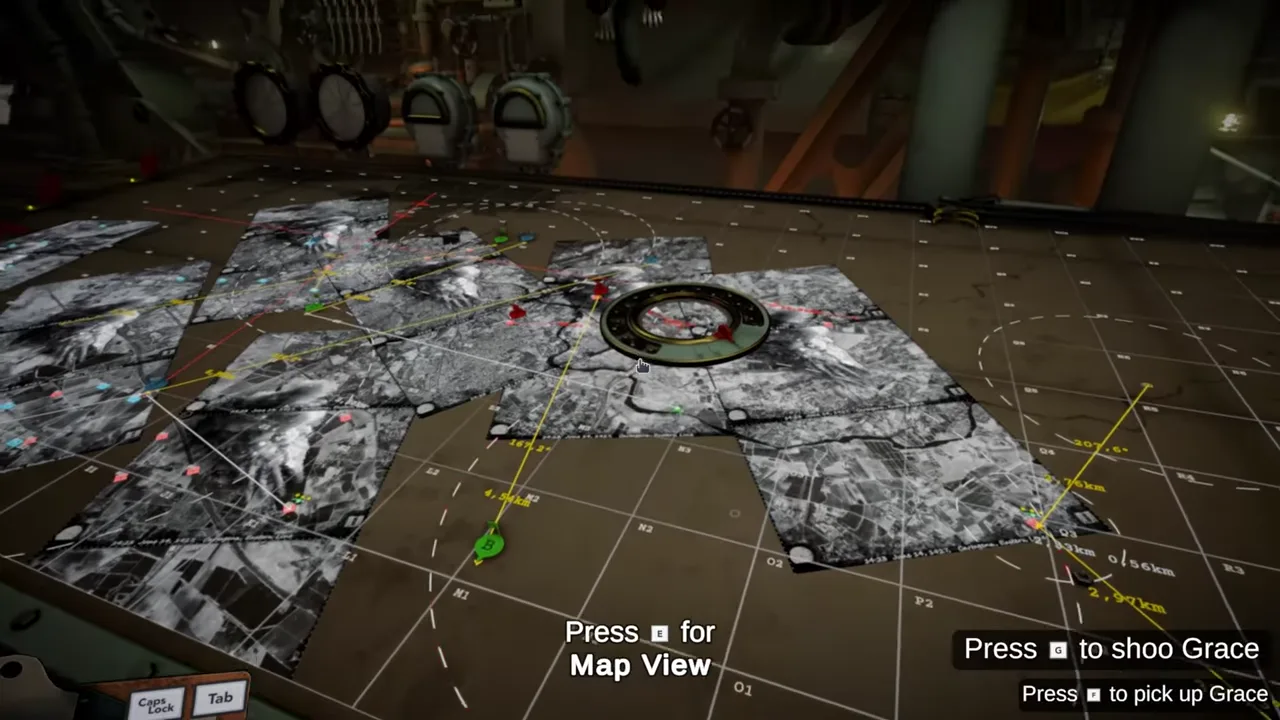
The mathematics in IRON NEST: Heavy Turret Simulator is best understood as a chain of practical decisions, not as a written examination. You receive incomplete battlefield information, turn it into a location on a map, determine how far and in what direction the target lies, then configure a weapon capable of reaching that point. Numbers matter because they connect one physical station in the turret to the next. The game gives those numbers purpose before it asks you to manipulate them.
That interpretation comes directly from the developer’s May 2026 community Q&A. During the section on mathematics, Nick Talmers described difficult missions in terms of forward-reconnaissance reports, spotter positions, bearings, ranges, map measurement and uncertainty. He also stressed that the game supplies tools to make the work approachable in most missions. You are expected to reason, measure and operate instruments; you are not normally expected to stop playing and reproduce an artillery textbook on paper.
The firing problem begins with information
A firing solution cannot start at the gun because the gun does not yet know where to point. It starts with a report. In the developer’s example, a mission may give the position of one or more forward observers and then provide a bearing or range from those observers to a target. Those pieces describe relationships rather than handing the operator a final coordinate.
This is the first mathematical task: convert relative information into a location. If a spotter is at a known point and reports a direction, the target must lie somewhere along that line. If another report supplies a distance, the set of possible points becomes much smaller. A second observer, bearing or range can further constrain the answer. The familiar word for combining observations this way is triangulation, although not every problem requires a textbook triangle or the same number of inputs.
IRON NEST represents that reasoning on a large tactical table. The official launch trailer shows reconnaissance photographs placed over a coordinate grid, colored markers, drawn lines, written distances and a circular measuring device. The image above is a frame from that sequence. The important design choice is that the spatial problem remains visible. Rather than entering a mission marker into an abstract menu, you work with the evidence that justifies the marker.
Bearing and range answer different questions
A bearing describes direction. A range describes distance. Confusing them produces a plausible-looking but useless answer: the correct distance along the wrong line, or the correct direction with no reliable point at which to stop. Keeping the two roles separate makes the workflow easier to diagnose.
When a shot misses, ask which part was uncertain. Was the observer’s position copied correctly? Was the reported direction measured from the right reference? Did the line pass through the intended sector of the map? Was the distance taken from the observer to the target, or from the turret to the target? The last distinction is especially important. Reconnaissance information can locate the target, but the gun needs a range measured from its own firing position.
The game turns those questions into physical actions: move around the map, align a tool, read a scale and record the result. Each transfer is an opportunity for error. That is deliberate. IRON NEST is interested in the operator’s process, so it preserves the small chances to misread, transpose or forget a number instead of collapsing the whole chain into a single objective icon.
From a map position to gun elevation
Once the target position is established, the task changes from geometry to gun laying. The turret-to-target range becomes an input for the ballistic system. Powder charge is another input, because changing the propellant changes the projectile’s available velocity and therefore the elevations that can reach a given distance. The required elevation is the useful output: the angle at which the gun must be laid for that combination.
The developer Q&A describes an in-game ballistic calculator that accepts the relevant bearing, range and powder-charge information and provides the needed gun elevation. The exact interface should be learned from version 1.0, but the logical relationship is stable:
- Locate the target from reconnaissance evidence.
- Measure bearing and range from the turret to that location.
- Select or enter the intended powder charge.
- Use the ballistic instrument to obtain the required elevation.
- Transfer the bearing and elevation to the gun controls.
- Confirm that the ammunition, charge and target all belong to the same solution.
The last check prevents a common class of mistake. A perfect calculation can still fail if its result is applied to a different charge, if a value is copied to the wrong barrel or if the turret is left on an earlier bearing. Mathematics produces a solution for a defined set of inputs; it cannot protect an operator who changes one input after the calculation.
Why the game does not require advanced mathematics
Nothing in the official explanation says that players must derive ballistic equations during ordinary play. Talmers explicitly framed the supplied tools as a way to solve the required mathematics easily in the great majority of missions. The challenge is therefore closer to applied geometry, careful measurement and correct data handling than to symbolic algebra.
That does not mean the process is trivial. Simple operations become demanding when information arrives in pieces, several devices must be operated and a firing sequence is already under way. Time pressure taxes working memory. Similar-looking labels invite transcription errors. An uncertain report may make several nearby locations defensible. The player’s skill lies in maintaining a reliable chain from evidence to shot.
The Q&A also described the possibility of accounting for the margin of error in different reports and estimating a probable target zone. That is a deeper layer, not a promise that every mission demands formal probability calculations. In practice, the concept means acknowledging uncertainty instead of treating every line on the map as perfectly precise. When two observations do not intersect at a single clean point, the useful answer may be a small region supported by both.
When the instruments stop helping
The developer deliberately discussed exceptions. Before release, he said the ballistic calculator would be unavailable or broken in at least one campaign mission and probably in a challenge mission. In that situation, players interested in faster manual calculation would use a reference sheet covering broad ranges, powder charges and elevations, then interpolate or narrow those values to hit a specific distance.
Because that statement was made before version 1.0, this page treats it as a dated official design statement until the exact released missions are independently checked. The principle remains valuable even if details changed: understanding the relationship among range, charge and elevation gives the player resilience when a convenient instrument is removed.
A reference table also explains why estimation matters. Suppose two rows bracket the measured range. The answer is unlikely to require either row unchanged; the operator must judge where the target falls between them. The game can test that judgment without requiring the player to know the hidden simulation formula.
What not to assume about the simulation
Real exterior ballistics can involve gravity, drag, projectile shape, air density, temperature, wind, rotation and other corrections. The official sources used here do not establish that version 1.0 simulates every one of those variables. It would be misleading to turn general artillery knowledge into undocumented game mechanics.
The safe approach is to distinguish three levels of evidence. Controls and values visible in the released game are direct observations. Explanations from the developer are official statements, best preserved with their dates and timestamps. Real-world physics can explain why a design is plausible, but it is background unless the game confirms that a variable affects its result.
That distinction is also why our fan-made browser calculator is a training aid, not a reverse-engineered model of IRON NEST. It demonstrates how range, velocity and elevation relate in ideal projectile motion. It does not claim to reproduce the game’s internal tables or substitute for the instrument inside the turret.
A reliable operator’s checklist
Approach every firing problem as a chain that can be audited. Record the original report before measuring. Mark the known observer position. Draw or align the reported bearing from the correct origin. Use additional information to constrain the target. Only then measure from the turret. Keep the chosen powder charge next to the range, obtain the elevation and transfer both direction and elevation to the correct controls.
If the result looks wrong, walk backward through that chain rather than changing several values at random. A disciplined correction teaches you which step failed; guessing may produce a hit without producing understanding. That is the real role of mathematics in IRON NEST. The arithmetic is accessible, but the machine makes accuracy depend on how well you organize information, instruments and action.
Frequently asked questions
Do you need a real calculator to play IRON NEST?
The developer said the game provides tools that make most mission calculations manageable without taking out an external calculator. Some missions are designed to test faster manual reasoning when an in-game aid is unavailable.
What information goes into an IRON NEST firing solution?
The documented workflow can involve reconnaissance locations, bearings or ranges from spotters, map measurement, target position, range, powder charge and the gun elevation returned by the ballistic instrument.
Does IRON NEST simulate full real-world exterior ballistics?
Official explanations emphasize an approachable geometry and instrument workflow. They do not establish that the game models every real-world variable, so players should not import assumptions about wind, drag or atmospheric corrections without checking the released build.