IRON NEST’s Decision-to-Shot Feedback Loop
How IRON NEST connects report provenance, map work, ballistic inputs, physical gun settings and aerial review into one accountable decision-to-shot feedback loop.
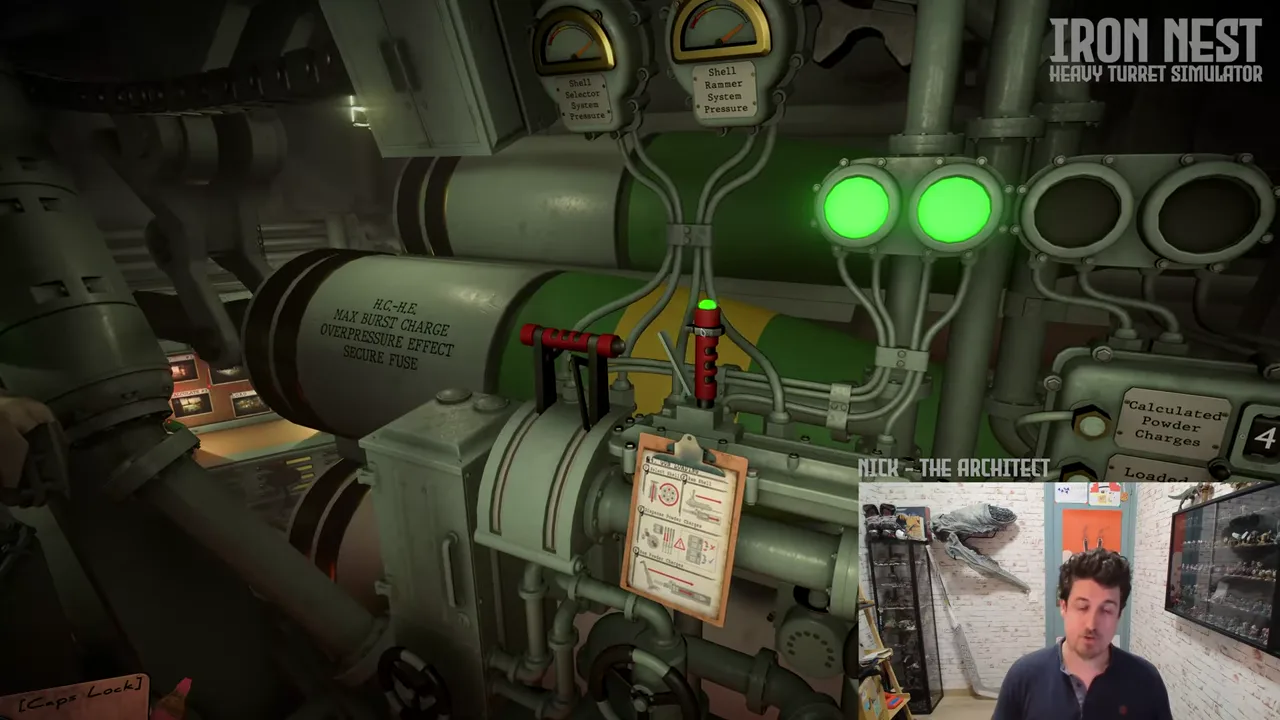
IRON NEST is not only a game about arriving at a number and firing a gun. Its published systems describe a loop in which information changes form, becomes an action and then returns as new evidence. A report arrives through a teleprinter. The Operator preserves its source, plots it on an interactive map, uses a ballistic calculator, sets a physical artillery configuration, fires and reviews aerial photographs plus persistent battlefield scars. The game’s most distinctive mechanical idea is the connection among those stages.
Calling that connection a “decision-to-shot feedback loop” is an interpretation of the official feature list, not a claim that the game exposes a single meter or formal tutorial with that name. It is useful because it explains why each station matters. The value of a map is not just navigation. The value of a calculator is not just arithmetic. The value of an aerial image is not just spectacle. Each station creates a check on what came before and a starting point for what comes next.
Reports begin the loop, but do not finish it
The current Steam listing says the Operator receives information through two teleprinters: High Command and frontline radio traffic. It also says that the player should track who said what and use the information to identify the target. This makes source provenance a mechanical input. A report is evidence with a perspective, not an automatically correct waypoint.
In practical terms, the first question is not “what button fires?” but “what does this message actually establish?” A High Command order may establish priority or desired action. A frontline observation may establish a location, a threat or uncertainty around a situation. They can reinforce one another, but a player should not silently collapse them into a single perfect fact. Keeping the messages separate preserves the ability to correct the correct stage later.
This is the first feedback principle: retain the path by which an assertion entered the system. If a shot produces an unexpected result, the player can reconsider the original report, not only the final elevation number. That is more useful than treating every failure as a generic aiming error.
The map turns a report into a spatial claim
IRON NEST’s listing explicitly includes an interactive map. Its role in the feedback loop is to turn an observation or order into a target placement that can be compared with the turret’s current position. The map therefore carries both location and context. A point may represent an observer statement, a proposed target or a location inferred from more than one message. Those are different kinds of confidence even when they occupy the same visible area.
The map also creates a valuable checkpoint. Before calculating range and bearing, the Operator can ask whether the point is actually the point intended by the report. If it is not, an impeccably performed calculation only produces an impeccably wrong action. A later aerial image can likewise be compared with the mark, helping to distinguish a plotting problem from a gun-setup problem.
The official page does not publish every map control or every marker type, so a reference should not invent a universal coordinate convention. The dependable principle is simpler: a plotted location is an intermediate claim, and it deserves review before it is converted into a firing solution.
Calculation makes the spatial claim operational
The published feature list names a ballistic calculator and tells the player to calculate trajectory. This is the stage where map-relative information is converted into settings that can be executed by the turret. It is not a substitute for target identification; it assumes that the target relationship being calculated is meaningful.
The calculator also helps preserve consistency. A firing solution combines relationships such as range and bearing with choices such as charge and elevation. If one element changes, other elements may no longer describe the same solution. The safe mental model is not that every output is a permanent answer, but that each output is associated with particular inputs and a particular turret position. A stale solution may be numerically plausible and still be mechanically inappropriate.
The developer-owned video provides visual context for a multi-station artillery workspace, while the Steam listing establishes the calculator as part of the official product description. Neither source publishes a complete ballistic equation or every ammunition stat. That boundary matters: players can verify the chain shown by the game, but should not fabricate hidden coefficients to explain an observation.
Physical controls make the decision irreversible
IRON NEST does not advertise an abstract “confirm target” button as the whole combat experience. Its page describes choosing ammunition, setting charges and elevation, and turning the massive turret. Those physical controls are where an information decision becomes a material event. The handoff is important because every control can preserve or break the intended configuration.
At this stage, a disciplined Operator checks for agreement rather than merely activity. Is the shell choice the shell assumed by the plan? Is the selected charge the charge associated with the elevation? Is the turret aligned to the calculated direction? Is the machine ready to act? The official listing says mechanisms can fail, so visible readiness and abnormal behavior belong in the record too. They should not automatically be relabeled as secret objective mechanics.
This is the point at which the feedback loop becomes consequential. A report can be reconsidered and a map mark can be moved. Once the gun acts, the game can reveal the cost of the current state. That is why careful handoffs are satisfying: they allow a player to feel responsibility for an outcome without demanding a claim that every outcome was predictable.
Aerial review closes the loop
The Steam page says the player receives aerial photographs after a strike and that scars persist on the battlefield. That gives the Operator a public, visible way to compare action and consequence. An aerial image may show an impact, altered terrain or a scene that contradicts the player’s expectation. Persistent scars make the result part of the continuing operational context rather than a disposable animation.
The safe way to use this evidence is descriptive first. Record what is visible relative to the intended area, then compare it to the earlier map mark and configuration. A lateral discrepancy points the investigation toward target placement, bearing or traverse; a range discrepancy points toward range, charge or elevation. This is a diagnostic hypothesis, not a promise that every image exposes a precise error direction or a hidden damage value.
The product page does not say that every objective has a universal score, perfect damage readout or automatic correction prompt. Aerial evidence is still powerful because it turns a shot into information. It can support a better next attempt even when it does not provide a complete answer.
The next decision is the real payoff
The loop matters because its output is another decision, not a final verdict. A good result can confirm that a particular report-to-map-to-shot chain worked in its current context. A poor result can identify one stage that deserves rechecking. The player does not need to reset every variable. In fact, changing target placement, shell type, charge and elevation all at once removes the evidence needed to learn from a second result.
Use the smallest justified correction. If the report and plot now look uncertain, revisit those first. If the plot is secure but the configuration was not recorded, rebuild a clean solution. If a mechanism appeared not to respond, verify readiness and input state before claiming that the mission rule is wrong. This practice reflects the design’s published emphasis on manual work and outcome review.
What this model does not claim
The decision-to-shot feedback loop is a framework for reading confirmed features together. It does not claim that all reports are unreliable, that every aerial photo gives exact coordinates, that damage has a fixed formula or that every mission allows unlimited correction. It also does not replace the live game interface, which is the authority for current mission rules and control behavior.
What it does provide is a way to make the available evidence actionable. IRON NEST advertises information sources, map work, ballistics, manual gun operation, machine risk and aerial aftermath. Taken together, those features support a game in which a player can explain why they acted, examine what happened and improve the next decision. That is the mechanical heart of the heavy-turret fantasy.
Frequently asked questions
What does feedback loop mean in IRON NEST?
It is a practical reading of the published workflow: reports are plotted and calculated, a shot is executed through physical controls, and aerial evidence can then inform the next decision.
Does an aerial photo reveal every hidden game variable?
No. The official listing confirms aerial photographs and persistent scars, not a complete diagnostic interface or a public damage-model formula.