The Operator and Responsibility in IRON NEST
How IRON NEST connects manual control, High Command orders, frontline evidence, ammunition choice and propaganda to the player's responsibility for every shot.
IRON NEST calls the player “Operator,” not commander-in-chief, gunner or anonymous camera. The title defines a person whose authority is narrow but concrete. High Command selects priorities and the frontline supplies reports, yet the Operator must transform that information into the physical state of a 5,000-ton weapon.
The official website states the theme directly: High Command may send orders, but the chain of command ends at the player’s fingertips. Distant authorities do not carry the consequences; the Operator does. That language connects the moral question to manual controls rather than separating story from simulation.
This page distinguishes confirmed framing from interpretation. The public sources do not name the Operator or guarantee that every order can be refused. They do make responsibility central to how the machine is described.
An institutional role without a named biography
The official material addresses “Operator” as a function. The person receives directives, monitors information and operates the turret. No canonical name, age, rank or personal history appears in the current website and store description.
That absence keeps attention on the player’s relationship to the system. A detailed protagonist could explain motives in dialogue. The Operator role instead asks the player to provide judgment while the machinery supplies constraints.
Do not fill the gap with an invented biography. If version 1.0 documents identify the character more precisely, those facts should be cited separately from the public premise.
Orders arrive, but action is not automated
One teleprinter delivers top-priority directives from High Command. Another relays direct frontline calls. The Operator receives at least two perspectives: institutional priority and immediate battlefield need.
Neither channel fires the gun. Reports must be interpreted on the tactical map, converted into bearing and range, processed through the calculator and applied to physical controls. The distance between order and action is filled with deliberate player work.
That structure creates room for responsibility. A remote instruction begins the chain, but each following choice remains visible: which evidence to trust, which target to mark, which shell to select and whether the machine is ready to fire.
Manual control makes authorship tangible
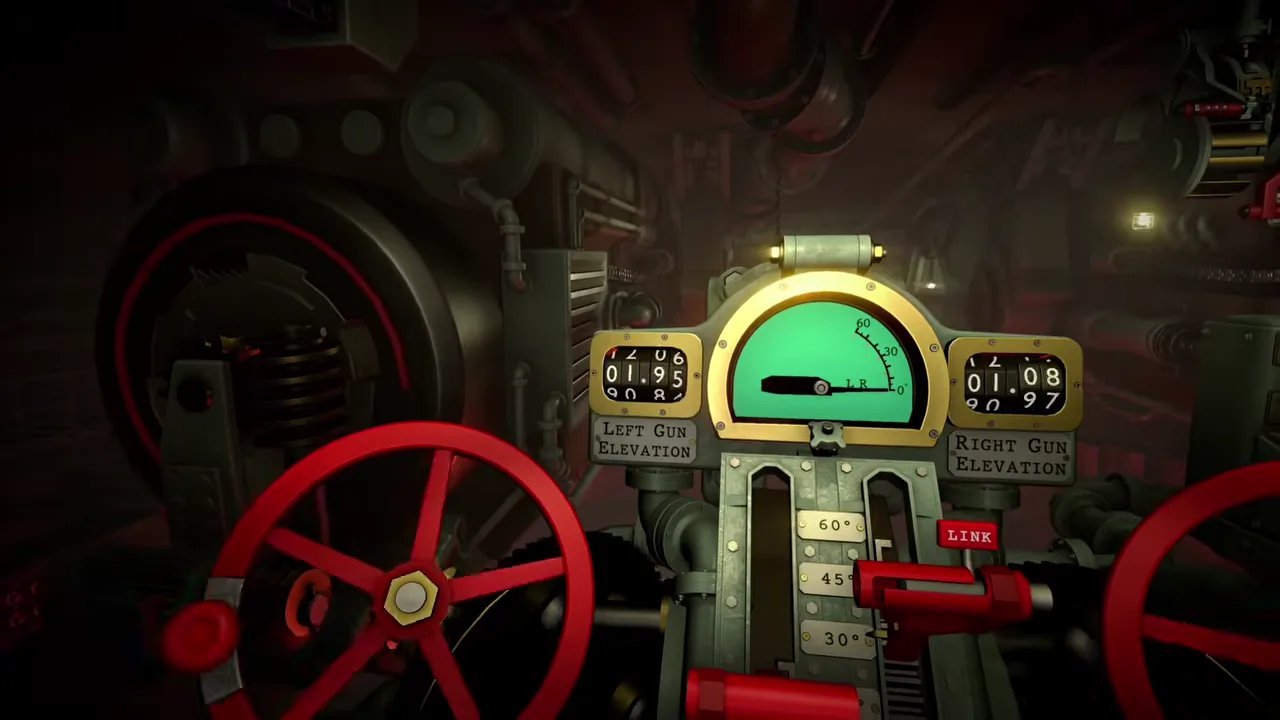
The image above shows separate left and right gun-elevation counters, red wheels and a central gauge. An order does not silently populate those values. The Operator must make the metal agree with the calculation.
Manual control does not automatically create moral depth, but it makes causal authorship hard to ignore. The player cannot say an AI unit misunderstood a waypoint. A shot follows from data they copied, a charge they selected and a trigger they operated.
This reading is an editorial interpretation grounded in the official emphasis on every lever, every dial and every shot being under player control.
Information creates responsibility before firing
Responsibility begins with what the Operator knows. A priority directive can be compared with a frontline call. Observer reports can be checked geometrically. Aerial photographs can reveal what an earlier shot changed.
The official site says every piece of information can determine the success of an operation. That statement treats attention as an ethical and tactical skill. Ignoring evidence is itself part of the decision chain, even before ammunition is loaded.
The game can create uncertainty without making all sources equal. High Command may be authoritative, a frontline call may be urgent, and a photograph may be direct evidence. The Operator decides how they fit together.
Ammunition choice is a choice of effect
The official description contrasts armor-piercing rounds for bunkers, smoke for friendly withdrawals and phosgene gas surrounded by redaction and denial. These are not only damage values. They represent different intentions at the same coordinate.
Selecting a shell therefore becomes part of the Operator’s authorship. A smoke screen supports movement; armor piercing attacks a hardened position; chemical use carries overt narrative discomfort. The effect can remain the player’s responsibility even when High Command named the target.
The full ammunition catalogue must be verified, but these confirmed examples are enough to establish the design principle.
Precision does not erase guilt
The store copy links exact charge and elevation with surgical strikes, then says paperwork and propaganda cannot erase guilt. Mechanical correctness and moral correctness are deliberately separated.
A shot can be technically perfect: correct target, bearing, range, shell, charge and elevation. That success answers whether the machine performed as intended. It does not automatically answer whether the intention was justified.
This is one of IRON NEST’s strongest thematic uses of simulation. Mastery gives the player more reliable agency, not an exemption from examining what that agency does.
The question of obedience
Official descriptions ask, “Will you obey High Command, Operator?” The wording frames obedience as a live question rather than a fixed identity. It is reasonable to interpret the story as interested in compliance, doubt and consequence.
It is not sufficient evidence for a universal “refuse order” button, a morality meter or a particular ending. The older lore guide claimed the player could refuse orders as a confirmed mechanic; that claim has been removed until mission-level version 1.0 evidence supports it.
The theme can exist even when choices are constrained. How the player interprets, executes or lives with an order may matter alongside whether a menu permits explicit refusal.
Aerial photographs and the return of consequence
The official site says aerial photos reveal outcomes and the map retains battlefield scars. The Operator receives evidence after the moment of firing rather than leaving the result entirely off-screen.
This return matters. Artillery creates distance between operator and target. The information systems reduce that distance by bringing consequences back into the room as images, reports and changed objectives.
The statement does not prove perfect persistent destruction across all missions. It confirms that the game uses evidence of outcome as part of its intended experience.
Newspaper reports and control of the narrative
Newspaper reports are a listed feature, while propaganda is repeatedly named in the official copy. After the Operator acts, institutions can describe that action to the public—or to the player—through an approved narrative.
The report may acknowledge, minimize, celebrate or reframe consequences. This page does not assume every newspaper lies. Its thematic role comes from the contrast between mediated language and the evidence the Operator already saw.
The player can know that a clean headline was produced by a messy chain of decisions. That knowledge makes propaganda part of responsibility rather than mere decoration.
The enclosed workplace
Coffee, a gramophone, manuals and a customizable cat give the turret traces of ordinary life. The Operator does not visit the machine only for a firing cutscene; it is an inhabited workplace with routines between directives.
Those domestic details create contrast. A player can choose music or wait for coffee while mechanisms prepare violence at enormous scale. The game does not need to state the theme in dialogue because the room places comfort and consequence side by side.
Our gramophone page documents one of those objects and the developer’s pre-release custom-music plan.
High Command and distance
High Command appears through directives rather than a leader standing beside the gun. That institutional distance allows authority to define necessity without performing the procedure.
The Operator occupies the opposite position: limited strategic authority but direct physical involvement. The official line that High Command does not carry consequences describes this imbalance.
This does not prove that every commander is malicious or every order false. It identifies a system in which those who decide and those who execute experience the act differently.
Responsibility under uncertainty
Observer reports can include uncertain bearings and ranges. Missions can provide partial information. Waiting for perfect knowledge may be impossible, while acting on a weak target plot can create avoidable damage.
The Operator’s responsibility therefore includes method: preserving sources, checking origins and recognizing when an inference is not a confirmed coordinate. A careless calculation is different from a morally disputed but accurately executed order, even if both produce consequences.
IRON NEST makes that distinction playable by exposing the chain rather than collapsing it into a hit percentage.
What the theme establishes—and what it does not
Confirmed public framing establishes manual control, High Command directives, frontline information, consequence, propaganda and the direct address to the Operator. The following remain unverified without the released missions: a named protagonist, universal refusal, a morality meter, multiple endings and an exact branching-consequence system.
The theme does not need those claims to be meaningful. The Operator is responsible because the game makes them the final active link between information and impact. Every lever narrows the distance between “an order was given” and “I made the machine do this.”
That is the role’s central tension: the Operator may not control the war, but inside IRON NEST, nothing reaches the battlefield without passing through their hands.
Frequently asked questions
Who is the Operator?
The Operator is the player-facing role inside the 5,000-ton IRON NEST turret: the person who interprets reports, configures the machine and executes shots. Official public sources do not provide a canonical personal name.
Can the Operator disobey High Command?
Official descriptions repeatedly ask whether the Operator will obey and emphasize personal consequences. That thematic framing does not by itself confirm a universal disobedience mechanic or specific ending; mission-level options require direct verification.
Why does manual control matter to the story?
Because the player physically transfers information into ammunition, charge, bearing and elevation, the game makes responsibility harder to delegate to an automated unit or distant commander. This is an interpretation grounded in the official control and consequence descriptions.