The Gramophone and Music Inside IRON NEST
What the turret's gramophone establishes about operator life, diegetic interfaces and the pre-release plan for custom music.
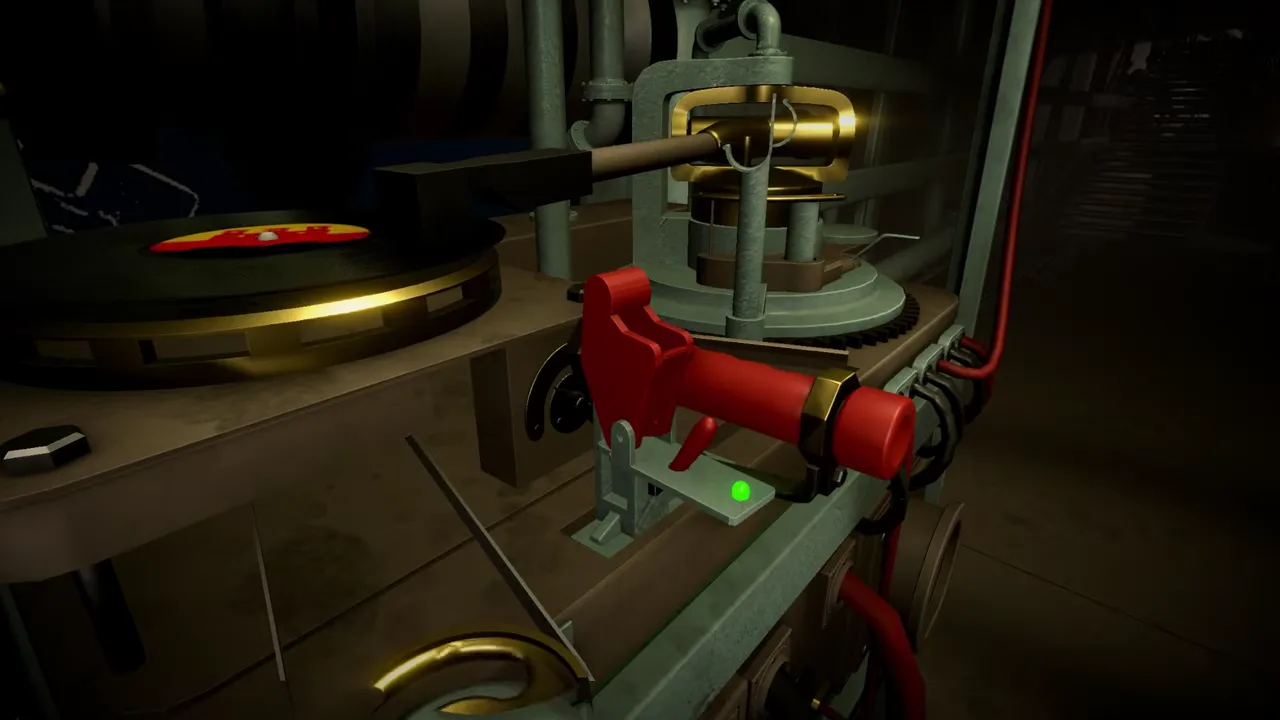
The gramophone inside IRON NEST: Heavy Turret Simulator is a small machine inside a colossal one. Its record, brass pickup and bright winding handle occupy the same physical world as the ballistic calculator and gun controls. Official footage does not present it through an abstract soundtrack menu; the operator approaches an object in the turret.
That choice makes the gramophone useful lore even before every version 1.0 function is catalogued. It says that the IRON NEST is not only a weapon platform. It is a place where someone waits, drinks coffee, listens and develops routines between orders. The game’s dieselpunk machinery extends into leisure.
Evidence needs careful labeling here. The official demo trailer clearly shows the gramophone. A May 2026 developer Q&A describes a hoped-for custom-music system but also says it might not be ready at launch. The device is confirmed; the complete pre-release feature plan is not automatically a shipped version 1.0 feature.
A diegetic way to control atmosphere
“Diegetic” means that an interface or sound source exists inside the fictional world. A conventional music slider belongs to a game menu. A record player belongs to the operator’s room. When the player changes a record by interacting with the gramophone, an ordinary media choice becomes part of inhabiting the turret.
IRON NEST applies the same principle to its core systems. Reports arrive through teleprinters. Calculations happen on a physical console. Bearings and elevations are set with wheels and displays. Placing music on a turntable follows the existing design language: if the operator can affect something, the game tries to give that effect a location and mechanism.
This consistency matters more than realism in a narrow sense. A gramophone near an enormous artillery system is stylized, but it feels coherent with the alternate interwar technology. The object helps bridge the player’s modern desire to choose music with the period vocabulary of records and mechanical playback.
What the official footage confirms
The frame above comes from the official June 2026 demo trailer. It shows a record on the turntable, a metal pickup assembly and a red handle mounted at the front. The camera is close enough to make the device a subject rather than distant set dressing.
From the frame alone, we can confirm the modeled object and its placement inside the operator environment. We cannot confirm the number of records, track list, audio controls or whether every visible component has a separate interaction. A responsible wiki does not turn a detailed model into a list of undocumented verbs.
The visual is nevertheless strong evidence that operator downtime is part of the space. The launch trailer also shows coffee equipment, manuals and the customizable cat advertised on Steam. Together, those details give the turret traces of domestic life without making it comfortable in any ordinary way.
The developer’s custom-record plan
At 31:22 in the May community Q&A, a player asked whether the gramophone could use custom music files through an immersion-friendly record collection. Developer Nick Talmers said that was his plan. He described folders in the game files: a player could create a named folder, add a central image and sound files, and have a record appear in the game using that image as its center label.
The same answer included an essential caveat. Talmers was not confident the feature would be finished by launch and called it a nice-to-have. That uncertainty must travel with the description. It is accurate to document the design idea; it is not accurate to publish a current setup guide without checking version 1.0.
The concept is notable because it preserves the fiction even for user-supplied media. Rather than opening an external playlist, the player’s folder would become a record object. Naming and label artwork would make a personal collection legible inside the turret.
Why music belongs in an artillery simulator
IRON NEST alternates between intense procedure and waiting. A firing solution may require careful map work, calculator input and movement among stations. Turret rotation itself takes time, and the official store description jokes that skilled operators can use that time for other tasks, including the coffee machine.
Music can shape those intervals. A record makes preparation feel like a routine rather than dead time. It can also create contrast: a familiar or cheerful track continues while the operator prepares a devastating shot. That contrast supports the game’s satire without needing an explanatory monologue.
The gramophone also gives the player limited personal control in a space dominated by High Command. Objectives, reports and military protocols arrive from outside. Choosing what to hear is a small act of self-direction. If custom records are available, that act becomes literally personal because the player supplies the sound.
This thematic reading is an interpretation, not a confirmed plot mechanic. The official sources establish the object and the intended feature, while the meaning comes from its relationship to the rest of the environment.
Technology, nostalgia and dieselpunk style
The gramophone compresses several associations into one prop. It belongs to the era evoked by the late-1920s setting. Its visible mechanism suits a world of gears, hydraulics and analogue instruments. Records are physical media, so changing music can involve handling an object rather than selecting a line of text.
Dieselpunk is not simply a list of old machines. It recombines historical forms with exaggerated industrial power. IRON NEST’s 5,000-ton turret is intentionally fantastical, while the gramophone provides a recognizable human scale. The player can understand its purpose at a glance, which makes the surrounding weapon seem even larger.
The bright metal and red handle also echo the visual language of operational controls. Leisure and warfare are manufactured from the same palette. Inside this machine, even entertainment looks like something that must be cranked and operated.
How to document the feature after launch
A complete version 1.0 verification should answer a short list of observable questions. Can the gramophone be activated? How are records selected? Which tracks ship with the game? Does playback persist while the operator moves around the turret? Is custom-folder loading present, and if so, what formats and paths are supported?
Each answer should come from the released build or current developer documentation, not from the old plan alone. If custom music is absent, the Q&A remains valuable as development history. If it arrived in a patch, the page should record the version and date rather than rewriting history as though it was always guaranteed.
This method also protects players. File-format or folder instructions can break after updates; citing a current source prevents a speculative lore page from becoming unsafe technical advice.
A small machine that defines the room
The gramophone does not calculate range or rotate the guns, but it helps explain who the operator is between those tasks. Someone lives a portion of life inside IRON NEST. They wait for paper to emerge from teleprinters, hear the machine strain, make coffee and place a needle on a record.
That ordinary ritual makes the extraordinary weapon more believable. It also makes its moral tension sharper. Music does not stop when an order becomes questionable; the operator decides whether to interrupt the routine and act. In a game where every important function has a lever, the gramophone gives atmosphere a mechanism of its own.
Frequently asked questions
Is there a gramophone inside IRON NEST?
Yes. The device is clearly shown in official developer-owned video footage.
Can version 1.0 play custom music files?
The developer described a folder-based custom-record system as a desired feature in May 2026 but explicitly said he was not confident it would be ready for launch. This page does not mark it as shipped without a version 1.0 check.
Is the gramophone only decoration?
Official video establishes it as a modeled, interactive-looking object, while the Q&A establishes intended music functionality. Its exact current controls and available records require direct verification in the released build.