IRON NEST Objective State Not Updating: A Safe Check
How to diagnose an IRON NEST objective that appears not to update by separating wording, target evidence, firing configuration, visible aftermath and reproducibility.
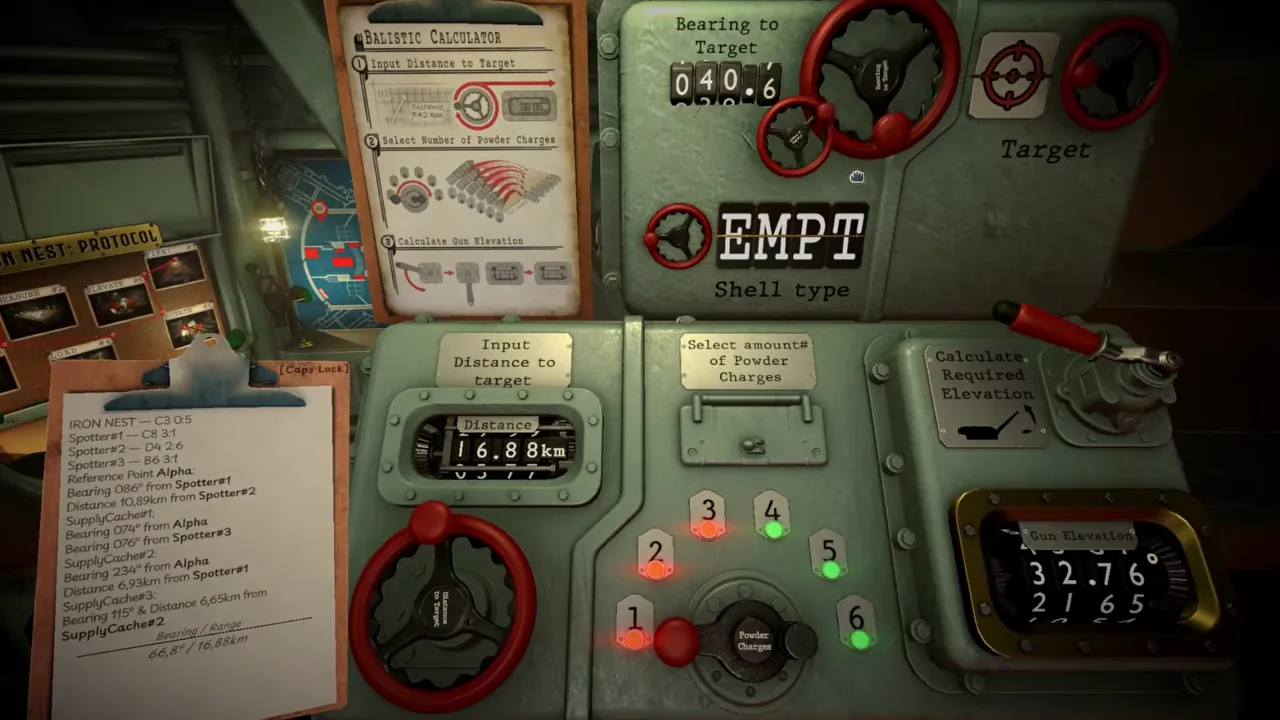
An IRON NEST objective that appears not to update is a reason to preserve evidence, not immediately a reason to declare the mission broken. The current Steam listing describes a linked workflow: reports from High Command and the frontline, an interactive map, ballistic calculation, ammunition choice, physical artillery settings and aerial photographs after a strike. A mismatch can enter at any of those stages. The objective may not be the one the player understood, a report may have changed the target context, a calculation may belong to an older marker, or the visible outcome may not establish the exact condition the current mission requires.
The public listing also advertises a handcrafted story alongside procedurally generated objectives. It does not publish a universal trigger table for every mission. This guide therefore uses an evidence-first check rather than inventing a hidden completion formula. It keeps the initial state intact, narrows the next test and produces a useful report if the result repeats.
Preserve the current wording
Write down or capture the exact active objective text before changing anything. Do not rely on an earlier briefing, a remembered instruction or a generic assumption that an apparent target must be sufficient. The current mission interface is the strongest source for what the game visibly asks right now. A new report may add context without changing the objective; alternatively, a new state message may redefine the active task. Preserve the distinction.
If the wording is ambiguous, label it ambiguous. Do not create a precise hidden requirement simply because the objective did not tick over. A player who correctly fired on a target that was no longer the active task has an interpretation problem, not necessarily a defect. The written wording gives a later retest an honest baseline.
Reconstruct the target evidence
The Steam description says the Operator receives separate High Command and frontline reports and should track who said what. Identify which current report, objective or map clue produced the target mark. Was it still current? Did a later message refine its location, change the priority or describe a different target? Is the map marker a direct instruction, a frontline observation or your own estimate?
Keep those details separate. A valid report can be mapped incorrectly. A correct marker can belong to an older objective. A new objective can supersede a previously reasonable plan. Recording provenance prevents an unexpected result from becoming an unhelpful claim that “the mission did nothing.”
Do not merge conflicting reports into a convenient average unless the current interface explicitly supports that interpretation. Retain source labels. They are the evidence that tells you what needs review after the next outcome.
Confirm the shot was a current configuration
IRON NEST publicly advertises a ballistic calculator, ammunition selection, charges, elevation and a massive turret. Verify the visible state that actually produced the attempted result. Did the calculator refer to the current target mark? Did the selected shell, charge, elevation and direction match that calculation? Did the turret move or did the target change after the calculation? Was a visible readiness or interaction state incomplete?
This matters because a calculation can be valid for its inputs but stale for the current mission. Do not change every variable in response. If target evidence changed, correct the map before rebuilding the solution. If the map is secure but physical settings are uncertain, rebuild the configuration cleanly. If a mechanism appeared to fail, record that as an operational observation; the listing says mechanisms can fail, but it does not make every unusual state an objective mechanic.
The goal is to ensure a second attempt answers a question. A shot made with a new target, new shell and new elevation all at once can still fail without explaining why.
Read aerial aftermath descriptively
The product page says aerial photographs arrive after strikes and scars persist on the battlefield. Describe the image before explaining it. Did an impact appear near the intended mark, away from it, or not clearly enough to compare? Did the objective text visibly change? Did a new report appear? These are separate observations.
An aerial image does not necessarily reveal a complete damage model, target health or hidden threshold. It can show an outcome without proving that an objective condition should be met. Use it to select the next smallest check. If the impact seems unrelated to the mark, revisit target placement and orientation. If it seems aligned but the objective text remains unchanged, re-read the task and preserve the result for a controlled retest.
Do not erase the first configuration after seeing the photo. Its record is what makes later comparison possible.
Retest one variable at a time
After documenting the initial attempt, run a controlled retest only if the current mission state allows it. Hold as much context steady as practical. If the map mark is doubtful, change that while retaining the confirmed configuration. If the mark is secure but the configuration is stale, rebuild it while retaining the target. If an interaction did not respond, repeat the same station and input context before attributing it to the objective.
One result is an observation. A repeated result under documented conditions is stronger evidence. If the issue disappears after a safe restart, record that too. Do not claim that a restart fixed a known cause unless you can demonstrate what changed. The uncertainty is useful information.
The current build is authoritative for its objective wording and available interactions. A historical trailer or old discussion can provide context but should not replace the live state during troubleshooting.
Avoid destructive recovery steps
Do not delete saves, reinstall or force a cloud action before preserving the current objective, reports, settings and visible outcome. Steam Cloud being listed on the storefront confirms a platform feature, not that every recovery action is safe or that a particular local state will return. A hasty reset can destroy the only record needed to diagnose the issue.
If a restart is appropriate after recording evidence, treat it as a separate test. Keep account details and unrelated personal data out of a public post. The useful context is the version, platform, mission state, objective text, source reports, target mark, configuration, outcome and repetition rate.
Write a reproducible report when needed
If the objective still fails to update after a clean, documented retest, write a concise report: current build and platform; mission context; exact objective text; relevant report wording; marker context; selected shell and gun settings; action taken; expected result; actual result; screenshots or short clips; and whether it repeats. Submit it through the current official channels linked from the Steam product page or official website.
Lead with the observation, not a theory about a hidden mission system. A clear sequence lets another player or maintainer recreate the context. A conclusion without the steps does not.
The dependable check order
Preserve the current objective. Identify the active target evidence. Verify the map. Reconcile calculator and gun state. Describe aerial and UI aftermath. Change one relevant variable. Report a repeated result. This order respects the systems the official listing confirms while leaving room for current mission behavior the listing does not enumerate.
An objective that does not visibly update may be a misunderstood condition, stale plan, interaction problem or defect. The evidence-first method does not prejudge the answer. It makes the answer possible to find.
Frequently asked questions
Does a visible impact guarantee an objective update?
No. The official listing confirms aerial photographs and objectives, but not a universal success rule for every mission. Check the current objective, evidence and configuration first.
What should I preserve before restarting?
Record version, exact objective text, relevant reports, target mark, selected configuration, visible outcome and any repetition attempt.