Configuration State Integrity in IRON NEST
Keeping one firing plan internally consistent
Why a target mark, calculator result, shell selection, charge, elevation and turret alignment must be treated as one matching IRON NEST configuration state.
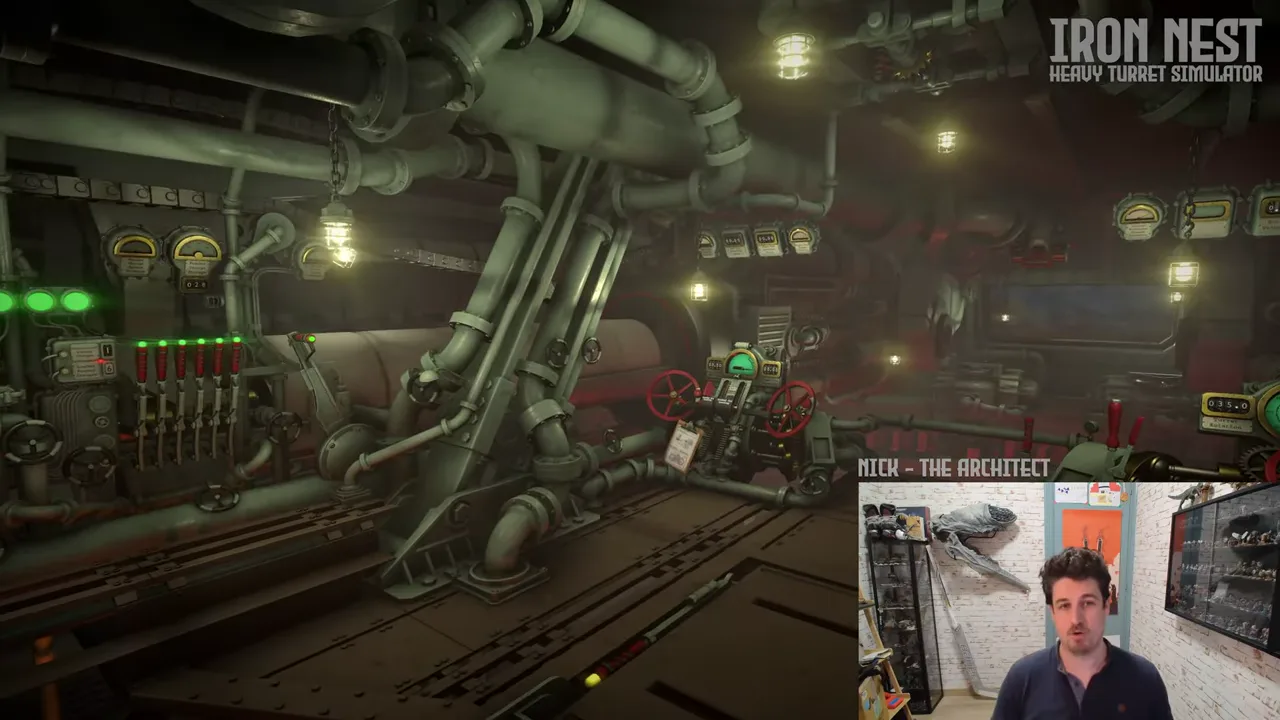
A calculator value matters only while it still belongs to the current target and machine state.
IRON NEST’s published description makes artillery operation a chain of connected tasks. The Operator reads reports, marks an interactive map, calculates trajectory, chooses ammunition, sets charges and elevation, turns the heavy turret and reviews the effect through aerial photographs. That chain has a practical requirement: its parts must still belong together when the shot is fired. A perfect calculator result does not help if it was produced for an old target mark. A correct shell label does not help if the charge and elevation belong to another solution. A carefully chosen target does not help if the turret is still aligned to a previous bearing.
This reference calls that requirement configuration state integrity. It is not an official in-game term or a claim that the game exposes a single integrity indicator. It is a concise way to understand the confirmed multi-station workflow. A configuration is intact when the map relation, ballistic inputs, ammunition choice, gun settings and turret orientation all describe one current intended action. It is broken when a player carries a value across a change without verifying whether the rest of the configuration changed with it.
A solution is a set, not an isolated number
The ballistic calculator named on the Steam listing is naturally tempting to treat as the center of every firing decision. It is important, but it is only one part of a solution. A result comes from inputs that are meaningful only in relation to the current target and current machine state. When the map position changes, range and bearing may change. When a player chooses another projectile or charge, the elevation relationship may change. When the turret moves, the prior alignment may no longer describe the same target.
Thinking in sets prevents a common mental shortcut: “I already have the answer.” A number can be correct for the question that produced it and still be wrong for the question now on the console. The safe habit is to attach a calculator result to a short label: target, map placement, shell, charge, elevation and orientation. If any member of that label changes, the player has reason to recheck the rest.
The public product description does not publish a full mathematical model or a UI flow for every input. The principle does not require either. It follows from the fact that the game presents separate map, calculation, ammunition and gun-control stages.
Preserve target identity before calculating
The current listing says reports arrive through High Command and frontline radio traffic, and that the Operator should track who said what. That provenance matters for configuration integrity because a target is not merely a point. It is a point associated with an instruction, observation or uncertainty. Before recalculating, establish which report or objective the current marker represents.
If a player shifts to a new target but keeps an old calculator value, the integrity problem is obvious. More subtle cases matter too. A new report may refine the location of the same target. A moved turret may change the relationship to a still-valid target. An objective may change the desired action even while the point remains. In each case, a configuration can become stale without any single number looking absurd.
Write or mentally state the target identity before touching the calculator: “this result is for this current mark, from this report, with this purpose.” That small practice makes a later mismatch easier to diagnose. It also avoids claiming that every incoming message is equally authoritative; the game’s own description encourages source-aware handling.
Match ammunition to the intended action
IRON NEST advertises a combined thirty ammunition types and abilities, and its official material visibly associates artillery operation with shell choice. The public listing does not publish a complete effect table for every shell, ability or target condition. A player should therefore make the narrow claim that a selected shell is part of the configuration, not invent an exact outcome formula.
Configuration integrity asks a simpler question: is the loaded or selected ammunition the one assumed when the plan was made? Shell selection is easy to overlook after a previous task, especially when the player moves between stations. If a new target needs a different approach, treat that as a new configuration rather than a minor edit to an old one. Record the intended shell and verify the visible state before the next step.
This habit is useful even when the player does not yet know every ammunition behavior. It separates a learning question about which shell is appropriate from an execution question about whether the chosen shell was actually the shell used. A post-action review can only answer the first question if the second is documented.
Reconcile charge, elevation and orientation
The Steam page explicitly names charges, elevation and the massive turret’s turning behavior. These are physical expressions of a firing plan. A player should treat them as a linked configuration rather than three independent sliders. A change in one element should trigger a quick review of the others. If the turret has taken time to swing or the plan changed while moving, the player should verify that the final direction still corresponds to the current map relationship.
The exact relationship between these controls belongs to the live game and current interface. This article does not claim a particular range table, a universal zeroing rule or a specific animation state. It explains a robust check: confirm that all visible settings are describing the same target and the same planned shot at the moment of firing.
The developer-owned video gives the operator workspace visual context, while the product page establishes the named physical controls. That combination supports the idea of manual, connected setup without authorizing unobserved mechanics.
Treat movement and new information as invalidation events
Not every action needs a complete rebuild. The useful skill is recognizing when a prior value might no longer be valid. A new target mark, corrected report, different shell choice, changed charge, adjusted elevation or major turret relocation are obvious invalidation events. So is any visible mechanical issue that calls a control state into question, since the official listing says mechanisms can fail.
When one of these events occurs, pause at the earliest affected stage. If the report changed, verify the map before recalculating. If the map changed, rebuild the solution. If the calculator inputs changed, verify the gun settings. If the turret moved unexpectedly, reconcile orientation before assuming that another variable caused a miss. This order reduces wasted rework and protects the evidence needed to learn from an outcome.
The goal is not to turn every operation into a checklist recital. It is to keep the chain legible enough that speed does not convert into confusion. Skilled repetition should make the checks quicker, not make them disappear.
Use aerial feedback to audit the configuration
The listing says aerial photographs arrive after a strike and that battlefield scars persist. These features make configuration integrity testable after action. Compare the visible outcome with the target mark and the recorded settings. If the effect is not where expected, ask which part of the configuration could have diverged: source interpretation, target placement, calculator inputs, ammunition selection, charge, elevation, alignment or visible readiness.
Do not leap from one outcome to an invisible rule. An aerial photo can support an observation about an impact or consequence; it does not necessarily expose every cause. Use it to prioritize the next check. A configuration review is more productive than changing every number at once because it retains the ability to link a correction to a result.
A compact integrity check
Before firing, confirm: this is the current target and objective; the target mark represents the latest justified evidence; the calculator result belongs to that mark and current position; ammunition matches the plan; charge and elevation match the result; turret alignment matches the required direction; and no visible fault or interrupted state undermines readiness. After firing, record the outcome and revise the first uncertain stage rather than rebuilding everything blindly.
IRON NEST’s manual systems become satisfying when a player can tell the story of a shot from message to aftermath. Configuration state integrity is the discipline that keeps that story internally consistent.