How to Verify Procedural Objectives in IRON NEST
A source-led method for approaching IRON NEST procedural objectives without inventing hidden mission rules, using briefing evidence, controlled execution and after-action review.
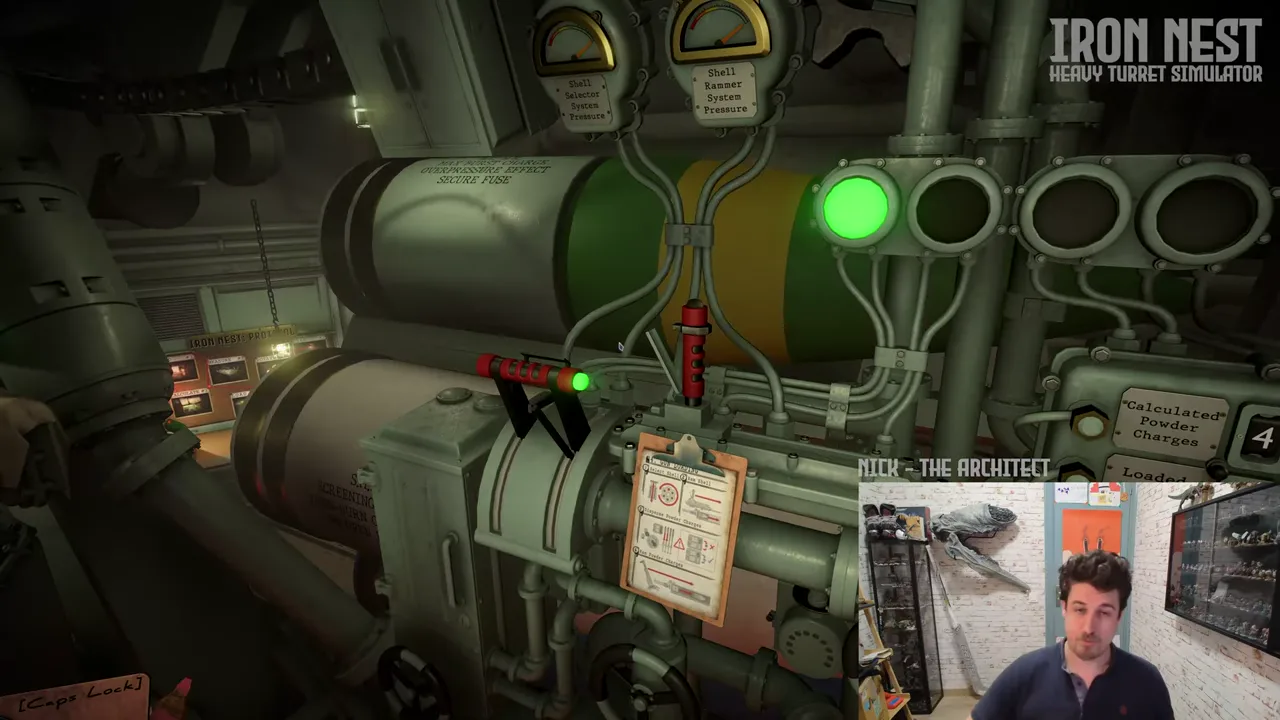
IRON NEST officially advertises a handcrafted story alongside procedurally generated objectives. That statement is useful, but it is not a public specification for every mission type, trigger, failure state or reward rule. A responsible guide should not turn the word “procedural” into an invented list of random targets, timers, map rules or hidden scoring formulas. The better approach is to treat a procedural objective as an evidence problem: establish what the briefing says, preserve what you actually did, inspect the outcome and only then decide what has been learned.
This method fits the game’s published operator fantasy. The current Steam listing describes an Operator receiving reports through two teleprinters, placing intelligence on an interactive map, using a ballistic calculator, selecting ammunition, setting charges and elevation, traversing a heavy turret, and reviewing results through aerial photographs. That is already a verification loop. A good mission review does not need access to an internal objective generator; it needs a clean record of the visible evidence and a willingness to distinguish facts, inferences and unknowns.
Start with the current briefing, not a remembered template
Before using an old checklist, write down the mission-facing facts visible in the current build. Identify the named primary objective, any stated secondary task, report sources, target descriptions, location information, time pressure and the consequence the briefing explicitly mentions. If the game presents a message through High Command and another through the frontline, keep those statements separate. They can support the same conclusion, conflict with one another or answer different questions.
This is especially important for procedural work. A player may recognize a familiar map layout or target label and assume the rest of the task follows an earlier mission. That is an inference, not confirmation. The reliable starting point is the text and signals in front of you. A target marker proves that something has been placed on the map; it does not automatically prove the desired shell, success radius, stage order or medal requirement unless the current interface says so.
Make a short objective record before touching a gun control. It can be as simple as: stated goal, report source, plotted location, evidence confidence and unresolved question. This prevents a later miss from becoming a blur of half-remembered assumptions.
Separate target identity from a firing solution
The official description makes clear that IRON NEST includes both an interactive map and a ballistic calculator. These are connected, but they answer different problems. The map work establishes where a reported situation belongs relative to the current turret position. The calculator helps translate a chosen target relationship into operational settings. Shell type, charge, elevation and turret orientation then have to agree with that solution.
For objective verification, do not collapse these stages into “the game told me to shoot there.” Ask four questions. First, what is the target or task named by the briefing? Second, what evidence supports its plotted location? Third, what settings were selected to act on that location? Fourth, what result was observed afterward? When a procedural objective fails, this separation narrows the possible cause. A wrong map mark is different from a correct mark paired with stale calculator inputs; both are different from a shot whose goal was misidentified.
The method also avoids unsupported claims. The Steam page confirms a manual artillery workflow and aerial photos, but it does not publish every damage model or objective formula. You can record that a certain setting produced a certain visible outcome. You should not claim that the game always uses an undisclosed multiplier or threshold unless repeatable current-build evidence establishes it.
Execute one traceable attempt
When a mission is uncertain, the first attempt should optimize for learning as well as success. Record the target marker, shell choice, charge, elevation, bearing or traverse state and the relevant report text. Do not change several uncertain variables at once merely because the objective feels urgent. If the second attempt differs in shell, target position, charge and elevation, its result cannot tell you which adjustment mattered.
This is not a demand for perfect real-world artillery procedure. It is a way to make the game’s visible information useful. The published product page promises manual operation and possible mechanical failures, so a record should also note whether the machine appeared ready and whether a fault or interrupted interaction was visible. If an input did not register, report that as an input or state observation rather than reclassifying it immediately as an objective rule.
For players who want fast challenge attempts, the same discipline still pays off. A short note made during a failed run can turn the next run into a meaningful test. A vague memory usually turns it into another guess.
Review visible consequences carefully
IRON NEST advertises aerial photographs and persistent battlefield scars. Those are strong reasons to make outcome review part of every objective workflow. Compare what the aerial evidence shows with the intended target and the objective text. Did the visible impact correspond to the plotted point? Did an explicit mission-state message change? Did the briefing introduce a new stage? Did the target remain, move or become less certain? Write only what the interface or image supports.
The key boundary is between observation and explanation. “The aerial evidence shows an impact west of the mark” is an observation. “The objective requires an invisible westward correction rule” is an explanation that needs more evidence. “The objective did not visibly update after the impact” is a useful troubleshooting record. “The game is bugged” is not yet established without checking the current objective wording, inputs, version and reproducibility.
If a multi-stage structure seems present, label it carefully. A pre-release developer Q&A discussed an intention for many new missions to have multiple stages, primary objectives and secondary objectives. That is useful historical context, but the released build and current mission interface are authoritative. Treat a new message or state change as evidence of a stage only when it actually appears in the version being played.
Turn a failure into a controlled second test
After a failed or ambiguous result, choose the smallest defensible change. Recheck the report source and map mark before changing ballistics. Recheck inputs before changing ammunition. Recheck the displayed objective before assuming that a visible impact is sufficient. This order follows the published system’s logic: intelligence, map work, calculation and physical execution are linked but not identical.
Keep the second test focused. If the evidence suggests the target was plotted incorrectly, correct the plot while keeping the verified shell and loading setup stable where practical. If the target appears correct but range or elevation is suspect, retain the map mark and test the solution. If no visible state changed, collect a concise reproducibility note: mission context, exact objective wording, actions, observed result and whether the outcome repeats after a clean restart. That note is useful whether the issue turns out to be a misunderstanding, a feature boundary or a defect.
What the sources do and do not establish
The released Steam listing establishes that IRON NEST combines story material with procedurally generated objectives. It also establishes the broad manual loop: reports, map, calculator, gun controls and aerial feedback. The developer video gives visual context for the operator workspace. Neither source publishes a complete catalogue of procedural generators, success conditions, spawn weights, challenge score formulas or every campaign trigger.
That absence is not a reason to fill the gaps with confident lore. It is a reason to keep a verification record. A wiki becomes more useful when it can say “confirmed,” “observed in this context,” and “not yet publicly documented” without treating those labels as failures.
A dependable procedural-objective checklist
For any procedural objective, record the current goal and exact wording; preserve each report source; plot only what the evidence supports; note the target relative to the turret; record shell, charge, elevation and traverse; execute one traceable attempt; review the aerial and mission-state evidence; then change one uncertain variable at a time. If the problem repeats, create a concise report rather than inventing a hidden mechanic.
This process respects both halves of the published design. It gives the player room to act under pressure, while making every outcome useful evidence for the next decision. That is a stronger way to learn procedural objectives than memorizing a mission that may not repeat in exactly the same form.
Frequently asked questions
Does the official listing confirm procedural objectives?
Yes. The current Steam listing advertises a handcrafted story alongside procedurally generated objectives, but it does not publish a complete objective generator or every success condition.
Can a player infer a hidden rule from one failed attempt?
No. Treat one attempt as evidence about that attempt. Record the briefing, inputs and result, then change one testable assumption rather than converting an observation into a universal rule.