How IRON NEST Missions Work: Objectives, Stages and Consequences
A spoiler-light, source-led explanation of IRON NEST's mission loop, evolving objectives, intelligence workflow, challenge modes and movement choices.
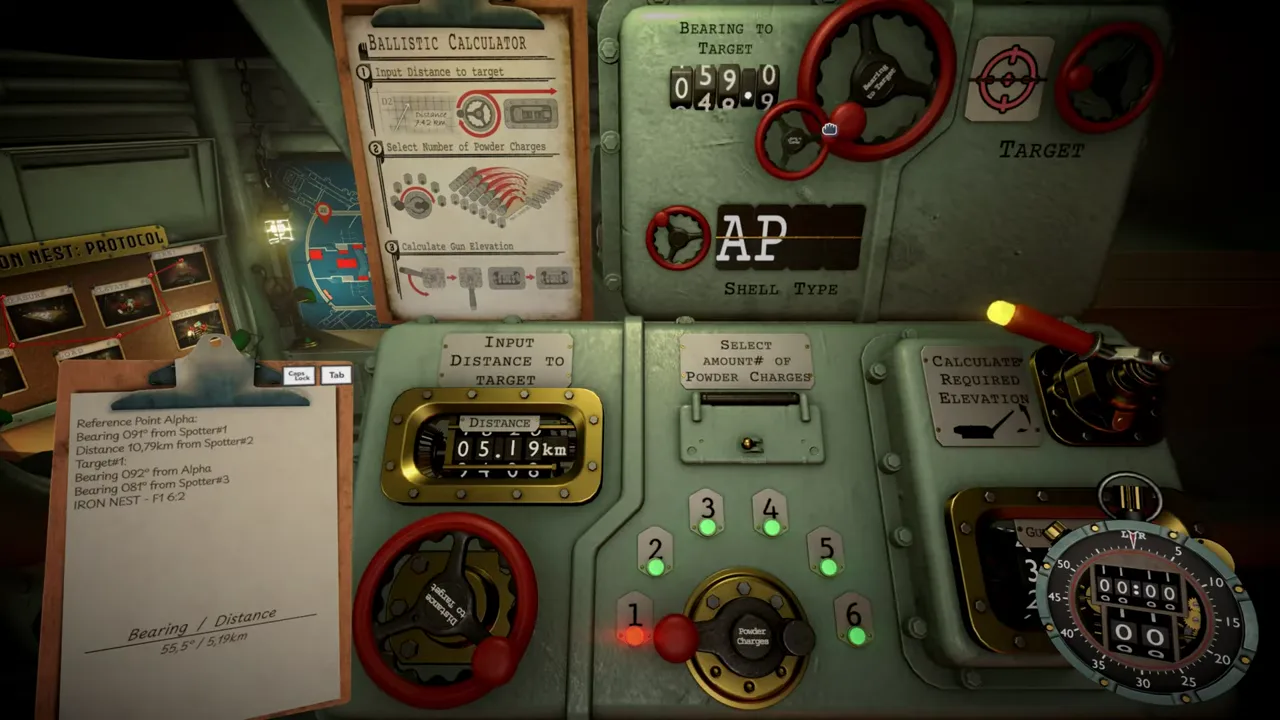
An IRON NEST: Heavy Turret Simulator mission is a chain of information and physical operations, not a waypoint followed by a single trigger pull. A directive arrives, intelligence gives it geographical meaning, the operator turns that meaning into a firing solution, and the turret performs the shot. The battlefield then answers back through new reports, photographs, damage and changing priorities.
That loop explains why the official Steam page can describe both a handcrafted story and procedurally generated objectives. The permanent machinery creates a consistent operating language, while objectives can change what information is available, which targets matter and what consequences follow. Campaign missions can build authored dramatic sequences on the same controls that support repeatable challenges.
This guide is deliberately spoiler-light. It explains the structure shown and described by official sources without naming every operation or pretending that a pre-release answer guarantees the exact behavior of every version 1.0 mission.
The basic mission loop
Most operations can be understood as six connected phases:
- Receive a directive or frontline report.
- Identify the target area from coordinates, bearings, ranges or photographs.
- Measure from the turret and prepare a firing solution.
- Choose the appropriate ammunition and powder charge.
- Lay, load and fire the guns through the physical controls.
- Evaluate the outcome and respond to the next objective or consequence.
These phases are conceptual rather than a rigid interface checklist. Information may arrive while the turret is already moving. A secondary objective may interrupt the current calculation. A photograph may reveal that the result of an earlier choice has changed the battlefield. The important point is that a mission asks the player to maintain continuity across stations.
The image above captures that density. The ballistic calculator sits beside a protocol board and a page of target information. Distance, bearing, shell type, powder charge and elevation occupy different controls. A mission succeeds only when the operator keeps those values associated with the same target.
Directives and reports begin the operation
The official description gives the turret two information channels. A teleprinter delivers priority directives from High Command, while another relays calls from the frontline. This creates more than atmosphere. It gives missions multiple ways to define urgency and authority.
A formal objective may state what High Command wants destroyed, protected or supported. A frontline call can add local information that changes how the operator understands the task. Neither automatically supplies a complete firing solution. Coordinates still have to be interpreted, reports compared and the target placed on the tactical map.
Operators should preserve the original message until the shot is complete. Many errors that look like faulty ballistics begin as faulty transcription: using the wrong observer as an origin, exchanging two digits, applying a bearing to the wrong target or measuring from the observer instead of from the turret. The mission loop rewards disciplined handling of evidence before speed at the controls.
The map turns intelligence into an objective
The tactical map connects the reported battlefield to the enclosed machine. The official Steam page calls it both a measurement surface and a window onto the battlefield. Aerial photographs reveal outcomes, while markers and measuring tools help the operator construct locations and ranges.
That work can begin with a direct coordinate, but the developer’s Q&A also describes problems built from forward observers, bearings and ranges. One report may define a line. Another may constrain distance or provide a second perspective. The player uses the combination to identify a likely target area, then measures the distance and direction from the turret’s current location.
This is where mission knowledge becomes gun data. The target’s relationship to an observer answers an intelligence question; its relationship to the turret answers a firing question. Treating those as the same measurement is a reliable way to miss.
Firing is a sequence, not a confirmation button
After establishing location and range, the operator still has to configure the weapon. Official material emphasizes choosing ammunition for purpose, matching propellant charge with elevation and physically manipulating heavy mechanisms. The game preserves the transitions that many strategy games automate.
Mission context informs ammunition choice. Armor-piercing, smoke and chemical examples on the official page serve different objectives. A shell useful against a bunker is not interchangeable with one intended to screen a withdrawal. That means the “correct” firing solution contains more than an angle. It is a consistent package of target, shell, charge, bearing and elevation.
The operator then transfers those values to the actual gun controls. Even a correct calculation can fail if a previous bearing remains set, if one barrel receives the wrong elevation or if the loaded charge no longer matches the calculator input. IRON NEST makes those handoffs playable because operational competence is its core challenge.
Multi-stage missions and evolving battlefields
In the May 2026 community Q&A, the developer said most new missions were being designed with multiple stages. He described battlefields that evolve through primary and secondary objectives rather than a single static target. Because the answer predates version 1.0, it is best treated as an official design statement, not a complete catalogue of shipped operations.
The idea fits the final store description. Aerial reports show consequences, the map retains scars and every shot can affect what follows. A secondary task can ask the operator to balance immediate assistance against the main directive. A later stage can depend on whether an earlier target was hit, ignored or attacked with the wrong tool.
Multi-stage structure also changes how players should manage the turret. Resetting every station after a shot may be safe but slow. Leaving values in place may save time but creates a risk that old data contaminates the next solution. Good procedure means knowing what can remain configured and what must be verified when a new objective arrives.
Movement under counter-battery pressure
An artillery position that keeps firing can attract retaliation. During the same Q&A, the developer described two requisition-console movement options then present in the project. A move to a specified location buys time but does not stop the counter-battery timer. An emergency reposition pauses the timer but puts the player at an initially unknown location, requiring the operator to determine the new position before efficient fire can resume.
That tradeoff is an excellent example of mission design built from the core tools. The first option preserves geographic certainty but not complete safety. The second preserves immediate safety at the cost of information. Movement does not merely change scenery; it changes the origin of every subsequent bearing and range.
Because this description comes from a pre-release video, consult the relevant version 1.0 mission before relying on exact timer behavior. The durable lesson is that relocation invalidates firing data tied to the old position. A disciplined operator re-establishes origin before reusing a solution.
Campaign, procedural objectives and challenges
The official store page lists three complementary forms of content. The handcrafted story provides authored context and consequences in alternate-history Spain. Procedurally generated objectives vary the operational problem and contribute to replayability. Two challenge modes and leaderboards isolate or score particular skills.
These categories should not be collapsed. “Procedural objectives” does not mean the entire campaign is randomly written, and “handcrafted story” does not mean every target placement is fixed. The published feature list intentionally includes both. Likewise, a challenge can reuse the same turret stations without carrying the same narrative status as a campaign event.
The Q&A discussed leaderboards for challenge modes and the possibility of simple cooperative or competitive ideas, but it did not confirm full multiplayer. The current Steam page lists single-player and leaderboards rather than multiplayer. Players should therefore treat leaderboard competition as the confirmed social feature and avoid interpreting an old brainstorming answer as a shipped cooperative mode.
A practical mission discipline
Before acting, label the current objective and preserve its source. On the map, separate reported positions from inferred target positions. Once a target is fixed, write down the turret-relative bearing and range together. At the calculator, keep shell type and powder charge attached to those values. At the gun, verify bearing, elevation, loaded ammunition and intended barrel before firing.
After impact, wait for evidence. A mission may communicate success through a new directive, a frontline call, a photograph, a newspaper or a changed objective. Do not assume that a dramatic explosion alone resolves the task. Conversely, do not change several variables at once when the result is unclear; walk backward through the chain and find the broken transfer.
This procedure makes complex missions manageable because every stage has a defined question. What are we being asked to do? Where is it? How do we reach it? Which effect is required? Did the shot produce that effect? IRON NEST’s missions become intense when those questions overlap, but the machinery remains legible. The game does not hide the operation behind a button. It asks the player to become the link that holds the whole sequence together.
Frequently asked questions
Does IRON NEST have a campaign?
Yes. The official Steam page lists a handcrafted story in alternate-history Spain alongside procedurally generated objectives and challenge modes.
Are all objectives procedurally generated?
No. The store distinguishes a handcrafted story from procedurally generated objectives. The developer also described many missions as multi-stage scenarios with primary and secondary objectives.
Does moving the turret end a counter-battery threat?
In the pre-release Q&A, the developer described a requested move that buys time without stopping the timer and an emergency reposition that pauses it but sends the operator to an initially unknown location. Exact version 1.0 behavior should be checked in the relevant mission.
Sources
- IRON NEST official Steam page — campaign, procedural objectives and challenge modes
- Developer Q&A — mission structure at 43:24
- Developer Q&A — movement and counter-battery options at 42:34
- Developer Q&A — challenge modes and leaderboards at 39:23
- Official launch trailer — mission stations and firing workflow