High Command in IRON NEST: What the Game Actually Establishes
A source-led reading of High Command, its orders, propaganda and place in IRON NEST's alternate-history Spain without turning implication into invented canon.
High Command is one of the most visible institutions in IRON NEST: Heavy Turret Simulator, yet it is deliberately difficult to see as a group of people. The operator encounters it through orders, machines, paperwork and official language. That distance matters. High Command is not merely a voice that tells the player which button to press; it is the source of authority that turns a technical firing procedure into a moral decision.
The official Steam description asks whether the operator will obey High Command. It also says that one teleprinter delivers top-priority directives from High Command while another relays calls from the frontline. Those two channels create the central tension. The command system speaks from above, but reports of immediate need arrive from people closer to the battlefield. The operator must transform both kinds of information into action from inside an enormous machine.
This page separates what the official material establishes from what its imagery invites us to infer. IRON NEST uses secrecy and propaganda as part of its style, so an unexplained emblem or redacted document should not automatically become a new faction, character or conspiracy in a wiki. Where version 1.0 has not been checked mission by mission, the honest answer is sometimes that High Command has not told us.
What High Command definitely is
At minimum, High Command is the operator’s military authority. It issues priority directives and expects the turret crew to execute them. The store page repeatedly connects its orders with the player’s control of the machine: High Command may send instructions, but the chain of command ends at the operator’s fingertips. That phrasing establishes both hierarchy and agency. Someone else chooses the objective, while the player performs the action that makes it real.
High Command is also an information source. Its messages enter a larger network that includes frontline radio traffic, aerial photographs, map coordinates and newspaper reports. Orders therefore do not exist in isolation. The player can compare an official directive with the physical evidence around it and with the consequences revealed after a shot.
The game does not need to place generals in the room for their institution to be present. A teleprinter, a formal directive and a marked tactical map carry the weight of an organization. The official launch trailer reinforces that approach with papers, machinery, maps and slogans rather than a conventional cast introduction. High Command is experienced as a system.
Its place in alternate-history Spain
The official setting is late-1920s alternate-history Spain on the brink of civil war. In this timeline the monarchy still holds power and a republican uprising is spreading. That statement gives High Command political context, but it does not answer every institutional question.
It is reasonable to describe High Command as operating within the established military order that directs the player. It is not yet responsible to state that High Command is literally the monarch, a named ministry or one particular general. The official store text does not make those identities explicit. Likewise, the mere existence of a republican uprising does not prove the allegiance of every unit, observer or civilian mentioned in a mission.
This distinction prevents a common lore error. A setting can strongly imply a relationship without formally defining it. A useful wiki records both levels: the confirmed political background and the narrower inference that the operator’s command authority belongs to the side maintaining the turret. Future dialogue, documents or endings may make the structure clearer, but those details should be added with direct citations rather than retrofitted into earlier pages.
Orders are only one side of the information war
The two-teleprinter setup is a compact model of the game’s themes. One machine carries institutional priority. The other carries direct calls from the front. Both can contain information essential to an operation, but they represent different distances from the result.
High Command can express a battlefield problem as coordinates, a target class or an objective. The operator must then locate the place, choose ammunition, calculate a firing solution, lay the guns and pull the trigger. Each step makes the player more physically involved than the authority that issued the order. The official description emphasizes that commands do not carry the consequences; the operator does.
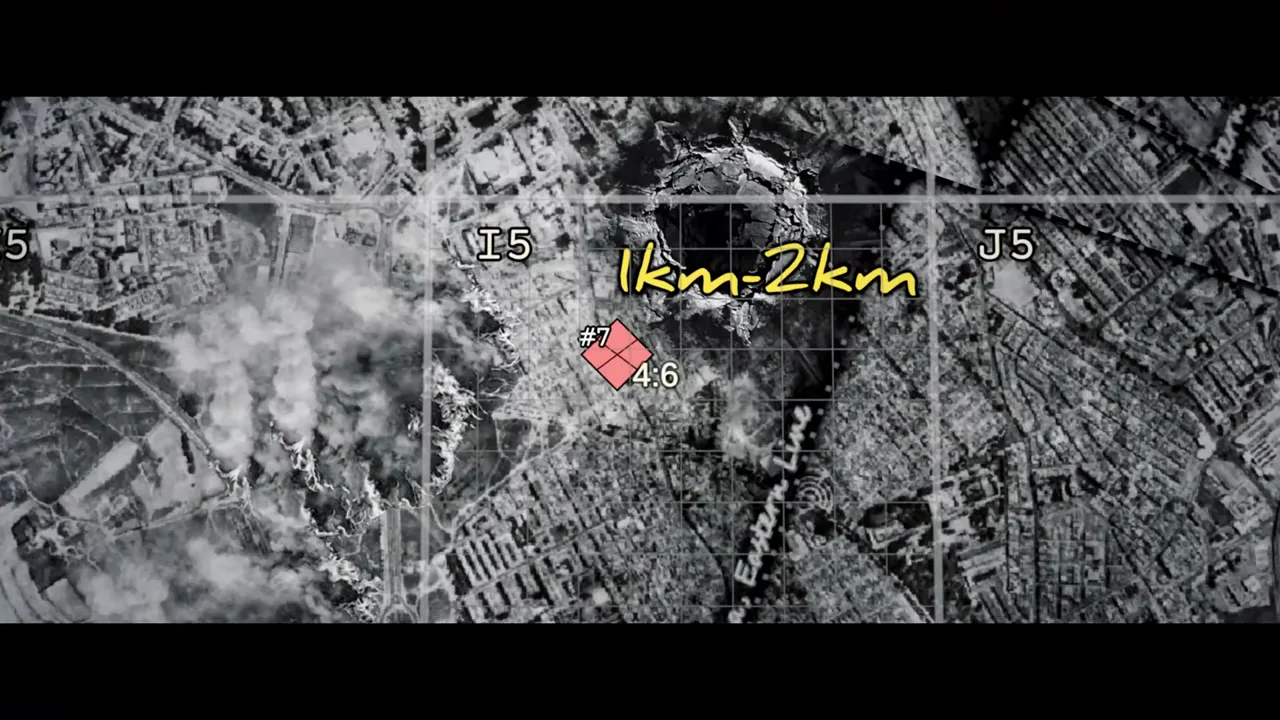
That is why the tactical map is more than a user interface. The frame above, taken from the official launch trailer, shows aerial imagery divided into grid squares, handwritten distance information and a marked location. It visually connects administrative data with a damaged landscape. The operator can move a marker, but not erase the effects represented by the photograph.
Propaganda and bureaucratic distance
IRON NEST presents military power through deliberately theatrical language. Official slogans celebrate machinery, ridicule injury and classify inconvenient facts. Newspaper reports and formal paperwork turn events into approved stories. This propaganda is not decorative wallpaper; it shapes how the player receives information.
High Command benefits from bureaucratic distance. A clean order can reduce a complicated place to a target, just as a newspaper can reduce an uncertain event to a headline. The operator, however, must manage the untidy mechanical process between instruction and impact. Hydraulics take time. Charges and shell types have specific uses. A misplaced bearing can turn precision into disaster.
The contrast supports satire without making every statement a lie. Some orders may be tactically sound, some reports may be accurate and some official praise may reflect real success. The critical reading is not “High Command always lies.” It is that the institution controls one channel of the narrative, while the player has access to other evidence. Truth has to be reconstructed from the relationship among them.
Why High Command remains faceless
Keeping the authority remote strengthens the operator fantasy. The player is confined to a colossal turret yet connected to an entire front through instruments. A conventional commander appearing in every scene would personalize responsibility and make the conflict easier to read. The faceless institution instead encourages the player to think about systems: who selects information, who defines necessity, who performs violence and who writes the report afterward.
It also mirrors the game’s mechanical design. Most interaction happens through devices rather than dialogue trees. Direction arrives as paper from a machine. Consequences arrive as photographs, calls and reports. High Command fits that grammar because it, too, is mediated by equipment.
That does not mean no individual leaders exist in the fiction. A military hierarchy obviously contains people. It means the cited official material does not yet give this page enough evidence to name or profile them. “Faceless” describes the player’s presentation of the institution, not a metaphysical claim about the world.
Obedience, choice and responsibility
The repeated question “Will you obey?” signals that obedience is meant to be examined rather than assumed. The store page describes strategic decision-making, a handcrafted story and consequences. It also pairs battlefield utility with morally loaded ammunition descriptions. Together, those elements establish a game interested in what operators do with authority.
We should still avoid converting that theme into an undocumented branching chart. Without verifying every version 1.0 mission, this page does not promise that every order can be refused, that each refusal produces a unique ending or that High Command reacts in a specific way. Narrative framing and mechanical options are related, but they are not identical.
A safer interpretation is that responsibility persists even inside a hierarchy. The operator may receive a goal, but remains responsible for measurements, ammunition and execution. A bad calculation cannot be blamed on an abstract order. A technically perfect shot may still raise a moral question. High Command explains why the gun is pointed somewhere; it does not remove the player’s hand from the trigger.
How this institution may fit the wider IRON NEST universe
In the May 2026 developer Q&A, the creators described the Spanish civil-war setting as the beginning of a broader IRON NEST universe and discussed the possibility of later games expanding elsewhere in Europe and beyond. That is a dated development statement, not confirmation of a particular sequel or future faction list.
It does suggest that High Command should be documented precisely. The term may be specific to this campaign’s authority, or it may become a recurring way of representing institutions across the setting. Until later official works answer that question, this wiki treats the version 1.0 presentation as the boundary of confirmed canon.
High Command is therefore best understood as an institutional character. It has a voice, priorities and power, but its body is a network of teleprinters, directives, maps and propaganda. The operator never needs to meet a general to feel the pressure of command. Every arriving strip of paper makes that pressure tangible—and every shot shows where the chain of command truly ends.
Frequently asked questions
Who leads High Command in IRON NEST?
The official sources cited here do not identify a single named leader. High Command is presented primarily as an institution that sends directives and expects obedience, so assigning it a specific commander would go beyond the evidence.
Is High Command the same thing as the Spanish monarchy?
The campaign takes place in an alternate Spain where the monarchy remains in power and a republican uprising is spreading, but the store description does not explicitly define High Command as identical to the monarchy. It is safer to describe it as the operator's military authority within that conflict.
Can the operator disobey High Command?
Official promotional text repeatedly frames obedience, consequences and responsibility as central questions. This page does not claim a specific branching outcome without a mission-by-mission version 1.0 verification.