IRON NEST Lore: Canon, Evidence and Source Boundaries
A source-led framework for separating confirmed IRON NEST setting facts from visual interpretation, pre-release intentions and player speculation.
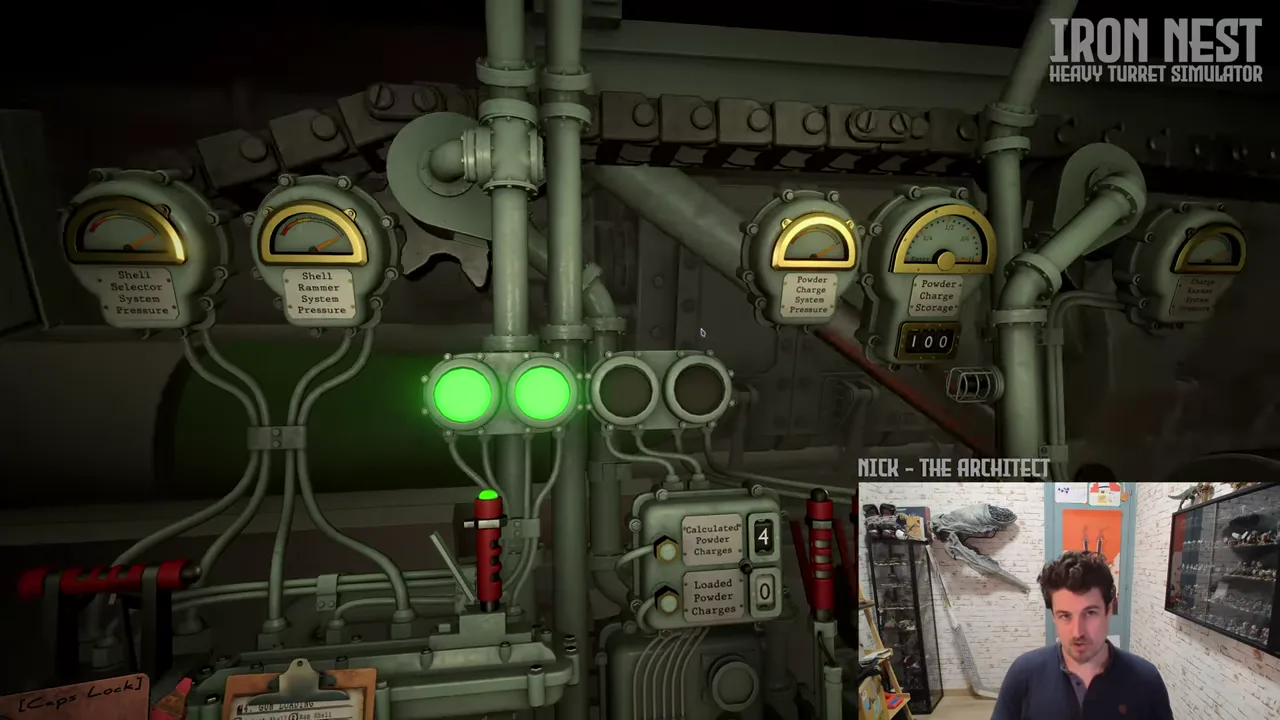
IRON NEST invites lore discussion because its world is immediately specific: late-1920s Spain, a monarchy that remains in power, a republican uprising, military bureaucracy, propaganda, dark humor and a fictional 5,000-ton spider-turret. That specificity can tempt a wiki to explain everything visible in a frame, turn a mood into a history lesson or promote a plausible fan theory into a fixed rule. A better lore reference does the opposite. It makes the boundary between what the sources say and what an observer infers visible.
The current Steam listing is the strongest public baseline for released setting facts. It describes an alternate-history late-1920s Spain in which the monarchy remains in power as a republican uprising spreads. It identifies the player as an Operator working a huge fictional turret and links that role to reports, maps, ballistics, physical controls, aerial photographs and consequence. The official developer video gives visual and tonal context for the dieselpunk workspace. Together, these sources establish a setting and an operational premise. They do not provide a complete political chronology, a named roster for every institution or a catalogue of hidden lore rules.
Treat sources as different kinds of evidence
Not every source answers the same question. The released Steam product page is good evidence for current public positioning, listed features, broad setting and release-era facts. In-game text is strongest for a line, objective or character detail encountered in the current build. A developer-owned video is strong evidence for what it visibly shows and for statements made in the video, but a frame alone may not establish what an object is called or how a system behaves off-screen. A pre-release interview or Q&A records what was intended or discussed at a particular time; it should not silently override the released game.
This does not make older material useless. A dated Q&A can explain why a feature or story direction was discussed. A trailer can preserve early public language. The important step is labeling it. “In a pre-release Q&A, the developer discussed…” is a historically precise statement. “The game always does…” may not be justified unless the released build demonstrates it. Source labels make a lore page more durable when patches, edits or fuller information appear.
Confirmed setting facts have clear wording
The Steam listing gives several clean anchors. IRON NEST is set in an alternate-history Spain in the late 1920s. The monarchy remains in power, a republican uprising has spread, and the player is the Operator of a massive heavy turret. The listed tone includes dieselpunk framing, propaganda and dark humor. These statements can be repeated confidently because they are part of the official current product description.
They also establish what should not be claimed. The setting is alternate history, so the wiki should not identify the fictional turret as a real historical artillery platform. The fact that Spain and recognizable political terms appear does not turn every map, insignia or report into a claim about a specific real event. The product description gives an alternate-history premise, not a complete academic reconstruction.
The same caution applies to scale. The official page calls the turret 5,000 tons and describes it as a heavy spider-turret. That supports statements about its fictional enormity and dieselpunk identity. It does not by itself establish a blueprint, manufacturing history, exact crew complement or a list of real-world engineering analogues. A good lore entry preserves the impressive confirmed detail without building unsupported scaffolding around it.
Visual reading is valuable when it stays visual
Official footage can show a teleprinter, a console, a task card, a cat companion, a warhorn, an aerial photograph or a particular interior texture. These are useful observations. A source-conscious caption can say that a video frame depicts a cramped operator workspace or visible mechanical controls. It should avoid claiming an unseen system from one image alone.
For example, visible propaganda design can support an observation about the game’s tone. It does not automatically establish the full ideology, agency or decision power of a faction. A newspaper report can support a claim that the game uses news or propaganda as part of its presentation; it does not prove a branching media simulation unless the current interface and official descriptions say so. A frame of a cat companion supports the fact that an official listing mentions a cat; it does not establish a detailed companion mechanic.
This is not an attempt to drain meaning from art. It protects meaning. When the evidence is named accurately, a reader can appreciate the atmosphere without being asked to accept a fiction about how the game works.
Separate diegetic claims from product claims
IRON NEST’s reports, teleprinters and newspaper-like material may make statements from within its fictional world. These can be lore evidence, but their status inside the story matters. A High Command message is a message from an institution in the setting. It may be an order, a claim, a propagandistic framing or an incomplete account. The game’s official page even emphasizes that the Operator should track who said what, which encourages players to think about provenance rather than treating every message as neutral truth.
A product-page claim is different. When Steam says the game contains two teleprinters, that is an external publisher/developer description of a feature. When a teleprinter in the game makes a claim about an event, that is part of the fiction. Keeping these levels separate avoids a common error: using in-world rhetoric as proof of the real-world development history of the game, or using a feature description as proof that an in-world speaker is reliable.
For lore analysis, this distinction is productive. It allows a page to say that the setting uses conflicting or perspective-bound information without asserting that every report is deliberately false. It allows a reader to discuss propaganda as a theme without inventing a hidden alignment system or moral meter.
Released material outranks intent for current lore
Pre-release material is especially tempting because it can be more conversational than a store description. A developer may mention an ambition, an early mission idea or an approach to story structure. That material belongs in a release history, but it needs a date and a scope. The current product listing confirms a handcrafted story alongside procedurally generated objectives; it does not publish every narrative route mentioned before release.
When sources conflict or differ in emphasis, do not force a false certainty. State the released source first, then present the older source as context. If the current build can be observed, record the version and the exact text. This approach does not diminish developer commentary. It simply recognizes that a game can change between a discussion and launch.
The same rule helps with theories. A theory can be compelling, carefully argued and still remain a theory. It should cite the detail that inspired it, state the inference and name what would confirm or challenge it. That is more respectful to readers than writing an imagined conclusion in encyclopedia voice.
A practical confidence vocabulary
Use three plain labels. Confirmed means a current official product description, official release material or current in-game text directly supports the statement. Observed means a public official video or a current build shows the detail, but the source does not establish every implication. Inferred means the conclusion follows reasonably from evidence but is not stated directly. Add unverified when a claim is repeated in community discussion without a source strong enough to support it.
These labels work well in prose. “The alternate Spanish setting is confirmed by the current Steam description.” “The developer video visibly shows a particular control-room motif.” “It is reasonable to infer that the interface is meant to feel bureaucratic, but the exact institutional history is unverified.” Such sentences give readers enough context to judge the claim themselves.
What a durable lore page should do
A durable IRON NEST lore page should connect its claim to a source, distinguish real-world product facts from in-world statements, date pre-release commentary and avoid filling silent spaces with invented names, timelines or mechanisms. It should also let visual and tonal analysis breathe. The official setting is rich enough without pretending that every unanswered question already has a canonical answer.
The strongest conclusion is simple. IRON NEST officially establishes an alternate-history, late-1920s Spanish dieselpunk world in which one Operator works a gigantic fictional turret during a republican uprising. Beyond that anchor, the wiki should show its evidence, label its interpretations and leave room for the game’s actual text to speak.
Frequently asked questions
What lore facts are confirmed by the released Steam listing?
The listing confirms an alternate-history late-1920s Spain, a monarchy that remains in power, a republican uprising and the player role as Operator of a fictional 5,000-ton heavy turret.
Are pre-release developer comments automatically current canon?
No. They are valuable dated context, but the released product and current in-game text are stronger evidence for what is present now.