How to Read Pre-Release and Current IRON NEST Information
A practical evidence guide for separating current IRON NEST release facts from demo observations, trailers, interviews and pre-release development intentions.
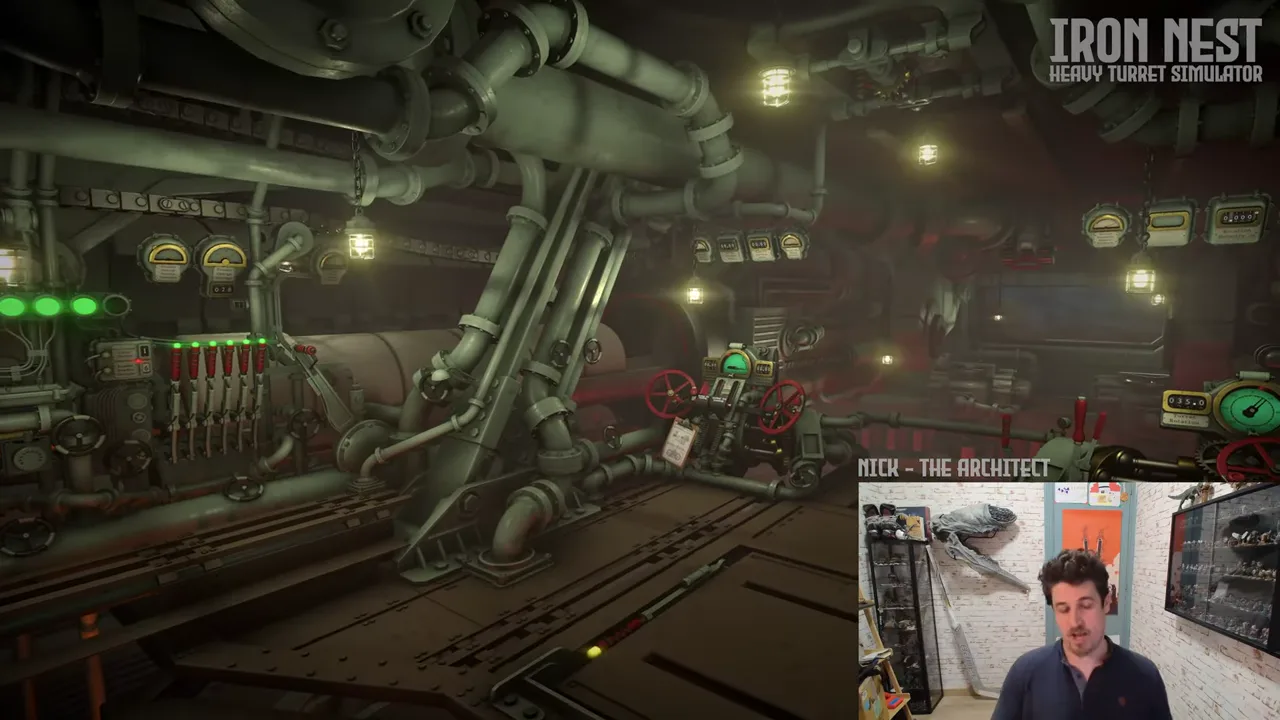
IRON NEST has both a current full Steam listing and a separate demo listing, plus launch material, developer videos and a pre-release Q&A. That is useful source material, but it does not all have equal authority for every question. A player deciding what is available now needs a different source from a reader studying how an idea was discussed before launch. A wiki that mixes those questions can accidentally turn an old intention into a current feature, or treat a demo observation as proof of the entire game.
The current full Steam listing establishes the basic release-era baseline: IRON NEST: Heavy Turret Simulator released on August 6, 2026. It presents a single-player heavy-artillery workflow involving reports, a map, ballistic calculation, physical controls and aerial photographs. It also lists the broader product framing: a handcrafted story, procedurally generated objectives, regions, medals, ammunition types and abilities. The demo has its own Steam page and remains a separate object of evidence. It can show what its current downloadable build does; it cannot automatically enumerate the full release’s content.
Start by defining the question
Before comparing sources, decide what you need to know. “Has the full game released?” is a status question. “What did the demo let players try during a particular period?” is a historical or testing question. “What did the developer hope to include before launch?” is a development-history question. “How does the current installed build behave?” is a version-specific gameplay question.
Each question has a preferred source. Current release status should come from the live full-product page and current storefront state. Demo availability and advertised scope should come from the demo listing. A feature visible in the installed build can be described with a version note and an exact observation. A developer Q&A or interview can be used for dated context, but its language should preserve the date: “the developer said,” “was considering,” or “described an intention.”
This step prevents a familiar error: asking a 2026 pre-release clip to answer a question about a later release build. The clip may still be accurate, but it is not automatically the newest evidence.
Use the full product page for current public claims
The full Steam listing is the clearest public source for what the released product currently advertises. It identifies the August 6, 2026 release date, publisher/developer presentation, supported feature labels and the game’s manual heavy-turret premise. It also supplies broad content claims such as the alternate-history setting, 15 regions, more than 100 medals, two challenge modes with leaderboards, and a combined thirty ammunition types and abilities.
Those claims should still be read at their actual level of detail. A statement that there are 15 regions does not publish every region name or route. A combined total of ammunition types and abilities does not reveal every unlock condition. A stated challenge mode does not provide a complete scoring formula. The product page is strong evidence for the listed feature category and count; it is not a reason to fill unlisted details with guesses.
When a store page changes, record the access date or archive a quote with its source. This lets a future reader distinguish a live marketing description from a claim that was true at an earlier point.
Use the demo as a bounded test, not a miniature encyclopedia
The IRON NEST Demo Steam page can establish that a distinct demo listing exists and what that listing currently says. A player can use a demo to test local performance, controls, readability and whether the central operator loop feels appealing. The observation should be phrased narrowly: “this demo build shows,” “this prompt appears in the downloaded demo,” or “this system did not appear in this session.”
The last sentence is especially important. An absence in a demo is not proof that the full release lacks the feature. The full game listing advertises a much broader set of campaign, region, challenge and progression features than any short trial necessarily demonstrates. Conversely, a demo behavior may not remain unchanged after launch. Do not turn either gap into certainty without newer evidence.
The most useful way to write demo notes is as a test protocol. Record the platform, date, build if visible, intended test, settings used and observable result. That produces a recommendation a reader can repeat rather than a vague claim that the demo “proves” overall quality or full-game scope.
Videos establish what they show and what they say
Developer-owned public YouTube videos are excellent sources for official framing, visual design and direct statements in the video. A frame can show an operator station, a map, a control surface, a task card or the game’s dieselpunk atmosphere. A trailer narration can establish the wording spoken or shown at that time. The official developer video cited here provides release-era visual context for the heavy artillery workspace.
Video evidence has limits. A short frame does not establish an invisible rule, a universal control layout or a feature that is not actually shown or stated. A trailer may simplify a workflow for presentation. A visible label may establish that the label appeared in the footage, but it may not prove its current implementation. Cite the timecode and say what the video supports.
This is why images on the wiki retain source metadata. The image is editorial context from an official channel, while the linked Steam page or in-game text carries the stronger claim about a current feature. Keeping those roles distinct improves both attribution and accuracy.
Treat Q&As and interviews as dated development context
The developer Q&A is valuable because it makes early thinking more visible. It discussed topics such as calculator work, challenge modes, story, movement and multi-stage mission intentions. That material can help readers understand the design conversation before release. It should not be rewritten as a guarantee that every described idea shipped unchanged.
Use explicit time language: “In a pre-release Q&A, the developer described an intention…” Then contrast it with the released listing or current build when the topic matters. For example, the current listing confirms a handcrafted story and procedural objectives. If the Q&A describes a possible structure for future missions, the right conclusion is that it was a stated pre-release plan, not a complete current mission specification.
This standard also protects good reporting when a feature evolves. A change from an early comment does not necessarily mean anyone was misleading; software development changes plans. The wiki’s job is to preserve the sequence clearly.
Resolve conflicts by recency and specificity
When two official sources differ, prefer the source that is both newer and more specific to the question. A current full-product page usually outranks an old trailer for current availability. Current in-game text usually outranks a generic store tag for a particular objective. A demo listing outranks a press summary for the current demo status. A dated Q&A remains valuable for historical context even when it loses priority for current behavior.
Do not hide a meaningful disagreement. State it. A useful note might read: “The pre-release discussion used this wording; the current release listing confirms only this narrower feature.” That wording tells readers what is known without forcing an artificial reconciliation.
Avoid current review counts, prices and promotional dates unless they are checked at the time of writing and clearly dated. They are especially likely to change and are rarely needed to explain the game’s operator systems.
A practical citation order
For a current IRON NEST article, begin with the full Steam page. Add the demo page when the claim concerns the demo. Cite a developer video for visible or spoken official material, with a timecode. Add an interview or Q&A only when its date and development context matter. Use credible media coverage as secondary context, never as a substitute for the game’s own current status when a primary source is available.
Then label the claim: confirmed current feature, observed in a named build, pre-release statement or inference. This takes little space, but it prevents a reader from mistaking a historical artifact for a present-day promise.
The dependable conclusion
IRON NEST’s release, demo, videos and interviews form a useful evidence trail when each is used for the question it can answer. The current full Steam listing is the baseline for public release facts. The demo is a bounded testing environment. Official videos show and say specific things at specific times. Pre-release discussions preserve intent, not automatic release guarantees.
Readers get a clearer picture when an article says not only what it claims, but also whether it is describing the released game, a demo observation, a visible trailer detail or a dated development conversation.
Frequently asked questions
What source best describes the currently released game?
Use the current full Steam listing and the current installed build first. A demo page, old trailer or pre-release interview can provide context but may not describe every release-version detail.
Does a developer intention guarantee a released feature?
No. Treat a dated intention as development context unless the released listing or current build independently confirms it.