IRON NEST vs War Thunder: Operator Procedure vs Multiplayer Vehicle Combat
A source-led comparison of IRON NEST and War Thunder for military-game players: manual single-player artillery operations versus a free-to-play cross-platform MMO built around competitive vehicle battles.
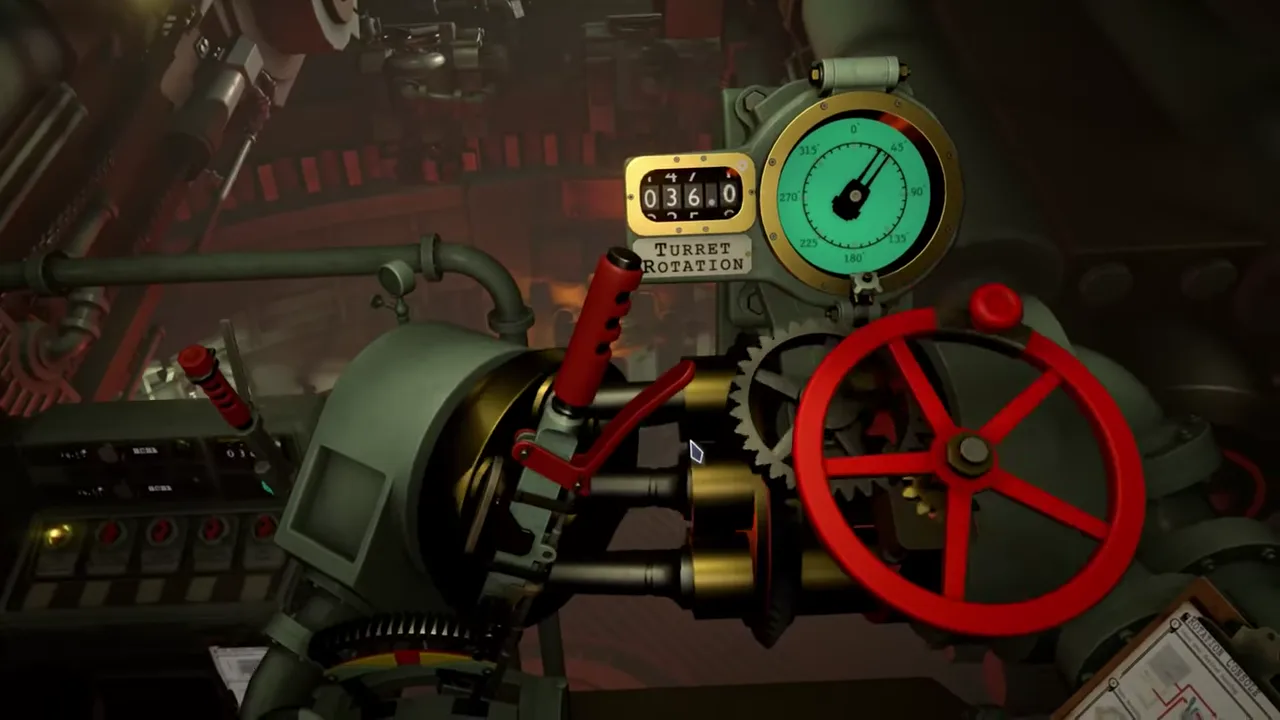
IRON NEST and War Thunder both attract people who enjoy military machinery, artillery silhouettes and the pressure of placing a shot. A screenshot can make them look adjacent: steel, guns, maps, targets and vehicles. Their official Steam pages describe almost opposite play structures.
IRON NEST is a single-player heavy-artillery operator game. The player works inside a fictional 5,000-ton turret, reads reports, makes map measurements, uses a ballistic calculator, sets charges and elevation, operates heavy controls and examines consequences. War Thunder is a free-to-play, cross-platform MMO centered on aviation, armored vehicles and naval craft, with online PvP, online co-op and large competitive battles across many vehicles and eras.
The choice is less about which game has “more realistic guns” and more about what kind of responsibility you want: slow information transformation in one enclosed machine, or rapid competitive vehicle combat in a large online ecosystem.
One shot as a procedure versus one vehicle in a battle
IRON NEST makes the path to a shot visible. The official page describes two teleprinters, an interactive map, aerial outcome photos, a ballistic calculator, charge selection, elevation wheels and a turret that takes time to rotate. The player is asked to turn reports into geometry and geometry into physical state. A shot is the end of a workflow, not the beginning of a match.
War Thunder’s official page describes battles on land, air and sea with thousands of detailed vehicles, extensive combat situations and different difficulty settings. Its core proposition is vehicle combat across a wide selection of platforms. It may include turrets, bombing, naval artillery or anti-aircraft guns, but the Steam description frames those tools as parts of larger competitive and cooperative battles rather than a single shared operator room.
If your favorite moment is planning one solution carefully and living with it, IRON NEST is the closer fit. If your favorite moment is selecting a vehicle, entering a live battle and adapting to opponents at speed, War Thunder is the closer fit.
Single-player consequence versus online competition
IRON NEST’s official features list single-player play, a handcrafted story, procedurally generated objectives, two challenge modes and leaderboards. Its tension comes from the player’s relationship with High Command, frontline reports, the machine and the aftermath of a shot. The game may have competitive score structures through its leaderboards, but it does not advertise online PvP or a cross-platform player-versus-player battlefield.
War Thunder explicitly lists MMO, online PvP, online co-op and cross-platform multiplayer features. Its official page emphasizes major battles with millions of players and a broad range of vehicles. The social and competitive context is therefore central: other players, team composition, progression systems and regular content updates shape the loop.
Do not choose IRON NEST expecting social squad play, combined-arms teams or a PvP ladder. Do not choose War Thunder expecting a solitary narrative about interpreting conflicting reports in a physical artillery room. Both can create adrenaline, but they direct it differently.
Fictional dieselpunk versus historical vehicle breadth
War Thunder describes more than 3,000 carefully crafted vehicles based on historical documents and surviving sources, spanning the early twentieth century to modern units. Its appeal includes breadth, research detail and the ability to move among aircraft, tanks, ships and other platforms.
IRON NEST is deliberately narrower and more fictional. Its setting is alternate-history late-1920s Spain, with a monarchy holding power against a republican uprising. The Iron Nest is a dieselpunk “heavy spider-turret,” not a historically catalogued tank or naval vessel. The game uses industrial and artillery visual language, but it does not claim to reproduce a historical vehicle roster.
Players seeking many real vehicles and eras should look to War Thunder. Players seeking a single invented machine with a strong material identity should look to IRON NEST. Historical interest is relevant to both, but it plays different roles.
Information design and skill expression
IRON NEST turns source provenance into skill expression. A bearing has to be drawn from its reporting observer. A distance has to be centered on its source. A target is built on the map before range and bearing can be measured from the current turret position. The calculator receives a clean range, and physical controls receive the resulting states. A mistake can be traced through the chain.
War Thunder’s official page emphasizes vehicle control, combat situations and player skill in large battles. Its detailed vehicle model and difficulty settings can create a deep skill ceiling, but the game is not marketed as an exercise in externalizing a teleprinter report into a map construction before every shot. Its tactical information and interfaces serve a different multiplayer combat model.
This is not a hierarchy of complexity. War Thunder can demand target recognition, positioning, team awareness, vehicle knowledge and fast decision-making. IRON NEST demands patient transformation of information, mechanical state management and self-auditing. The learning curve is shaped by different questions.
Progression and business model context
War Thunder is listed as free-to-play and includes in-app purchases. Its Steam page shows a large roster, ongoing content and vehicle progression context. A player considering it should evaluate the current live-service and purchase model directly from its official materials.
IRON NEST is a paid single-player release on Steam with its own progression claims: more than 100 medals, 15 regions and a combined set of 30 ammunition types and abilities. It does not advertise an MMO vehicle tree or in-app purchases in the same way. The product pages should not be used to infer equivalent grind, matchmaking, premium or update structures.
If you want a game you can approach as a self-contained operator campaign, IRON NEST is built for that. If you want a long-lived online vehicle platform with frequent content and many vehicle paths, War Thunder is built for that.
Which should you choose?
Choose IRON NEST if you want a single-player atmospheric simulation in which the work of reading, plotting, calculating and physically operating a fictional artillery system is the main event. It suits players who enjoy slow procedure, narrative pressure and a compact machine space.
Choose War Thunder if you want free-to-play online military vehicle combat across land, air and sea; enjoy competitive or cooperative multiplayer; and want a large historical roster with many vehicles and combat modes.
Play both if your interest crosses the boundary between meticulous operation and broad vehicular combat. Start IRON NEST when you want one consequential operation to occupy your full attention. Start War Thunder when you want a vehicle battle whose threats and opportunities are created by a live online match.
The dependable conclusion
IRON NEST and War Thunder share a military-machinery surface but use it for different games. IRON NEST is a single-player dieselpunk heavy-turret workflow driven by reports, map work and manual controls. War Thunder is a free-to-play cross-platform MMO built around competitive and cooperative battles among thousands of largely historical vehicles.
Choose based on the loop, not the screenshot: one machine and one carefully constructed shot, or many vehicles and an evolving online battlefield.
Frequently asked questions
Is IRON NEST a War Thunder-style multiplayer tank game?
No. IRON NEST's Steam listing identifies a single-player manual heavy-turret experience, while War Thunder is a free-to-play cross-platform MMO with online PvP and co-op features.
Do both games use historical vehicles?
War Thunder officially advertises thousands of detailed historical vehicles. IRON NEST uses a fictional dieselpunk heavy turret in alternate-history Spain.