IRON NEST vs The Invincible: Operational Procedure or Philosophical Exploration
A source-led comparison of IRON NEST and The Invincible for players who like analogue machinery, demanding information work and science-fiction atmosphere.
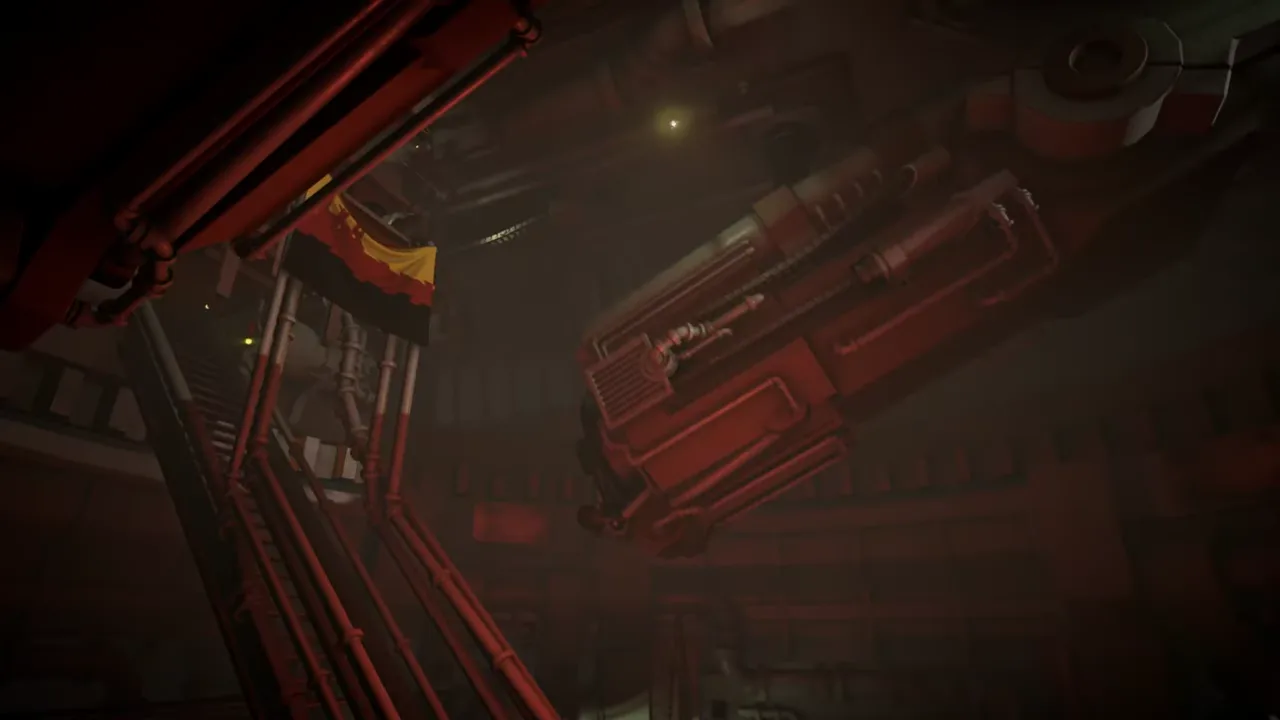
IRON NEST and The Invincible can appeal to the same player before either game explains its mechanics. Both present large, imperfect technologies with buttons, instruments and physical-looking tools. Both ask the player to respect information that arrives through equipment rather than through an all-knowing interface. Both place their machinery inside a larger political or philosophical mood. That surface resemblance is real, but it can be misleading if it becomes a purchase recommendation on its own.
IRON NEST is a single-player heavy-turret operation set in an alternate-history late-1920s Spain. Its official listing concentrates on an Operator converting reports into artillery action: two teleprinters, an interactive tactical map, a ballistic calculator, ammunition, charges, elevation, traverse and aerial confirmation. The Invincible is a story-driven first-person adventure based on motifs from Stanisław Lem, where scientist Yasna explores the planet Regis III, searches for a missing crew, uses atompunk tools and makes choices that shape one of eleven advertised endings. The shared appeal is analogue technology; the central activity is not shared.
This comparison therefore separates atmosphere from agency. Pick the game whose main job you want to perform, not simply the one with the more attractive control panel.
A common affection for imperfect instruments
IRON NEST makes information handling operational. The published description says that reports arrive through High Command and frontline teleprinters, that their provenance matters, and that the player plots intelligence on an interactive map before using a ballistic calculator and the turret controls. The equipment is not a scenic layer around combat. It is how a report becomes a shot. An operator must decide which source is useful, locate the relevant point, derive a solution and then execute it through a machine that may suffer failures.
The Invincible also foregrounds tools, but it assigns them another purpose. Its Steam page names a telemeter and tracker, describes driving a vehicle through an atompunk landscape and emphasizes realistic interactions with analogue technologies. Those tools support an exploration-and-investigation story on Regis III. They help Yasna search, interpret a mystery and navigate a hostile environment rather than calculate gunfire against a target.
For players who love the feeling of a device demanding attention, this is genuine overlap. For players who expect a similar loop, it is an important boundary. IRON NEST turns an instrument reading into a controlled military action. The Invincible turns a tool interaction into discovery, uncertainty and narrative consequence.
Procedure versus exploration
The published IRON NEST loop is deliberately procedural. Its steps have dependencies: an unverified report should not be treated as a precise target; an unplotted target cannot responsibly be converted into a firing solution; a correct number still needs the appropriate ammunition, charge, elevation and traverse. The official page also mentions aerial photographs and persistent battlefield scars, which frame a shot as something that can be reviewed after execution. The player works within one formidable installation, repeatedly moving from evidence to action.
The Invincible begins with an astrobiologist and her missing crew on an unexplored planet. Its official description directs the player to follow evidence, report to an Astrogator, make hard choices and confront the limits of human assumptions. It calls the game a first-person adventure and explicitly describes a philosophical story. While it contains tools and a vehicle, its stated loop is to investigate and decide, not to master a repeatable weapon procedure.
That distinction affects what “slow” means. IRON NEST can be slow because careful calculation and physical station handoffs are part of the challenge. The Invincible can be slow because observation, dialogue and moral or epistemic uncertainty are the point. A player seeking repeated mechanical competence should favor IRON NEST. A player seeking a guided, choice-driven encounter with an unknown world should favor The Invincible.
Information has different consequences
Both games make incomplete knowledge matter. IRON NEST explicitly asks the player to track where reports came from. This creates a practical question: does the message establish a target, a situation or merely a lead? The player then tests that information through map work, calculation and, after firing, aerial evidence. The stakes are operational. A mistaken interpretation can produce a bad shell choice, an incorrect placement or wasted time.
The Invincible also frames knowledge as dangerous and incomplete. The Steam description asks players to search for lost crew members, interact with creatures on Regis III and reconsider humanity’s ambitions and biases. Its choices are said to shape the outcome of the story. The stakes are narrative and philosophical as well as immediate: information changes what Yasna believes, whom she trusts and how the story resolves.
This is why the games should not be described as interchangeable “thinking games.” IRON NEST makes rigorous interpretation a condition for artillery work. The Invincible makes interpretation part of the meaning of its science-fiction mystery. One rewards building a defensible firing chain; the other invites reflection on whether the assumptions behind a decision are sound.
Setting, history and fiction
IRON NEST uses an alternate-history Spain in the late 1920s. Its official listing says the monarchy remains in power as a republican uprising spreads, and it wraps that scenario in dieselpunk heavy machinery, propaganda and dark humor. The spider-turret is fictional. The game may draw on recognizably historical visual language, but its public description should be read as a stylized invented setting rather than a reconstruction of a real vehicle or campaign.
The Invincible is hard science fiction based on motifs from a novel by Stanisław Lem. Its official page identifies Regis III, Yasna and a retro-futurist atompunk timeline. It is likewise not historical simulation, but it uses a different kind of fictional authority: a literary science-fiction world concerned with discovery, limits and consequences.
The tonal choice matters. Choose IRON NEST when you want a compressed workplace drama about propaganda, orders and the material result of artillery. Choose The Invincible when you want a reflective expedition story where alien environment, human ambition and uncertainty are foregrounded. Liking one does not guarantee liking the other, even if both make an old-looking device feel persuasive.
Structure and replay value
IRON NEST advertises a handcrafted story, procedurally generated objectives, fifteen regions, two challenge modes with leaderboards, more than one hundred medals, and a combined thirty ammunition types and abilities. These features indicate room to revisit operational problems and improve execution. The listing does not publish every challenge rule or mission branch, so prospective players should check the live build for exact unlocks and progression details.
The Invincible explicitly advertises eleven possible endings. That is a clear signal that player choices can alter the story outcome. Its official page does not present a comparable leaderboard or challenge-mode focus. Its replay value is therefore more naturally framed around seeing consequences, routes and narrative outcomes rather than achieving faster or cleaner technical execution.
If you replay games to refine a practiced loop, IRON NEST is the better bet. If you replay to explore decisions and understand a story from another angle, The Invincible is the clearer fit. Neither framing says which is objectively deeper; they offer different reasons to return.
Which should you choose?
Choose IRON NEST if your ideal experience is a physical control room, structured fire-control work, source-aware map plotting and the pressure of making a correct artillery decision. Its advertised campaign and challenge features suit players who want to improve at a specialized operational routine.
Choose The Invincible if you want a first-person science-fiction adventure, an astrobiologist protagonist, retro-futurist exploration tools, a search for missing crewmates and choices that lead to multiple published endings. Its machinery serves a mystery and philosophical story.
Play both when analogue technology is your entry point, but approach them in different moods. Start IRON NEST when you want to become competent at an exacting process. Start The Invincible when you want to explore an unfamiliar world and weigh what its evidence means.
The dependable conclusion
IRON NEST and The Invincible share a tactile, retro-technical appeal, not a core genre. IRON NEST is about transforming messages into physical artillery action inside a heavy turret. The Invincible is about exploration, narrative choice and uncertainty on a science-fiction planet.
The decisive choice is simple: do you want an instrument panel to be a workbench for a firing solution, or a companion in an investigative journey? The official descriptions make both answers defensible, but they point to different games.
Frequently asked questions
Are both games about analogue technology?
Both official descriptions foreground tactile or analogue-looking tools, but IRON NEST uses them for artillery procedure while The Invincible uses retro-futurist tools for exploration and a story-driven investigation.
Which game has branching endings?
The Invincible explicitly advertises 11 possible endings. IRON NEST advertises a handcrafted story and procedural objectives, but its listing does not promise a numbered multiple-ending structure.